2019年11月21日
Salk scientists discover brain circuit in mice that controls compulsive
drinking of alcohol
Salk scientists discover brain circuit in mice that controls compulsive drinking of alcohol
LA JOLLA—Although alcohol use is ubiquitous in modern society, only a portion of individuals develop alcohol use disorders or addiction. Yet, scientists have not understood why some individuals are prone to develop drinking problems, while others are not. Now, Salk Institute researchers have discovered a brain circuit that controls alcohol drinking behavior in mice, and can be used as a biomarker for predicting the development of compulsive drinking later on. The findings were published in 科学 on November 21, 2019, and could potentially have implications for understanding human binge drinking and addiction in the future.
“I hope this will be a landmark study, as we’ve found (for the first time) a brain circuit that can accurately predict which mice will develop compulsive alcohol drinking weeks before the behavior starts,” says 凯泰, a professor in the Systems Neurobiology Laboratory and holder of the Wylie Vale Chair. “This research bridges the gap between circuit analysis and alcohol/addiction research, and provides a first glimpse at how representations of compulsive alcohol drinking develop across time in the brain.”
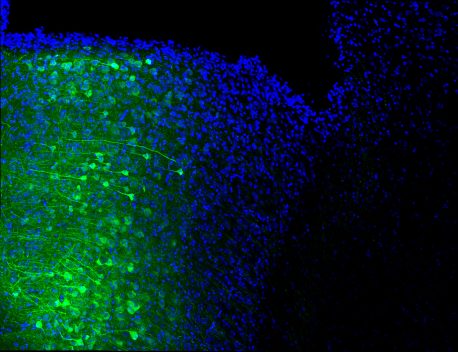
点击此处 用于高分辨率图像。.
版权:萨克研究所
The National Institutes of Health defines alcohol use disorder as a chronic brain disease in which an individual drinks compulsively, often with accompanying negative emotions. Previous research has focused on examining the brain after a drinking disorder develops. Tye’s team sought to discover the brain circuits that are responsible for a predisposition for compulsive drinking to develop in the first place, which had not been previously studied.
“We initially sought to understand how the brain is altered by binge drinking to drive compulsive alcohol consumption,” says Cody Siciliano, first author and assistant professor in the Department of Pharmacology at Vanderbilt University. “In the process, we stumbled across a surprising finding where we were actually able to predict which animals would become compulsive based on neural activity during the very first time they drank.”
In this study, the researchers created a test called a binge-induced compulsion task (BICT) to examine how susceptibility toward alcohol consumption interacts with experience to produce compulsive drinking in mice. The BICT allowed the researchers to examine alcohol consumption as well as consumption with negative consequences, such as a bitter taste added to the alcohol. Through a series of tests, the scientists observed that the mice could be sorted into three groups: low drinkers, high drinkers and compulsive drinkers. Unlike the first two groups, the compulsive drinkers showed insensitivity to negative consequences.

点击此处 用于高分辨率图像。.
版权:萨克研究所
The researchers then used an imaging technique called microendoscopic single-cell resolution calcium imaging to chart the cells and brain regions of interest prior to drinking, during drinking and after drinking alcohol. Specifically, they looked at neuron activity in two regions involved in behavioral control and responding to adverse events: the medial prefrontal cortex and the periaqueductal gray matter, respectively. They found that the development of compulsive alcohol drinking was related to neural communication patterns between the two brain regions, and was a biomarker for predicting future compulsive drinking. Further, the researchers used optogenetics to control the activity of the neural pathway using light. By turning the brain circuit on or off, the scientists were able to either increase compulsive alcohol drinking or reduce it.
“Now, we can look into the brain and find activity patterns that predict if mice will become compulsive drinkers in the future, before the compulsion develops,” says Tye. “We do not know if this brain circuit is specific to alcohol or if the same circuit is involved in multiple different compulsive behaviors such as those related to other substances of abuse or natural rewards, so that is something we need to investigate.”
Next, the scientists plan to sequence these cortical-brainstem neurons in order to identify targets that could be used for therapeutics.
Other authors included Habiba Noamany, Chia-Jung Chang, Alex R. Brown, Xinhong Chen, Daniel Leible, Jennifer J. Lee, Joyce Wang, Amanda N. Vernon, Caitlin M. Vander Weele, Eyal Y. Kimchi and Myriam Heiman.
The work was funded by grants from the National Institutes of Health (F32 MH111216, K99 DA045103, R01-MH102441, DP2-DK102256 and DP1-AT009925), the Brain and Behavior Research Foundation, New York Stem Cell Foundation and the JPB Foundation.
DOI: 10.1126/science.aay1186
日记
科学
作者
Cody A. Siciliano, Habiba Noamany, Chia-Jung Chang, Alex R. Brown, Xinhong Chen, Daniel Leible, Jennifer J. Lee, Joyce Wang, Amanda N. Vernon, Caitlin M. Vander Weele, Eyal Y. Kimchi, Myriam Heiman and Kay M. Tye
宣传办公室
电话:(858) 453-4100
press@salk.edu
萨尔克研究所是一个独立的非营利性研究机构,由首个安全有效的脊髓灰质炎疫苗的研发者乔纳斯·索尔克于1960年创立。该研究所的使命是推动以合作、敢于冒险为特点的基础性研究,以应对癌症、阿尔茨海默病和农业脆弱性等社会最紧迫的挑战。这项基础科学支撑着所有的转化研究,产生有助于全球新药和创新的见解。.