October 23, 2014
Salk scientists identify a promising target for HIV/AIDS treatment
Salk scientists identify a promising target for HIV/AIDS treatment
LA JOLLA–Like a slumbering dragon, 艾滋病 can lay dormant in a person’s cells for years, evading medical treatments only to wake up and strike at a later time, quickly replicating itself and destroying the immune system.
Scientists at the Salk Institute have uncovered a new protein that participates in active HIV replication, as detailed in the latest issue of 基因与发育. The new protein, called Ssu72, is part of a switch used to awaken HIV-1 (the most common type of HIV) from its slumber.
More than 35 million people worldwide are living with HIV and about a million people die a year due to the disease, according to the World Health Organization. There is no cure, and while regular medication makes the disease manageable, treatment can have severe side effects, is not readily available to everyone and requires a regiment that can be challenging for patients to adhere to.
The team began by identifying a list of 50 or so proteins that interact with a well-known protein HIV creates called Tat.
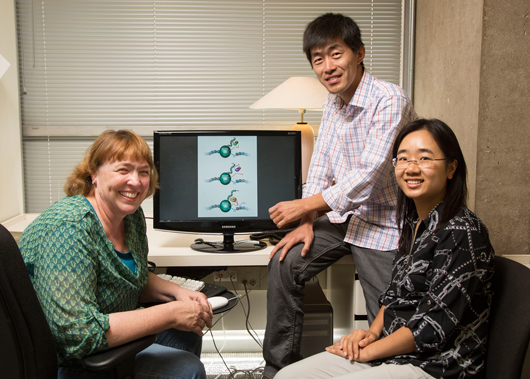
“The virus cannot live without Tat,” says Katherine Jones, Salk professor in the 调节生物学实验室 and senior author of the study.
Tat acts as a lookout in the cell for the virus, telling the virus when the cellular environment is favorable for its replication. When the environment is right, Tat kicks off the virus’ transcription, the process by which HIV reads and replicates its building blocks (RNA) to spread throughout the body.
One of the proteins on the list that caught Jones’ eye was Ssu72 (a phosphatase). This enzyme had been shown in yeast to affect the transcription machinery. Sure enough, her team found that Ssu72 binds directly to Tat and not only begins the transcription process, but also creates a feedback loop to ramp up the process.
“Tat is like an engine for HIV replication and Ssu72 revs up the engine,” says Lirong Zhang, one of the first authors and a Salk researcher. “If we target this interaction between Ssu72 and Tat, we may be able to stop the replication of HIV.”
The findings were surprising to the team because Tat, a relatively small protein, was previously thought to have a simpler role. Jones’ lab previously discovered the CycT1 protein, another critical protein that Tat uses to begin the steps of replicating the virus. “After all these years, we thought that Tat only had this one partner (CycT1), but when we looked at it a bit harder, we found that it also binds and stimulates the Ssu72 phosphatase, which controls an immediately preceding step to switch on HIV,” she said.
CycT1 is needed for normal cell function, so it may not be an ideal anti-viral target. However, the team found that Ssu72 is not required for making RNA for most host cell genes in the way it is used by HIV, making it a potentially promising target for drug therapy.
“Many proteins that Tat interacts with are essential for normal cellular transcription so those can’t be targeted unless you want to kill normal cells,” says co-first author Yupeng Chen, a Salk researcher. “Ssu72 seems to be different–at least in the way it is used by HIV.”
Now that the team knows the protein is specifically required for HIV transcription, they next plan to investigate how they can target the protein, for example by inhibiting Ssu72’s ability kick off the transcription process. They are also examining whether latent HIV infections result from low levels of Ssu72 in resting T cells. And stay tuned: the lab is excited about checking other new host cell partners of Tat that were identified in this study.
Authors of the work include Katherine A. Jones, Yupeng Chen, Lirong Zhang, Conchi Estarás, Seung H. Choi, Luis Moreno Jr. of the Salk Institute; John R. Yates III and James J. Moresco of The Scripps Research Institute; and Jonathan Karn of Case Western Reserve University School of Medicine.
Funding for the work was provided by the 美国国立卫生研究院, , 那个 National
Center for Research Resources, , 那个 Blasker-Rose-Miah Fund and the Margaret T. Morris Foundation.
关于索尔克生物研究所:
索尔克生物学研究所是世界上首屈一指的基础研究机构之一,其国际知名的教职员工在一个独特的、协作和创新的环境中,深入探索生命科学的基本问题。索尔克科学家既注重科学发现,也注重培养下一代研究人员,通过研究神经科学、遗传学、细胞生物学、植物生物学及相关学科,为我们理解癌症、衰老、阿尔茨海默病、糖尿病和传染病做出了开创性的贡献。.
教职员工的成就获得了无数荣誉,包括诺贝尔奖和美国国家科学院院士资格。该研究所由脊髓灰质炎疫苗先驱 Jonas Salk 医生于 1960 年创立,是一家独立的非营利组织和建筑地标。.
日记
基因与发育
作者
Yupeng Chen, Lirong Zhang, Conchi Estarás, Seung H. Choi, Luis Moreno Jr., Jonathan Karn, James J. Moresco, John R. Yates III, and Katherine A. Jones
宣传办公室
电话:(858) 453-4100
press@salk.edu