April 11, 2014
LA JOLLA—Reuben Shaw, a member of the Salk Institute’s Laboratorio de Biología Molecular y Celular and a Howard Hughes Medical Institute early career scientist, has been promoted from associate professor to full professor.
After a rigorous evaluation process by Salk senior faculty, nonresident fellows and scientific peers, the promotion was announced Friday.
“We are pleased to recognize Professor Shaw’s original, innovative and notable contributions to biological research in pathways that underlie the development of cancer and metabolic disorders,” says Salk President William R. Brody.
While investigating one of the most commonly mutated genes in lung cáncer, Shaw discovered an energy-sensing pathway that shuts down cell growth and reprograms metabolism when nutrients are scarce. His lab went on to molecularly decode a number of new components of this biochemical pathway, which connects nutrition and exercise to suppression in both cancer and diabetes.
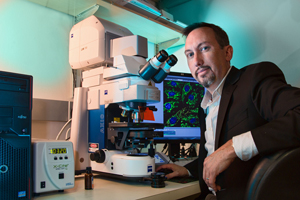
Reuben Shaw, Professor – Molecular and Cell Biology Laboratory
Imagen: Cortesía del Instituto Salk de Estudios Biológicos
This biochemical circuit, the AMPK pathway, is activated by exercise and caloric restriction and serves to tell cells to lower their glucose, lipids and cell growth. This pathway halts the growth tumor cells, which have aberrant revved-up metabolism, but also acts to restore normal function to the liver and other tissues in diabetics. Shaw’s lab followed up on a prediction from its previous studies to recently test whether drugs widely used to treat type 2 diabetes could work as cancer treatments. The team found specific efficacy in some forms of lung cancer for which there are currently no good therapies.
In addition, researchers in Shaw’s lab use genetic mouse models to further examine the connections between cancer and metabolic diseases, and to tease out the precise role of each component of the signaling pathway. In the past five years at Salk, the lab’s studies have lead to the discovery of new therapies for both cancer and type 2 diabetes.
Acerca del Instituto Salk de Estudios Biológicos:
The Salk Institute for Biological Studies is one of the world’s preeminent basic research institutions, where internationally renowned faculty probes fundamental life science questions in a unique, collaborative and creative environment. Focused both on discovery and on mentoring future generations of researchers, Salk scientists make groundbreaking contributions to our understanding of cancer, aging, Alzheimer’s, diabetes and infectious diseases by studying neuroscience, genetics, cell and plant biology, and related disciplines.
Los logros del cuerpo docente han sido reconocidos con numerosos galardones, entre los que se incluyen premios Nobel y la pertenencia a la Academia Nacional de Ciencias. Fundado en 1960 por el Dr. Jonas Salk, pionero en la vacuna contra la poliomielitis, el Instituto es una organización independiente sin fines de lucro y un hito arquitectónico.
Oficina de Comunicaciones
Tel.: (858) 453-4100
press@salk.edu