February 19, 2019
A new CRISPR/Cas9 therapy can suppress aging, enhance health and extend life span in mice, opening door for better understanding of aging in humans
A new CRISPR/Cas9 therapy can suppress aging, enhance health and extend life span in mice, opening door for better understanding of aging in humans
LA JOLLA—Aging is a leading risk factor for a number of debilitating conditions, including heart disease, cancer and Alzheimer’s disease, to name a few. This makes the need for anti-aging therapies all the more urgent. Now, Salk Institute researchers have developed a new gene therapy to help decelerate the aging process.
The findings, published on February 18, 2019 in the journal Nature Medicine, highlight a novel CRISPR/Cas9 genome-editing therapy that can suppress the accelerated aging observed in mice with Hutchinson-Gilford progeria syndrome, a rare genetic disorder that also afflicts humans. This treatment provides important insight into the molecular pathways involved in accelerated aging, as well as how to reduce toxic proteins via gene therapy.
“Aging is a complex process in which cells start to lose their functionality, so it is critical for us to find effective ways to study the molecular drivers of aging,” says Juan Carlos Izpisua Belmonte, a professor in Salk’s Gene Expression Laboratory and senior author of the paper. “Progeria is an ideal aging model because it allows us to devise an intervention, refine it and test it again quickly.”
Kredit: Salk Institut
With an early onset and fast progression, progeria is one of the most severe forms of a group of degenerative disorders caused by a mutation in the LMNA gene. Both mice and humans with progeria show many signs of aging, including DNA damage, cardiac dysfunction and dramatically shortened life span. The LMNA gene normally produces two similar proteins inside a cell: lamin A and lamin C. Progeria shifts the production of lamin A to progerin. Progerin is a shortened, toxic form of lamin A that accumulates with age and is exacerbated in those with progeria.
“Our goal was to diminish the toxicity from the mutation of the LMNA gene that leads to accumulation of progerin inside the cell,” says co-first author Hsin-Kai Liao, a staff researcher in the Izpisua Belmonte lab. “We reasoned that progeria could be treated by CRISPR/Cas9-targeted disruption of both lamin A and progerin.”
The researchers utilized the CRISPR/Cas9 system to deliver the gene therapy into the cells of the progeria mouse model expressing Cas9. An adeno-associated virus (AAV) was injected containing two synthetic guide RNAs and a reporter gene. The guide RNA ushers the Cas9 protein to a specific location on the DNA where it can make a cut to render lamin A and progerin nonfunctional, without disrupting lamin C. The reporter helps researchers track the tissues that were infected with the AAV.
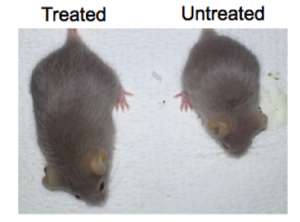
Two months after the delivery of the therapy, the mice were stronger and more active, with improved cardiovascular health. They showed decreased degeneration of a major arterial blood vessel and delayed onset of bradycardia (an abnormally slow heart rate)—two issues commonly observed in progeria and old age. Overall, the treated progeria mice had activity levels similar to normal mice, and their life span increased by roughly 25 percent.
Klicken Sie hier für ein hochauflösendes Bild.
Kredit: Salk Institut
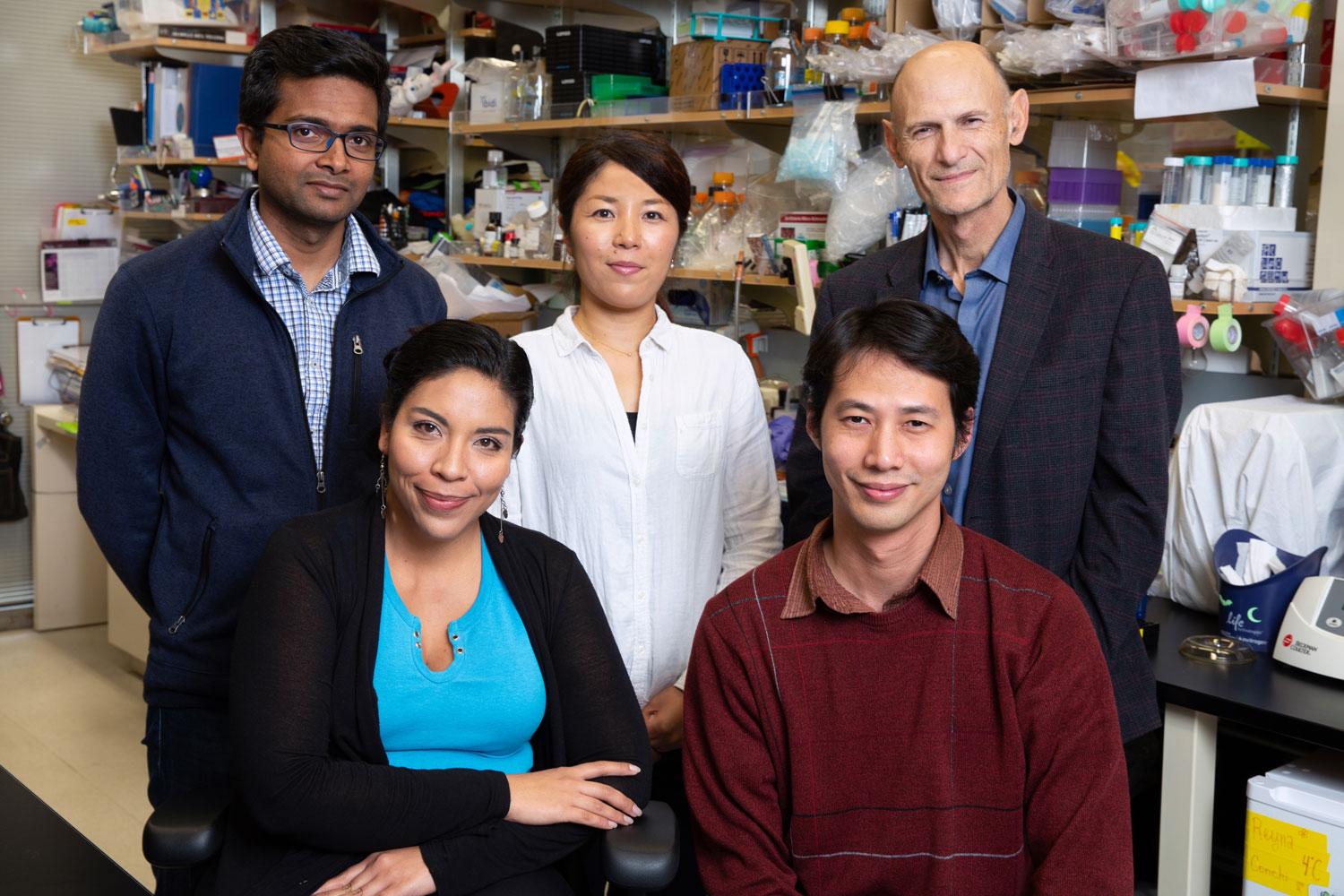
“Once we improve the efficiency of our viruses to infect a wide range of tissues, we are confident that we will be able to increase life span further,” says Pradeep Reddy, a postdoctoral fellow in the Izpisua Belmonte lab and an author of the paper.
Taken together, the results suggest that targeting lamin A and progerin using a CRISPR/Cas9 system can dramatically improve the physiological health and life span of progeria mice. These results provide a significant new understanding of how scientists may eventually be able to target molecular drivers of aging in humans.
Future efforts will focus on making the therapy more effective and will refine it for human use. Currently, there is no cure for progeria, so the symptoms are managed and complications are treated as they arise.
“This is the first time a gene editing therapy has been applied to treat progeria syndrome,” says Izpisua Belmonte, holder of the Roger Guillemin Chair. “It will need some refinements, but it has far fewer negative effects compared to other options available. This is an exciting advancement for the treatment of progeria.”
Other authors included Ergin Beyret, Mako Yamamoto, Reyna Hernandez-Benitez, Yunpeng Fu and Galina Erikson of the Salk-Institut für biologische Studien.
The work was funded by the Catharina Foundation, the Muscular Dystrophy Association, NIH-NCI CCSG: P30 014195, the Helmsley Trust, The Progeria Research Foundation, Universidad Católica San Antonio de Murcia (UCAM), Fundacion Dr. Pedro Guillen, the G. Harold and Leila Y. Mathers Charitable Foundation, The Glenn Foundation and The Moxie Foundation.
DOI: 10.1038/s41591-019-0343-4
JOURNAL
Nature Medicine
TITEL
Single-dose CRISPR/Cas9 therapy extends lifespan of mice with Hutchinson–Gilford progeria syndrome
AUTOREN
Ergin Beyret, Hsin-Kai Liao, Mako Yamamoto, Reyna Hernandez-Benitez, Yunpeng Fu, Galina Erikson, Pradeep Reddy and Juan Carlos Izpisua Belmonte
Büro für Kommunikation
Telefon: (858) 453-4100
press@salk.edu
Das Salk Institute ist ein unabhängiges, gemeinnütziges Forschungsinstitut, das 1960 von Jonas Salk, dem Entwickler des ersten sicheren und wirksamen Polio-Impfstoffs, gegründet wurde. Die Aufgabe des Instituts besteht darin, grundlegende, kooperative und risikofreudige Forschung voranzutreiben, die sich mit den dringendsten Herausforderungen der Gesellschaft befasst, darunter Krebs, Alzheimer und die Gefährdung der Landwirtschaft. Diese Grundlagenforschung bildet die Basis für alle translationalen Bemühungen und führt zu Erkenntnissen, die neue Medikamente und Innovationen weltweit ermöglichen.