November 16, 2020
Salk’s Harnessing Plants Initiative is enhancing plants to capture and store more carbon to offset climate change
Salk’s Harnessing Plants Initiative is enhancing plants to capture and store more carbon to offset climate change
Klicken Sie hier für ein hochauflösendes Bild.
Kredit: Salk Institut
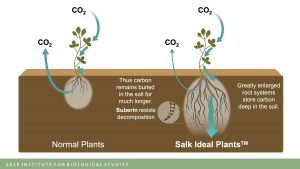
LA JOLLA—Salk’s Initiative zur Nutzung von Pflanzen (HPI) will receive $30 million from the Bezos Earth Fund to advance efforts to increase the ability of crop plants, such as corn and soybeans, to capture and store atmospheric carbon via their roots in the soil. This work will explore carbon-sequestration mechanisms in six of the world’s most prevalent crop species with the goal of increasing the plants’ carbon-storage capacity. It complements an ongoing HPI project focused on identifying genes for increased carbon sequestration in model plants and then utilizing those genes to enhance carbon sequestration in crops.
“The Bezos Earth Fund’s generous donation will help realize an exciting new HPI research program that significantly increases our scientific efforts towards the ultimate goal of utilizing crop plants to mitigate the effects of climate change,” says Salk President and Professor Rusty Gage.

Klicken Sie hier für ein hochauflösendes Bild.
Kredit: Salk Institut
Plants have immense potential to remove excess carbon from Earth’s atmosphere to help respond to our warming planet. The Bezos Earth Fund grant will enable Salk scientists to advance work in plant genetics, genomics, and biochemistry—and use the power of plant diversity—to develop global crops that will increase the amount of carbon removed from the atmosphere and store it deep in the earth’s soil. Members of the HPI leadership team include Salk faculty members Wolfgang Busch, Joanne Chory, Joseph Ecker, Julie Law, Todd Michael und Joseph Noel.
Büro für Kommunikation
Telefon: (858) 453-4100
press@salk.edu
Das Salk Institute ist ein unabhängiges, gemeinnütziges Forschungsinstitut, das 1960 von Jonas Salk, dem Entwickler des ersten sicheren und wirksamen Polio-Impfstoffs, gegründet wurde. Die Aufgabe des Instituts besteht darin, grundlegende, kooperative und risikofreudige Forschung voranzutreiben, die sich mit den dringendsten Herausforderungen der Gesellschaft befasst, darunter Krebs, Alzheimer und die Gefährdung der Landwirtschaft. Diese Grundlagenforschung bildet die Basis für alle translationalen Bemühungen und führt zu Erkenntnissen, die neue Medikamente und Innovationen weltweit ermöglichen.