1955 - 2024
Professor und Direktor
Labor für molekulare und zelluläre Pflanzenbiologie
Howard Hughes Medical Institute Investigator
Howard H. und Maryam R. Newman Lehrstuhl für Pflanzenbiologie

Environmental and agricultural sustainability are urgently needed for the rapidly growing human population. With the accumulation of carbon dioxide (CO2) in our atmosphere, there is an increased trapping of heat, which causes changes in weather such as more extreme storms, droughts, fires and flooding. The global population recently topped 7 billion and is expected to reach 12 billion by the end of the century. This growing demand, combined with extreme temperature fluctuations, has resulted in widespread environmental damage, economic hardship and famine.
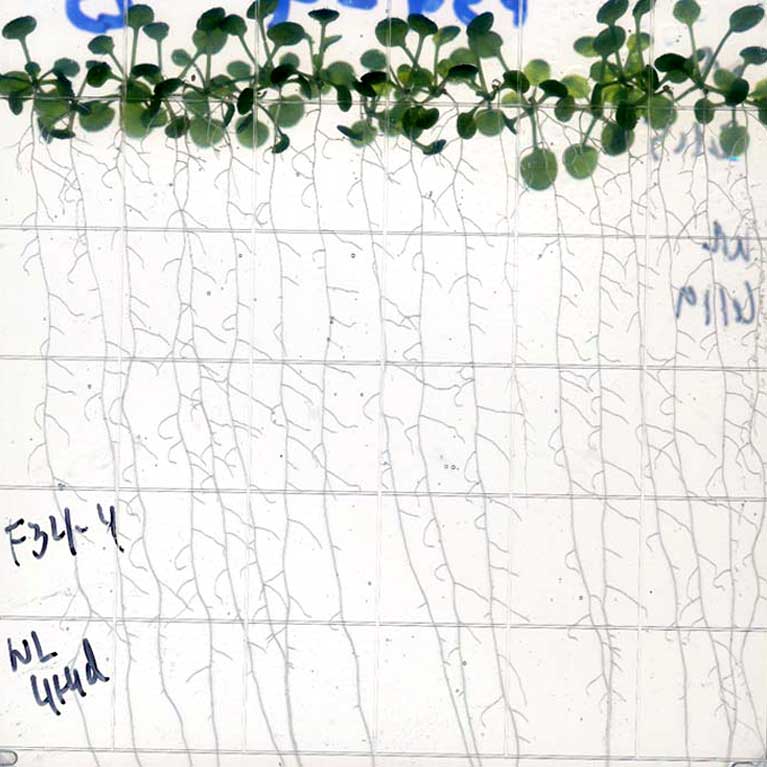
Joanne Chory is leading the Salk Institute’s Harnessing Plants Initiative (HPI), an innovative, scalable, and sustainable approach to stabilize the environment by optimizing a plant’s natural ability to capture and store carbon and adapt to diverse climate conditions. Chory and the HPI team aim to help plants grow bigger, more robust root systems that can absorb larger amounts of carbon by burying it in the ground in the form of suberin, a naturally occurring carbon-rich substance. The Salk team will use cutting-edge genetic and genomic techniques to develop these Salk Ideal Plants™.
Chory has spent more than 30 years using Arabidopsis thaliana, a small flowering mustard plant, as a model for plant growth. She has pioneered the use of molecular genetics to study how plants alter their size, shape and form to optimize growth and photosynthesis for particular environments. Utilizing plant genetics coupled with biochemical studies has allowed her to determine one of the most complex signaling networks that controls growth and development in response to environmental change.
Chory and her colleagues discovered that plants make and respond to a steroid hormone to control their final size. In a tour-de-force genetic study, they mapped the entire plant steroid hormone signaling system, defining a new paradigm for steroid perception that is distinct from that in humans.
Chory’s team found that greater than 90 percent of the approximately 30,000 Arabidopsis thaliana genes have a peak of expression at a particular time of day, and, moreover, the timing changes with the seasons. Farmers, working with scientists, can use this information to predict the consequences of environmental changes on agricultural yield.
Chory’s team determined the mechanism by which a shaded plant can outgrow its neighbor. Since dense planting by farmers leads to a major loss of yield, knowledge of this pathway is already being put to good use.
AB, Biologie, Oberlin College, Ohio
Promotion, Mikrobiologie, University of Illinois
Postdoktorandin, Harvard Medical School