May 6, 2021
Salk scientists quantify process to permanently store plant-captured CO2 as SiC, a valuable material for electronics
Salk scientists quantify process to permanently store plant-captured CO2 as SiC, a valuable material for electronics
LA JOLLA—Plants are unparalleled in their ability to capture CO2 from the air, but this benefit is temporary, as leftover crops release carbon back into the atmosphere, mostly through decomposition. Researchers have proposed a more permanent, and even useful, fate for this captured carbon by turning plants into a valuable industrial material called silicon carbide (SiC)—offering a strategy to turn an atmospheric greenhouse gas into an economically and industrially valuable material.
In a new study, published in the journal RSC Advances on April 27, 2021, scientists at Salk transformed tobacco and corn husks into SiC and quantified the process with more detail than ever before. These findings are crucial to helping researchers, such as members of Salk’s 植物利用计划, evaluate and quantify carbon-sequestration strategies to potentially mitigate climate change as CO2 levels continue to rise to unprecedented levels.
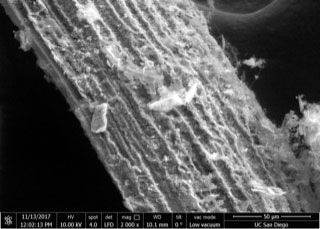
点击此处 用于高分辨率图像。.
Credit: UC San Diego
“The study offers a very careful accounting for how you make this valuable substance and how many atoms of carbon you’ve pulled out of the atmosphere. And with that number, you can start to extrapolate what role plants could play in mitigating greenhouse gases while also converting an industrial byproduct, CO2, into valuable materials by using natural systems like photosynthesis,” says co-corresponding author and Salk Professor Joseph Noel.
SiC, also known as carborundum, is an ultrahard material used in ceramics, sandpaper, semiconductors and LEDs. The Salk team used a previously reported method to transform plant material into SiC in three stages by counting carbons at each step: First, the researchers grew tobacco, chosen for its short growing season, from seed. They then froze and ground the harvested plants into a powder and treated it with several chemicals including a silicon-containing compound. In the third and final stage, the powdered plants were petrified (turned into a stony substance) to make SiC, a process that involves heating the material up to 1600 °C.
“The rewarding part was that we were able to demonstrate how much carbon can be sequestered from agricultural waste products like corn husks while producing a valuable, green material typically produced from fossil fuels,” says first author Suzanne Thomas, a Salk staff researcher.
Through elemental analysis of the plant powders, the authors measured a 50,000-fold increase in sequestered carbon from seed to lab-grown plant, demonstrating plants’ efficiency at pulling down atmospheric carbon. Upon heating to high temperatures for petrification, the plant material loses some carbon as a variety of decomposition products but ultimately retains about 14 percent of the plant-captured carbon.
The researchers calculated that the process to make 1.8 g of SiC required about 177 kW/h of energy, with the majority of that energy (70 percent) being used for the furnace in the petrification step. The authors note that current manufacturing processes for SiC carry comparable energy costs. So while the production energy required means that the plant-to-SiC process isn’t carbon neutral, the team suggests that new technologies created by renewable energy companies could bring down energy costs.
“This is a step towards making SiC in an environmentally responsible approach,” says co-corresponding author and Salk visiting scientist James La Clair.
Next, the team hopes to explore this process with a wider variety of plants, in particular plants like horsetail or bamboo, that naturally contain large amounts of silicon.
DOI: 10.1039/d1ra00954k
日记
RSC Advances
作者
Suzanne T. Thomas, Yongsoon Shin, James J. La Clair, Joseph P. Noel
宣传办公室
电话:(858) 453-4100
press@salk.edu
萨尔克研究所是一个独立的非营利性研究机构,由首个安全有效的脊髓灰质炎疫苗的研发者乔纳斯·索尔克于1960年创立。该研究所的使命是推动以合作、敢于冒险为特点的基础性研究,以应对癌症、阿尔茨海默病和农业脆弱性等社会最紧迫的挑战。这项基础科学支撑着所有的转化研究,产生有助于全球新药和创新的见解。.