
February 3, 2011
Stem cell based treatment to focus on Parkinson's disease
Stem cell based treatment to focus on Parkinson's disease
LA JOLLA, CA—The Salk Institute has been awarded a $2.3 million grant by the California Institute for Regenerative Medicine (CIRM) for translational research focusing on developing a novel stem cell based therapy for Parkinson’s disease.
The research will concentrate on studying human induced pluripotent stem (iPS) cells derived from patients suffering from Parkinson’s disease to replicate the disorder in the lab and investigate the role of inflammation in the cause and progression of the neurodegeneration typical of the disease.
Led by 弗雷德·H·盖奇, Ph.D., a professor in the Salk’s Laboratory of Genetics and holder of the Vi and John Adler Chair for Research on Age-Related Neurodegenerative Diseases, the grant will fund a joint effort between Salk researchers, the team of Christopher Glass, Ph.D., a professor of Medicine and Cellular and Molecular Medicine at the University of California, San Diego, and international collaborators in Germany.
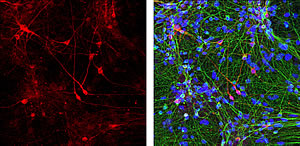
These images show dopaminergic neurons, the cell type implicated in Parkinson’s Disease, differentiated from human pluripotent stem cells.
Image: Courtesy of Leah Boyer, Salk Institute for Biological Studies
Parkinson’s disease is a chronic, progressive neurological disease that usually occurs later in life and is linked to decreased dopamine production, the chemical messenger involved in communication between the brain and the muscles. The most common neurodegenerative movement disorder, Parkinson’s disease is characterized by motor impairment such as slowness of movements, shaking and gait disturbances.
“Given that age is the most consistent risk factor for Parkinson’s, and we have an aging population, it is of utmost importance that we unravel the cellular, molecular, and genetic causes of the highly specific cell death characteristic of the disease and find new therapies to limit the social, economic and emotional impact,” said Gage.
Most studies to find better drugs to treat Parkinson’s disease were done with mice and often failed when tested in patients. In the past, scientists had been limited to study the brains of people with Parkinson’s disease via imaging technologies or postmortem brain tissues. Now, the ability to obtain iPS cells from patients’ skin cells, which can be reprogrammed into neurons provides researchers with a model to study the pathological development of Parkinson’s in a human system.
The main goal of the collaborative effort is to identify key molecular events involved in the early stages of the disease, which can be exploited as potential points of therapeutic intervention.
“This is an extremely exciting development – the ability to create stem cells from skin cells taken from patients with Parkinson’s disease, then use those stem cells to create networks of neurons which can then be studied to give clues about the abnormal function of nerve cells in this debilitating disease – that would never have been conceived, let alone come to fruition, without the significant investment in regenerative medicine by CIRM,” said Salk president William R. Brody, M.D., Ph.D.
关于索尔克生物研究所:
索尔克生物研究所是世界顶尖的基础研究机构之一,其国际知名的教职人员在一个独特、协作和富有创造性的环境中,深入探究生命科学的基本问题。索尔克科学家们致力于发现和指导未来几代研究人员,通过研究神经科学、遗传学、细胞和植物生物学以及相关学科,在癌症、衰老、阿尔茨海默氏症、糖尿病和传染病的认识方面做出了开创性的贡献。.
学院取得了许多成就,获得了包括诺贝尔奖和美国国家科学院院士在内的无数荣誉。该研究所由脊髓灰质炎疫苗先驱 Jonas Salk 博士于 1960 年创立,是一家独立的非营利组织和建筑地标。.
宣传办公室
电话:(858) 453-4100
press@salk.edu




