April 15, 2012
Findings could lead to high-yield crops that gather light more efficiently and make better use of farmland
Findings could lead to high-yield crops that gather light more efficiently and make better use of farmland
LA JOLLA, CA—Mild mannered though they seem, plants are extremely competitive, especially when it comes to getting their fair share of sunlight. Whether a forest or a farm, where plants grow a battle rages for the sun’s rays.
A plant’s primary weapon in this fight is the ability to grow towards the light, getting just the amount it needs and shadowing its competition. Now, scientists at the Salk Institute for Biological Studies have determined precisely how leaves tell stems to grow when a plant is caught in a shady place.
In a paper published April 15 in Genes and Development, the researchers report that a protein known as phytochrome interacting factor 7 (PIF7) serves as the key messenger between a plant’s cellular light sensors and the production of auxins, hormones that stimulate stem growth.
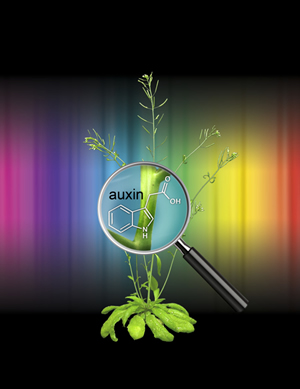
图片:由萨克生物研究所提供
“We knew how leaves sensed light and that auxins drove growth, but we didn’t understand the pathway that connected these two fundamental systems,” says 乔安·乔里, professor and director of the Salk’s Plant Biology Laboratory and a Howard Hughes Medical Institute investigator. “Now that we know PIF7 is the relay, we have a new tool to develop crops that optimize field space and thus produce more food or feedstock for biofuels and biorenewable chemicals.”
Plants gather intelligence about their light situation—including whether they are surrounded by other light-thieving plants—through photosensitive molecules in their leaves. These sensors determine whether a plant is in full sunlight or in the shade of other plants, based on the wavelength of red light striking the leaves.
If a sun-loving plant, such as thale cress (Arabidopsis thaliana), the species Chory studies, finds itself in a shady place, the sensors will tell cells in the stem to elongate, causing the plant to grow upwards towards sunlight.
When a plant remains in the shade for a prolonged period, however, it may flower early and produce fewer seeds in a last ditch effort to help its offspring spread to sunnier real estate. In agriculture, this response, known as shade avoidance syndrome, results in loss of crop yield due to closely planted rows of plants that block each other’s light.
Scientists knew that a pigment found in leaves of thale cress plants, phytochrome B (PHYB), is excited by both the red wavelengths of light that drive photosynthesis, as well as the near infrared light that is enriched in shady spots. But no one had found a direct link between this response to light and the hormone-driven growth response to shade.
In their study, Chory and her colleagues, including 约瑟夫·R·艾克, a professor in Salk’s Plant Molecular and Cellular Biology Laboratory, used biochemical and genomic analyses to identify PIF7, as the key molecular link between a plant’s light sensors and production of auxins.
They showed that when a thale cress plant is placed in shade, a cascade of molecular changes occurs in the cells of the leaves: the PHYB photoreceptor causes chemical changes in PIF7, which then activates genes that direct the cell to produce auxin.
“We already knew that auxin is made in the leaves and travels to the stem to stimulate growth,” says Chory. “Now we know how shade stimulates the leaves to produce auxin, and it turns out that it’s a remarkably simple pathway to control such an important function.”
She added that the findings may offer new avenues for developing crops with stem architectures better suited to tightly planted field rows, making them less prone to shade avoidance syndrome. If successful, such crops would produce higher yields of foods and biofuels than existing strains.
Other authors on the paper include: Lin Li, the first author and a former postdoctoral researcher in Chory’s lab; Benjamin J. Cole, Lauren J. Ivans, Ullas V. Pedmale, Hou-Sung Jung and Robert J. Schmitz of Salk Institute; Karin Ljung, of Swedish University of Agricultural Sciences; and Ghislain Breton, Chris Cowing-Zitron, Steve Kay and Jose Pruneda-Paz of University of California at San Diego.
The research was supported by the National Institutes of Health and the Howard Hughes Medical Institute.
关于索尔克生物研究所:
索尔克生物研究所是世界顶尖的基础研究机构之一,其国际知名的教职人员在一个独特、协作和富有创造性的环境中,深入探究生命科学的基本问题。索尔克科学家们致力于发现和指导未来几代研究人员,通过研究神经科学、遗传学、细胞和植物生物学以及相关学科,在癌症、衰老、阿尔茨海默氏症、糖尿病和传染病的认识方面做出了开创性的贡献。.
学院取得了许多成就,获得了包括诺贝尔奖和美国国家科学院院士在内的无数荣誉。该研究所由脊髓灰质炎疫苗先驱 Jonas Salk 博士于 1960 年创立,是一家独立的非营利组织和建筑地标。.
日记
Genes and Development
作者
Lin Li, Karin Ljung, Ghislain Breton, Robert J. Schmitz, Jose Pruneda-Paz, Chris Cowing-Zitron, Benjamin J. Cole, Lauren J. Ivans, Ullas V. Pedmale, Hou-Sung Jung, Joseph R. Ecker, Steve Kay and Joanne Chory
宣传办公室
电话:(858) 453-4100
press@salk.edu