
January 9, 2024
LA JOLLA—Salk Institute Professor 特伦斯·塞津诺维奇 has been named 2024 Scientist of the Year by the ARCS Foundation of San Diego. The ARCS (Achievement Rewards for College Students) San Diego chapter is honoring Sejnowski for his pioneering research in neural networks and computational neuroscience.
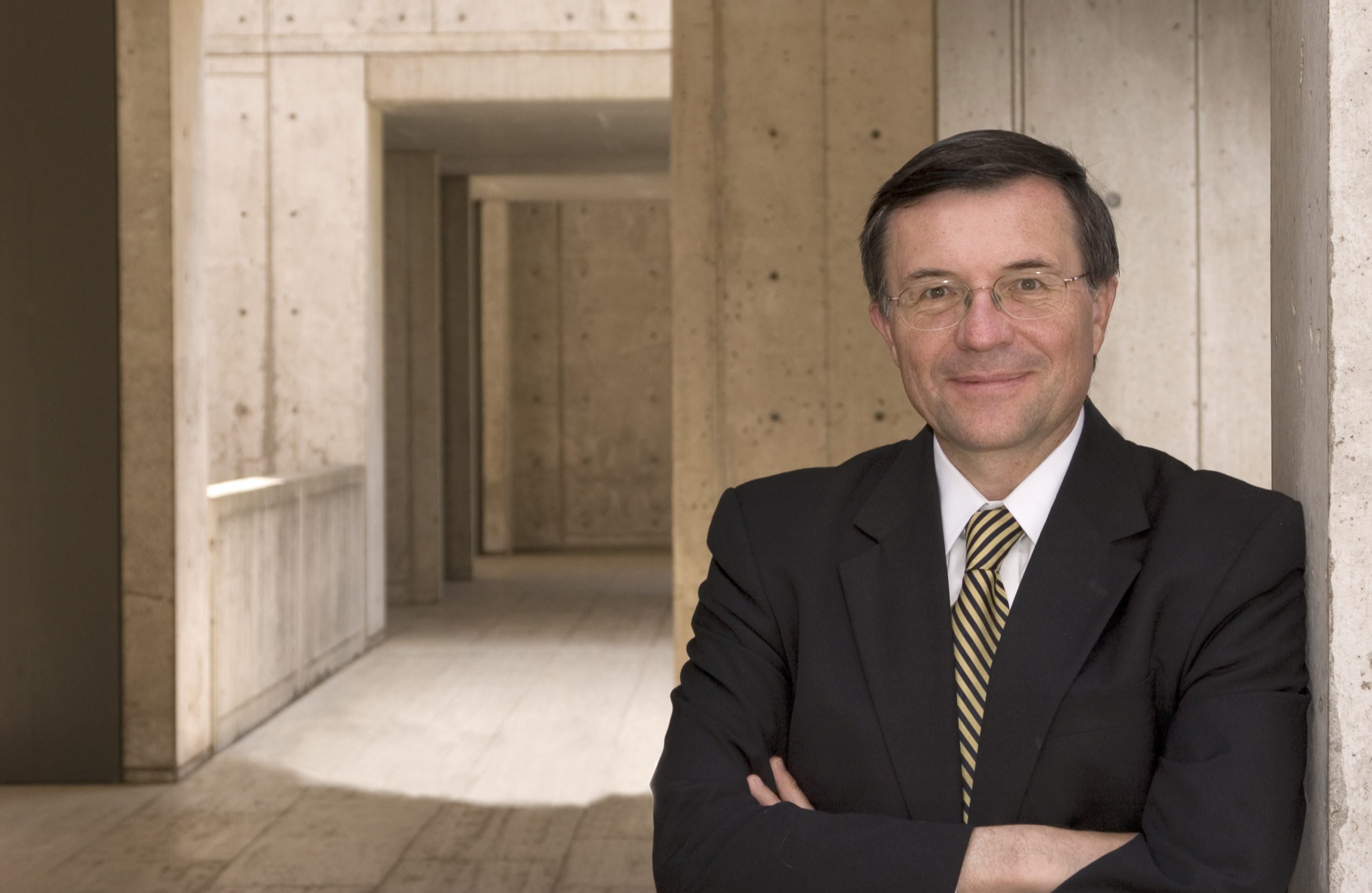
Each year, an ARCS committee that includes multiple members and the foundation’s president, and seeking input from former Scientist of the Year honorees and scientific advisors in the community, makes a recommendation to its membership for the Scientist of the Year award. ARCS voted unanimously for Sejnowski to be its 2024 honoree.
“This honor is validation of the trailblazing work Terry has done in the field of computational neuroscience,” says Salk President 杰拉尔德·乔伊斯. “We are thrilled ARCS has recognized him in this prestigious manner.”
"The importance of artificial intelligence, AI, its incredible potential in today’s data-driven world, cannot be overstated, and the San Diego Chapter of ARCS is thrilled to honor one of its pioneers," says Kathe Albrecht, president of ARCS San Diego. "Dr. Terry Sejnowski’s visionary work on neural networks and computational neuroscience in the 1980s laid the foundation for the machine learning and AI revolution that we’re experiencing today. His current research continues to further our understanding of the brain and its complex functions, from filtering what we see to recalling memories. We are proud to recognize Dr. Sejnowski as our 2024 Scientist of the Year and look forward to celebrating his achievements in April."
Sejnowski, who is head of Salk’s Computational Neurobiology Laboratory, holder of the Frances Crick Chair, and a distinguished professor at UC San Diego, has helped shape the fields of neuroeconomics, neuroanatomy, neurophysiology, psychology, and artificial intelligence. In 1985, while at Johns Hopkins University, he collaborated with computer scientist Geoffrey Hinton to invent the Boltzmann machine, the first algorithm to solve the problem of learning in multilayered neural networks. It remains the most biologically plausible of all subsequent learning algorithms for artificial neural networks.
Soon after announcing the Boltzmann machine, Sejnowski created NETtalk, a computer program that, like the human brain, was able to learn how to turn written text into speech. Not only was this an astounding engineering accomplishment but it also marked a major cultural milestone as it raised new challenges for philosophy, linguistics, and cognitive science.
Sejnowski also helped develop the first unsupervised learning algorithm for independent component analysis, which is now a mainstay in brain imaging. He has also shown that sleep spindles (brain wave patterns during nonrapid eye movement sleep) are not synchronous across the cortex, as was previously believed, but instead create circular traveling waves.
“It is a singular honor to be chosen by ARCS as the Scientist of the Year, which also honors the remarkable computational advances being made by computer scientists and neuroscientists,” says Sejnowski.
Sejnowski has received numerous other awards, including the Institute of Electrical and Electronics Engineers Frank Rosenblatt Award, Neural Network Pioneer Award, Hebb Prize, and Wright Prize. He is a member of the National Academy of Sciences, National Academy of Medicine, National Academy of Engineering, and National Academy of Inventors.
ARCS will hold a special event to bestow the Scientist of the Year award to Sejnowski on April 27, 2024, at the Conrad Prebys Performing Arts Center in La Jolla, California.
宣传办公室
电话:(858) 453-4100
press@salk.edu
萨尔克研究所是一个独立的非营利性研究机构,由首个安全有效的脊髓灰质炎疫苗的研发者乔纳斯·索尔克于1960年创立。该研究所的使命是推动以合作、敢于冒险为特点的基础性研究,以应对癌症、阿尔茨海默病和农业脆弱性等社会最紧迫的挑战。这项基础科学支撑着所有的转化研究,产生有助于全球新药和创新的见解。.




