
LA JOLLA-The Salk Institute awarded two American scientists with its prestigious Medal for Research Excellence, a distinction that has only been bestowed twice before in the Institute’s 55-year history. The honorees, who received their awards April 13, independently addressed the Salk community in presentations prior to an awards reception.
Neuroscientist Solomon Snyder of Johns Hopkins University School of Medicine and cancer biologist Robert Weinberg, a founding member of the MIT-affiliated Whitehead Institute for Biomedical Research, were awarded the Salk Institute Medal for Research Excellence.
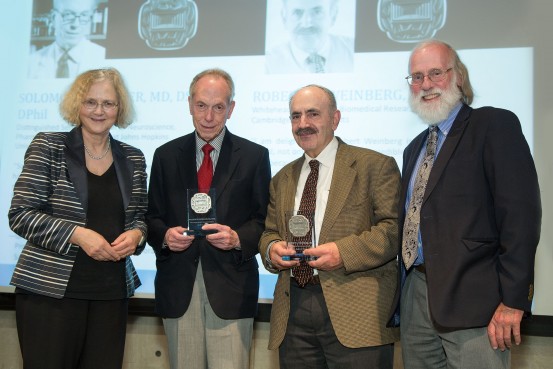
Click here for a high-resolution image
版权:萨克研究所
“Sol Snyder’s seminal contributions to the field of neuroscience continue to fuel research today, while Robert Weinberg’s work has changed the world’s understanding of cancer,” says Elizabeth Blackburn, president of the Salk Institute. “It is pioneering careers such as theirs that embody the spirit of Salk’s research excellence honor.”
Snyder, a member of the US National Academy of Sciences, is regarded internationally for his research on neuropharmacology, seeking the cellular mechanisms by which neurotransmitters and drugs alter brain function. In the early 1970s, he discovered the brain’s opiate receptors and is credited with launching a generation of research into neuropeptides, receptors and behavior. He is the recipient of the Albert Lasker Award for Basic Medical Research, the Wolf Prize, the Bower Award, the National Medal of Science and the Albany Medical Center Prize in Medicine and Biomedical Research.
A graduate of Georgetown University, Snyder is the Distinguished Service Professor of Neuroscience, Pharmacology and Psychiatry at Johns Hopkins University School of Medicine. In 1980, he founded the Department of Neuroscience, serving as its director until 2006 when the department was renamed in his honor. He helped start the companies Nova Pharmaceuticals and Guilford Pharmaceuticals, and is the Director of Drug Discovery at the Lieber Institute for Brain Development in Baltimore, MD.
“Sol Snyder is one of the giants of modern neuroscience,” says Greg Lemke, professor in the Molecular Neurobiology Laboratory at Salk. “His work has defined the basic pharmacology of most of the brain’s neurotransmitters, their receptors, and their transporters, and has been translated into important therapeutics. If you’ve benefited from selective serotonin reuptake inhibitors such as Prozac, you can thank Sol.”
Robert Weinberg, the Daniel K. Ludwig Professor for Cancer Research at Massachusetts Institute of Technology (MIT) and Director of the Ludwig Center at MIT, is most widely known for his discoveries of the first human oncogene—a gene that causes normal cells to form tumors—and the first tumor suppressor gene. His lab now focuses on the interactions between the two major types of cells found in mammalian tissue that produce carcinomas and the processes by which cancer cells invade and metastasize.
Weinberg has received the National Medal of Science, the Keio Medical Science Prize, the Albert Einstein World Award of Science and the Wolf Prize in Medicine. He is a member of the US National Academy of Sciences and the Royal Swedish Academy of Sciences.
“I am delighted that Robert Weinberg was awarded the Salk Medal, not only because of his incredible scientific contributions, but also because he has roots with the Institute as a postdoctoral researcher in Renato Dulbecco’s lab in the early 1970s,” says 英德·维尔马, professor in the Laboratory of Genetics at Salk and a member of the medal selection committee.
The first Salk Institute Medals were awarded in 2006 to Donald Metcalf, an Australian physiologist whose research on cancer has improved disease treatment, and to Paul Farmer, anthropologist, physician and co-founder of Partners in Health. In 2010, gene expression pioneer Robert G. Roeder of The Rockefeller University was awarded the Salk Medal for Research Excellence, and Irwin M. Jacobs, renowned entrepreneur and philanthropist, received the Salk Medal for Public Service. In 2014, violinist Itzhak Perlman was awarded the Public Service medal for all he has done to eradicate polio around the globe.
“The immense accomplishments of both these scientists in their respective research fields made the decision easy to bestow upon them the Salk Medal for Research Excellence,” says Professor 托尼·亨特, who chairs the faculty committee that determines whom to honor.
The Salk Institute Medal was designed for the Institute by French fashion designer and businesswoman Paloma Picasso. Known for her dramatic jewelry creations, she is the youngest daughter of Pablo Picasso and painter and writer Françoise Gilot, who later married Jonas Salk.
宣传办公室
电话:(858) 453-4100
press@salk.edu
萨尔克研究所是一个独立的非营利性研究机构,由首个安全有效的脊髓灰质炎疫苗的研发者乔纳斯·索尔克于1960年创立。该研究所的使命是推动以合作、敢于冒险为特点的基础性研究,以应对癌症、阿尔茨海默病和农业脆弱性等社会最紧迫的挑战。这项基础科学支撑着所有的转化研究,产生有助于全球新药和创新的见解。.




