August 7, 2012
Salk study finds stress triggers widespread epigenetic changes that aid in disease resistance
Salk study finds stress triggers widespread epigenetic changes that aid in disease resistance
LA JOLLA, CA—It was long thought that methylation, a crucial part of normal organism development, was a static modification of DNA that could not be altered by environmental conditions. New findings by researchers at the Salk Institute for Biological Studies, however, suggest that the DNA of organisms exposed to stress undergo changes in DNA methylation patterns that alter how genes are regulated.
The scientists found that exposure to a pathogenic bacteria caused widespread changes in a plant’s epigenetic code, an extra layer of biochemical instructions in DNA that help control gene expression. The epigenetic changes were linked to the activity of genes responsible for coordinating a plant’s response to stress, suggesting that the epigenome may help organisms develop resistance to pathogens and other environmental stressors.
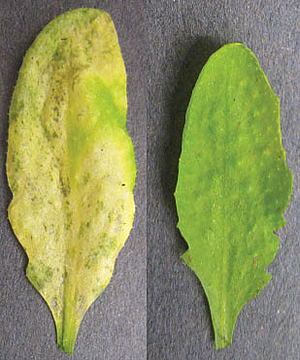
The Salk researchers infected two lines of plants with a bacteria to determine whether methylation, a type of epigenetic chemical modification to DNA, plays a role in a plant’s response to stress.
The leaf on the left, taken from a normal plant five days after infection, shows disease systems. The leaf on the right, taken from a mutant plant incapable of methylation, shows no signs of disease, suggesting that methylation functions in stress responses.
Image: Courtesy of Robert H. Dowen
“This means the epigenome may not just be a static set of instructions, but also a way of rewriting those instructions based on experience,” says 约瑟夫·埃克尔, ,索尔克研究所的教授 基因组分析实验室, who led the research team. “Our findings, combined with other researchers’ findings, build the case that life experiences leave an imprint on our DNA.”
In the study, published August 7 in the 美国国家科学院院刊, Ecker and his colleagues studied how DNA methylation regulates the immune system of the 拟南芥 plant. Methylation is a biochemical process that, among other things, suppresses the expression of “jumping genes” called transposons that have been incorporated into the genome over time. Using genome-wide sequencing technologies, the researchers found a wide range of methylation changes in the plant’s response to a bacterial infection and performed a variety of analyses to determine how these methylation changes alter gene expression.
“From previous studies, we know that the expression of a few genes is coupled to methylation changes in response to stress,” says first author Robert Dowen, who worked on the project at Salk with Ecker and is now with Massachusetts General Hospital in Boston. “Our findings, however, show that exposing a plant to stress triggers a multitude of methylation changes that help the plant defend against invading pathogens.”
Plants use a sophisticated series of defense mechanisms to restrict the growth of parasitic bacteria upon infection by stimulating various hormonal signals that trigger alterations in gene expression networks. The Salk findings and other recent studies suggest that these cellular defense responses engage the DNA methylation machinery to impart control over gene expression networks. Epigenetic changes in the genetic material, including changes in DNA methylation patterns and modifications to histones (proteins which play a key role in gene regulation), can alter the expression of a gene without changing its DNA sequence. In addition, molecules called small interfering RNAs (siRNAs) are intimately connected with DNA methylation, especially at the jumping genes, where these siRNAs direct the methylation process. Surprisingly, the researchers found that the levels of these siRNAs also change during infection at specific transposons and correspond to activation of these mobile DNA fragments. These findings illustrate the dynamic nature of the epigenome in response to stress.
The Salk findings may have broad implications for agriculture, including engineering the DNA methylation patterns of plants to generate pathogen-resistant crops and minimize pesticide exposure. These application technologies are of intense interest, as more than 30 to 40 percent of annual crops are lost to pathogens each year at a cost of some $500 billion.
A recent study published in 植物生理学 suggests that memory of environmental conditions may be passed transgenerationally, as plant defenses are primed in the progeny of plants whose parents have already been exposed to pathogens. “While this phenomenon is poorly understood, it is of wide interest and is being intensively studied in the field,” says Dowen. “We think our findings may provide a framework for directly testing whether the methylation changes that we observed are passed to the progeny or whether a similar mechanism may be occurring in human cells.”
Other researchers on the study were Mattia Pelizzola, Robert J. Schmitz, Ryan Lister, and Joseph R. Nery, from the Salk Institute; and Jill M. Dowen and Jack E. Dixon of the University of California at San Diego.
这项工作得到了...的支持 美国国立卫生研究院 (AI060662), the Catharina Foundation, , 那个 加州再生医学研究所, , 那个 Mary K. Chapman Foundation, , 那个 霍华德·休斯医学研究所 和 戈登和贝蒂·摩尔基金会.
关于索尔克生物研究所:
索尔克生物研究所是世界顶尖的基础研究机构之一,其国际知名的教职人员在一个独特、协作和富有创造性的环境中,深入探究生命科学的基本问题。索尔克科学家们致力于发现和指导未来几代研究人员,通过研究神经科学、遗传学、细胞和植物生物学以及相关学科,在癌症、衰老、阿尔茨海默氏症、糖尿病和传染病的认识方面做出了开创性的贡献。.
学院取得了许多成就,获得了包括诺贝尔奖和美国国家科学院院士在内的无数荣誉。该研究所由脊髓灰质炎疫苗先驱 Jonas Salk 博士于 1960 年创立,是一家独立的非营利组织和建筑地标。.
日记
美国国家科学院院刊
作者
Robert H. Dowen, Mattia Pelizzola, Robert J. Schmitz, Ryan Lister, Jill M. Dowen, Joseph R. Nery, Jack E. Dixon, and Joseph R. Ecker
宣传办公室
电话:(858) 453-4100
press@salk.edu