June 26, 2017
Salk scientists improved upon a classic approach to mapping the interactions between proteins
Salk scientists improved upon a classic approach to mapping the interactions between proteins
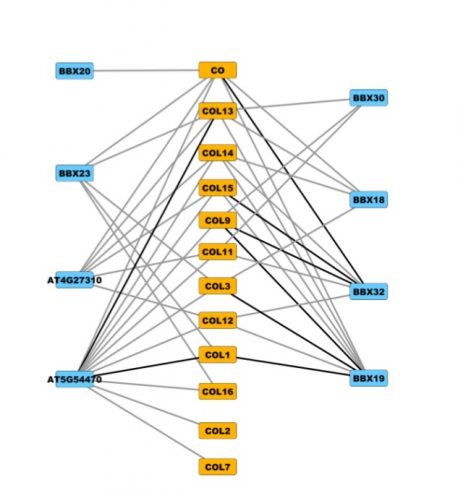
LA JOLLA—Salk scientists have developed a new high-throughput technique to determine which proteins in a cell interact with each other. Mapping this network of interactions, or “interactome,” has been slow going in the past because the number of interactions that could be tested at once was limited. The new approach, published June 26 in 自然方法, lets researchers test millions of relationships between thousands of proteins in a single experiment.
点击此处 用于高分辨率图像
版权:萨克研究所
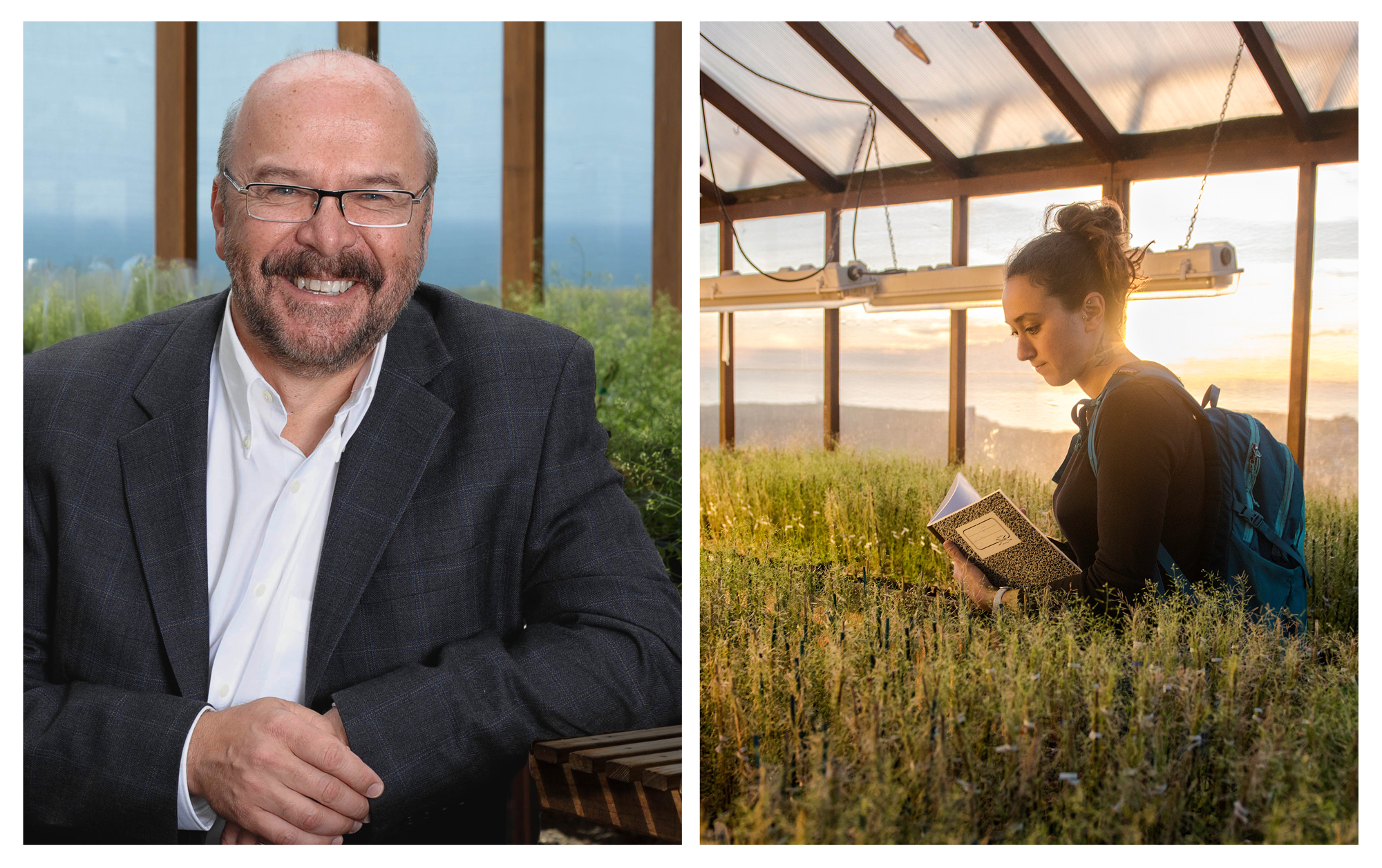
“The power of this new approach is in the ability we now have to scale it up,” says senior author 约瑟夫·埃克尔, professor and director of Salk’s Genomic Analysis Laboratory and investigator of the Howard Hughes Medical Institute. “This assay has the potential to begin to address questions about fundamental biological interactions that we haven’t been able to address before.”
The interactome of a cell, like a map of social networks, lets scientists see who’s working with who in the world of proteins. This helps them figure out the roles of different proteins and piece together the different players in molecular pathways and processes. If a newly discovered protein interacts with lots of other proteins involved in cellular metabolism, for instance, researchers can deduce that’s a likely role for the new protein and potentially target it for treatments related to metabolic dysfunction.
Until now, researchers have typically relied on standard high-throughput yeast two-hybrid (Y2H) assays to determine the interactions between proteins. The system requires using a single known protein—known as the “bait”—to screen against a pool of “prey” proteins. But finding all the interactions between, for instance, 1,000 proteins, would require 1000 separate experiments to screen once for each bait’s interaction partners.
“Current technologies essentially require that interactions detected in primary screening get retested individually,” says Shelly Trigg, an NSF Graduate Research Fellow at the 加州大学圣地亚哥分校, in the Ecker lab, and first author of the new paper. “That may no longer be necessary with the screening depth this approach achieves.”
In their new method, Ecker, Trigg and their colleagues added a twist to the standard Y2H assay for a much more effective way of measuring the interactome. The genes for two proteins, each on their own circle of DNA, are added to the same cell. If the proteins of interest interact inside the cell, a gene called Cre is activated. When turned on, Cre physically splices the two individual circles of DNA together, thus pairing the genes of interacting proteins together so the team can easily find them through sequencing. The team can generate a massive library of yeast cells—each containing different pairs of proteins by introducing random combinations of genes on circular DNA called plasmids. When cells are positive for a protein interaction, the researchers can use genetic sequencing to figure out what the two proteins interacting are, using new high-throughput DNA sequencing technologies similar to those used for human genome sequencing. This way, they’re no longer limited to testing one “bait” protein at a time, but could test the interactions between all the proteins in a library at once.
点击此处 用于高分辨率图像。.
Ecker’s group tested the new method, dubbed CrY2H-seq, on all the transcription factors—a large class of proteins—in the plant 拟南芥.
“When you take 1,800 proteins and test the interactions among them, that’s nearly 4 million combinations,” says Ecker. “We did that ten times in a matter of a month.”
They revealed more than 8,000 interactions among those proteins tested, giving them new insight into which 拟南芥 transcription factors interact with each other. The data, they say, helps answer longstanding questions about whether certain groups of transcription factors have set functions. Some of the poorly understood transcription factors, they found, interact with more well-understood factors that regulate the plant’s response to auxin, a hormone involved in coordinating plant growth.
In the future, the method could be scaled up to test larger sets of proteins—human cells, for instance, contain about 20,000 different proteins. This easier and faster method to determine the entire interactome of a cell also opens up the possibility of studying how the interactome changes under different conditions—an experiment that’s never been possible in the past.
Other researchers on the study were Renee Garza, Andrew MacWilliams, Joseph Nery, Anna Bartlett, Rosa Castanon, Adeline Goubil, Joseph Feeney, Ronan O’Malley, Shao-shan Carol Huang, Zhuzhu Zhang, and Mary Galli of the Salk Institute.
这项工作以及参与研究的学者得到了以下机构资助: U.S. Department of Energy, National Science Foundation Graduate Research Fellowship Program, 霍华德·休斯医学研究所, ,和 Mary K. Chapman Foundation.
日记
自然方法
作者
Shelly A Trigg, Renee M Garza, Andrew MacWilliams, Joseph R Nery, Anna Bartlett, Rosa Castanon, Adeline Goubil, Joseph Feeney, Ronan O'Malley, Shao-shan C Huang, Zhuzhu Z Zhang, Mary Galli & Joseph R Ecker
期刊封面
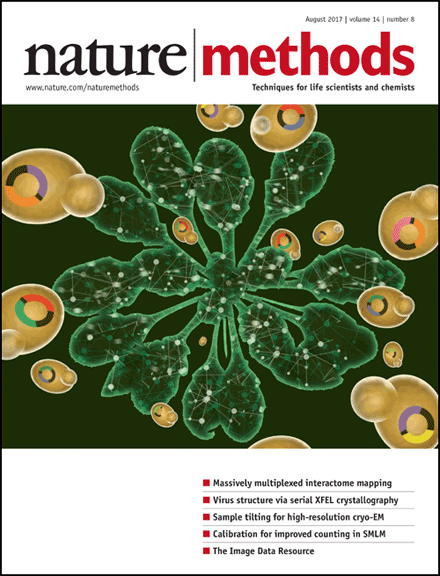
A massively multiplexed yeast two-hybrid method, CrY2H-seq, enables deep-coverage mapping of the 拟南芥 interactome. Cover prepared by Erin Dewalt, based on design and artwork by Shelly Trigg, Lisa Servilio, and Jamie Simon at The Salk Institute for Biological Studies and by Austin Trigg at Austin Trigg Photography.
宣传办公室
电话:(858) 453-4100
press@salk.edu
萨尔克研究所是一个独立的非营利性研究机构,由首个安全有效的脊髓灰质炎疫苗的研发者乔纳斯·索尔克于1960年创立。该研究所的使命是推动以合作、敢于冒险为特点的基础性研究,以应对癌症、阿尔茨海默病和农业脆弱性等社会最紧迫的挑战。这项基础科学支撑着所有的转化研究,产生有助于全球新药和创新的见解。.