August 3, 2015
Salk scientists unveil how a critical molecule turns on T cells
Salk scientists unveil how a critical molecule turns on T cells
LA JOLLA–T cells are the guardians of our bodies: they constantly search for harmful invaders and diseased cells, ready to swarm and kill off any threats. A better understanding of these watchful sentries could allow scientists to boost the immune response against evasive dangers (e.g., cancer or infections), or to silence it when it mistakenly attacks the body itself (e.g., autoimmune disorders or allergies).
Now, scientists at the Salk Institute have discovered that T cell triggering relies on a dynamic protein network at the cell surface, as reported in August 3, 2015, in Nature Immunology.
“This is a completely new principle for how T cell activity is controlled–whether it ignores or responds to a threat,” says senior author Björn Lillemeier, an assistant professor in the 诺米斯基金会免疫生物学与微生物病原学实验室 和 韦特先进生物光子学中心 at the Salk Institute.
T cells become active when a signal–often from a virus or bacterium–triggers molecular sensors on their surface, namely T cell receptors. Previously, scientists believed that additional molecules that bind T cell receptors and help it to perceive this signal were like grapes hanging from a vine, occasionally dropping away or joining to begin the process. In contrast, the new discovery shows that T cell receptors are incredibly active–more like a bustling train station, with molecules rapidly coming and going at different intervals of time, says Lillemeier.
A protein called ZAP-70 is well known as a crucial player for kicking the T cell into action. Until now, scientists assumed that a silent form of ZAP-70 floats around inside the T cell until a threat is detected, which recruits ZAP-70 to the cell surface and activates it. By analyzing mutant forms of ZAP-70, Lillemeier’s group discovered that instead of ZAP-70 binding the T cell receptor firmly, it comes in contact with the receptor sporadically. Each time this happens, ZAP-70 has to adopt an unfavorable shape that forces it back inside the cell. This cycle continues until a second molecule, called Lck, helps it to remain with the T cell receptor. The prolonged stay at the cell surface activates ZAP-70 and prompts the T cell to attack invaders and diseased cells.
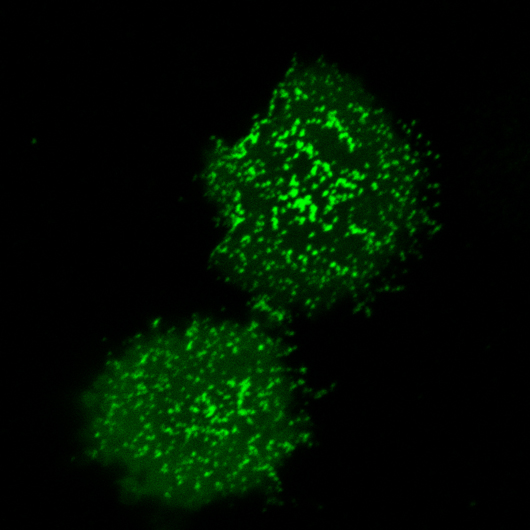
Salk scientists have discovered details into how immune cell activity is controlled by a key protein. The protein kinase ZAP-70 (green) clusters at the plasma membrane upon T cell activation.
点击此处 用于高分辨率图像。.
图片:由萨克生物研究所提供
This study shows that the steps underlying T cell activation are much more dynamic compared with the less mobile modes that scientists had suspected before. The new study highlights how ZAP-70 and other molecules communicate in space and time, which is crucial for controlling the ultimate activity of a T cell. By understanding this process, Lillemeier says, “We might be able to encourage the immune system to be a little more sensitive in order to recognize and eliminate diseases.”
Lillemeier’s team is working to identify new principles that determine if T cells respond to a threat versus staying quiet. In addition, they are testing whether their findings could be applied across additional processes in T cells and other immune cells. Because proteins have many of the same modular building blocks, in principle, any protein with structural characteristics comparable to those of ZAP-70 could be controlled by similar mechanisms, Lillemeier says.
Other authors on the study were Christian Klamm, Lucie Novotná, Dongyang Li, Miriam Wolf, and Amy Blount of Salk’s Nomis Center for Immunobiology and Microbial Pathogenesis and the Waitt Advanced Biophotonics Center; and Kai Zhang and Jonathan Fitchett of Eli Lilly’s Lilly Biotechnology Center in San Diego.
该研究得到了 美国国立卫生研究院, the Nomis Foundation, the Waitt Foundation and the James B. Pendleton Charitable Trust.
日记
Nature Immunology
作者
Christian Klammt, Lucie Novotná, Dongyang T. Li, Miriam Wolf, Amy Blount, Kai Zhang, Jonathan R. Fitchett and Björn F. Lillemeier
宣传办公室
电话:(858) 453-4100
press@salk.edu
萨尔克研究所是一个独立的非营利性研究机构,由首个安全有效的脊髓灰质炎疫苗的研发者乔纳斯·索尔克于1960年创立。该研究所的使命是推动以合作、敢于冒险为特点的基础性研究,以应对癌症、阿尔茨海默病和农业脆弱性等社会最紧迫的挑战。这项基础科学支撑着所有的转化研究,产生有助于全球新药和创新的见解。.