October 13, 2015
LA JOLLA–Salk Institute scientist 贾内尔·艾尔斯 has received an award of $500,000 over two years from the Defense Advanced Research Projects Agency (DARPA) to further her research on bolstering a person’s microbiome to help their body overcome an infection. The award comes with the possibility of an additional $500,000 for a third year.
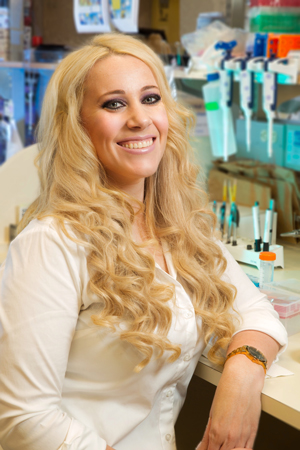
Janelle Ayres, Salk Assistant Professor of Immunobiology and Microbial Pathogenesis
图片:由萨克生物研究所提供
Ayres, assistant professor in Salk’s Nomis Foundation Laboratory for Immunobiology and Microbial Pathogenesis, is one of 24 to receive DARPA’s Young Faculty Award (YFA). “There is a disconnect between our methods for treating infectious disease and our understanding of the mechanisms that keep us healthy during infection,” says Ayres. “With DARPA’s support, I hope to develop a better understanding of how the body’s microbiome helps defend it against infections and how these mechanisms might be enhanced to improve disease tolerance.”
Ayres’ award comes as DARPA is proposing a new approach for medical countermeasure against biological threats with a shift away from eradicating pathogens and instead finding therapies for disease tolerance. The agency is part of the U.S. Department of Defense and responsible for the development of emerging technologies for use by the military for national security.
“Support for basic biomedical research that is aimed at identifying new ways to combat infectious diseases rather than the traditional anti-microbial based strategies is important and timely,” Ayres says. “Especially given the rate at which infectious diseases are evolving resistance to our anti-microbial strategies.”
In pivotal studies, Ayres was one of the first to demonstrate that animals encode disease tolerance defense strategies and that these defense mechanisms are crucial for survival of lethal infections. A main goal of Ayres’ research program is to elucidate disease tolerance mechanisms by studying how the body controls and repairs the collateral damage generated during interactions with harmful microbes. She is taking an innovative approach grounded in mathematical and evolutionary predictions that uses the beneficial microbes that inhabit our digestive system for damage-control therapeutics.
Ayres’ revelation of an entirely new set of defense mechanisms will likely lead to novel therapies that bacteria won’t be able to evolve resistance to. And because pathologies that arise during infection are similar to those created by non-infectious diseases, therapies that manipulate damage-control mechanisms could also have broader applications than antibiotics.
Ultimately, by leveraging those damage-control mechanisms, Ayres aims to develop treatments for infectious and non-infectious diseases (such as pathologies associated with cancer and aging) without the need for antibiotics.
宣传办公室
电话:(858) 453-4100
press@salk.edu
萨尔克研究所是一个独立的非营利性研究机构,由首个安全有效的脊髓灰质炎疫苗的研发者乔纳斯·索尔克于1960年创立。该研究所的使命是推动以合作、敢于冒险为特点的基础性研究,以应对癌症、阿尔茨海默病和农业脆弱性等社会最紧迫的挑战。这项基础科学支撑着所有的转化研究,产生有助于全球新药和创新的见解。.