June 23, 2023
Salk scientists discover that pairing disease-causing bacteria with dietary interventions creates long-term immunity in mice
Salk scientists discover that pairing disease-causing bacteria with dietary interventions creates long-term immunity in mice
LA JOLLA—Worldwide, more than a million deaths occur each year due to diarrheal diseases that lead to dehydration and malnutrition. Yet, no vaccine exists to fight or prevent these diseases, which are caused by bacteria like certain strains of 大肠杆菌. Instead, people with bacterial infections must rely on the body taking one of two defense strategies: kill the intruders or impair the intruders but keep them around. If the body chooses to impair the bacteria, then the disease can occur without the diarrhea, but the infection can still be transmitted—a process called asymptomatic carriage.
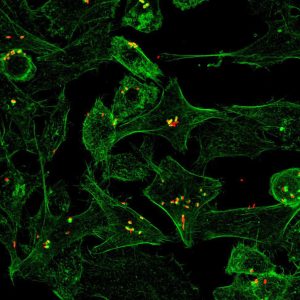
Now, Salk scientists have found that pairing specific diets with disease-causing bacteria can create lasting immunity in mice without the costs of developing sickness, revealing a new potential vaccination strategy. Their findings, published in 科学进展 on June 23, 2023, pave the way for the development of new vaccines that could promote immunity for those with diarrheal diseases and possibly other infections.
“We discovered that immunization against diarrheal infections is possible if we allow the bacteria to retain some of its disease-causing behavior,” says senior author Professor 贾内尔·艾尔斯, Salk Institute Legacy Chair and head of the Molecular and Systems Physiology Laboratory. “This insight could lead to the development of vaccines that could reduce symptoms and mortality, as well as protect against future infections.”
In 2018, Ayres’ lab looked at how dietary interventions can create an asymptomatic infection, which Ayres calls a cooperative relationship between bacteria and host (the person or animal that the bacteria have infected) where the host does not experience any symptoms. They discovered that an iron-rich diet enabled mice to survive a normally lethal bacterial infection without ever developing signs of sickness or disease. The high-iron diet increased unabsorbed sugar (glucose) in the mice’s intestines, which the bacteria could feast on. The excess sugar served as a “bribe” for the bacteria, keeping them full and incentivized to not attack the host.
This process produced long-term asymptomatic infection with the bacteria, leading the researchers to believe that the adaptive immune system (cells and proteins that “remember” infections) may be involved.

“Being able to generate lasting immunity against bacteria like C. rodentium or 大肠杆菌 has not been possible using established vaccination strategies. We wanted to figure out what mechanism was sustaining this lasting immunity, so we could use that mechanism to create an impactful solution to these diarrheal diseases,” says first author Grischa Chen, a former postdoctoral researcher in Ayres’ lab.
The researchers moved to figure out how the body suppresses infection symptoms, whether infection without symptoms can create long-term immunity, and whether that immunity is reproducible as a vaccination strategy.
The team compared mice with iron-rich and normal diets after C. rodentium infection to find whether the diet impacted symptomless infection. Immediately after infection, mice fed an iron-rich diet had no symptoms whereas mice fed a normal diet did have symptoms. All mice were then put on a normal diet to see whether the asymptomatic infection would last.
Mice with nonfunctional adaptive immune systems (the immune system that “remembers” previous infections), regardless of whether they had ever been on an iron-rich diet, could not continue to maintain a cooperative relationship with the bacteria. Although the iron-rich diet suppressed symptoms immediately after infection, the adaptive immune system was required for lasting cooperation. Importantly, the mice with functional adaptive immune systems had the disease without any symptoms, with lasting immunity, as demonstrated by survival upon reinfection after a month.
Ayres and team concluded that an iron-rich diet alone can prevent bacteria from creating deadly symptoms in mice during active infection. But a functional adaptive immune system is required for immunity against future infection in the absence of dietary supplementation.
Some bacterial strains, if mutated enough, don’t cause symptoms. To test whether such bacteria could produce lasting immunity, the team repeated their iron-diet versus normal-diet experiment in mice, but this time using bacteria that could cause disease and bacteria that could not cause disease. They found that only mice that received disease-causing, unmutated bacteria were able to support immunity upon reinfection.
The scientists note that people shouldn’t consume large amounts of iron after reading this study. Their findings are preliminary and will need to be confirmed in human subjects.
The researchers hope their insights will provide a basis for future research in humans and the creation of a vaccination regimen that protects and prevents against diarrheal illness.
Other authors include Natalia R. Thorup, Abigail J. Miller, and Yao-Cheng Li of Salk.
The work was supported by the National Institutes of Health (DPI AI144249, R01AI4929), the NOMIS Foundation, a DARPA Yong Faculty Award (YFA15 D15AP00097), a Hillblom Foundation Fellowship Grant, the Chapman Foundation, the Helmsley Charitable Trust,
DOI: 10.1126/sciadv.adg8719
日记
科学进展
作者
Grischa Y. Chen, Natalia R. Thorup, Abigail J. Miller, Yao-Cheng Li, Janelle S. Ayres
宣传办公室
电话:(858) 453-4100
press@salk.edu
萨尔克研究所是一个独立的非营利性研究机构,由首个安全有效的脊髓灰质炎疫苗的研发者乔纳斯·索尔克于1960年创立。该研究所的使命是推动以合作、敢于冒险为特点的基础性研究,以应对癌症、阿尔茨海默病和农业脆弱性等社会最紧迫的挑战。这项基础科学支撑着所有的转化研究,产生有助于全球新药和创新的见解。.