
June 7, 2024
Congratulations to the awardees of the Kavli Small Equipment Grant Program, where Salk Faculty and Research Professors working in neuroscience, and related fields, submitted proposals to receive funds to purchase or build small equipment needed to further their research.
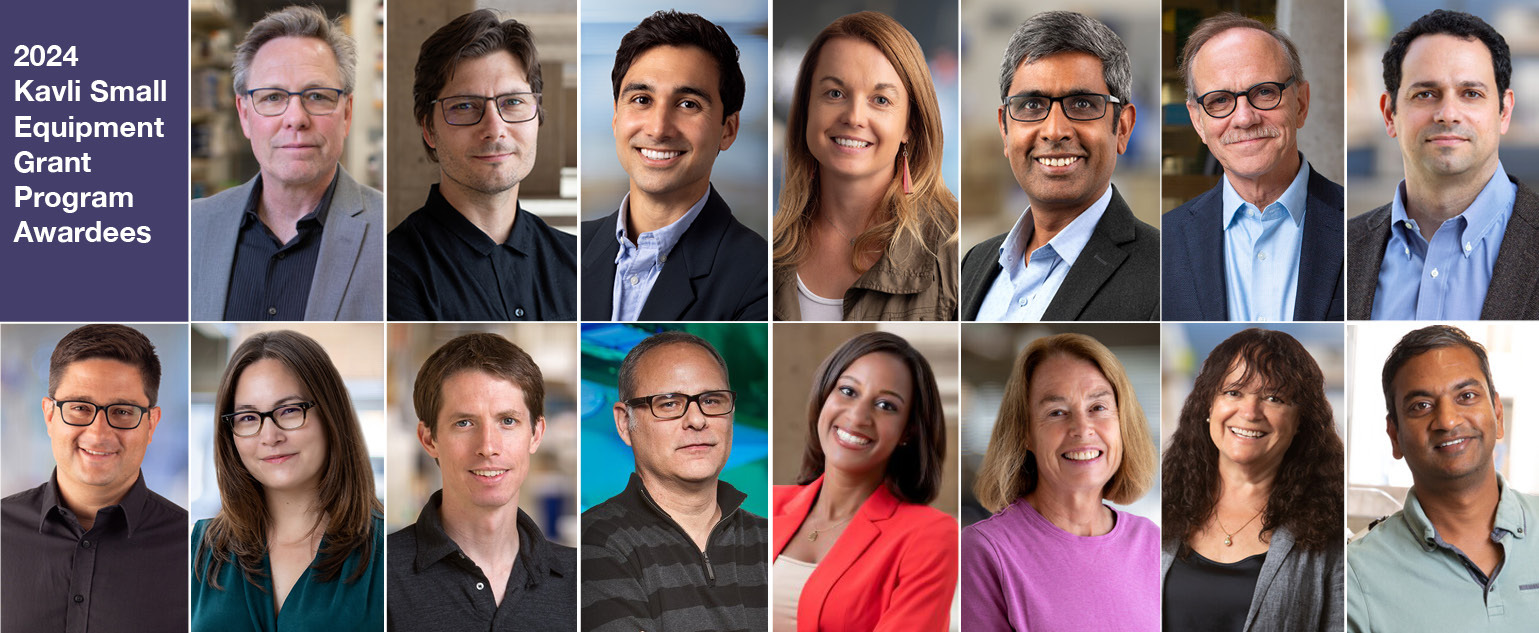
Here is a sumary of the six awardees that were selected:
"Atomic Force Microscope" from Pallav Kosuri, Dmitry Lyumkis, and Aga Kendrick
The “Atomic Force Microscope” proposal seeks to elevate our institute’s nanotechnology research capabilities by acquiring a Bruker Dimension FastScan AFM. This state-of-the-art Atomic Force Microscope uses an ultrasharp needle to scan the topography of samples with nanometer resolution. With this instrument it will be possible to image and map the mechanical stiffness of biomolecules, materials, and cells, with minimal sample preparation and in ambient conditions. This instrument will enable projects ranging from structural determination of protein-DNA complexes to measuring the changes in cell stiffness during differentiation and carcinogenesis.
"Kavli small equipment grant for An Oroboros O2k Modular system for High-Resolution Respirometry" from Satchindananda Panda, Rusty Gage, Alan Saghatelian, Christian Metallo, Dannielle Engle, Christina Towers, Pamela Maher, Joseph Noel, and Gerald Shadel
The Oroboros O2k Modular system for High-Resolution Respirometry provides an indirect calorimetric approach to the measurement of metabolic heat changes, by measuring oxygen uptake (and carbon dioxide production and nitrogen excretion in the form of ammonia, urea or uric acid) and converting the oxygen consumed into an enthalpy change, using the oxycaloric equivalent. In combination with various energy substrates and/or with specific modulators of mitochondria energy flux, the approach offers fine-grained characterization of respiration and energy production at multiple scales from organelle (mitochondria) to cells and tissue levels. A unique aspect of the Oroboros system is the ability to perform studies in live tissues. The equipment will be partially funded by the Wu Tsai Human Performance Alliance award.
"Shared Real-Time PCR system for Laboratory South Building 3rd Floor" from Graham McVicker, Marga Behrens, Sreekanth Chalasani, Christina Towers, and Aga Kendrick
The qRT-PCR instrument runs in a 96-well format and provides high sensitivity and precision in each well, two-target multiplexing, and gradient optimization. Applications for the machine include gene expression analysis, protein thermal shift assays, genotyping, copy number variation, and assay optimization. These assays are essential for modern molecular biology and span disciplines including genetics, cancer biology, and neuroscience
ABOUT THE 2024 KAVLI SMALL EQUIPMENT GRANTS
The goal of the 2024 Kavli Small Equipment Grants Program is to provide funds to buy or build small equipment designed to strengthen research capacity and capability. The grant has a total funding amount of $200,000 and awards range from a minimum of $10,000 up to $100,000. This year, the research area focus was labs working on neuroscience, particularly Alzheimer’s, as well as cancer research.
In alignment with Salk’s strong tradition of sharing equipment among labs, equipment funded by the Kavli Small Equipment Grants Program will be available to Kavli Institute for Brain and Mind (KIBM) researchers at Salk. We look forward to offering many more opportunities for grants like this one that bring the best minds at Salk together to enable break-through research together.
宣传办公室
电话:(858) 453-4100
press@salk.edu
萨尔克研究所是一个独立的非营利性研究机构,由首个安全有效的脊髓灰质炎疫苗的研发者乔纳斯·索尔克于1960年创立。该研究所的使命是推动以合作、敢于冒险为特点的基础性研究,以应对癌症、阿尔茨海默病和农业脆弱性等社会最紧迫的挑战。这项基础科学支撑着所有的转化研究,产生有助于全球新药和创新的见解。.




