




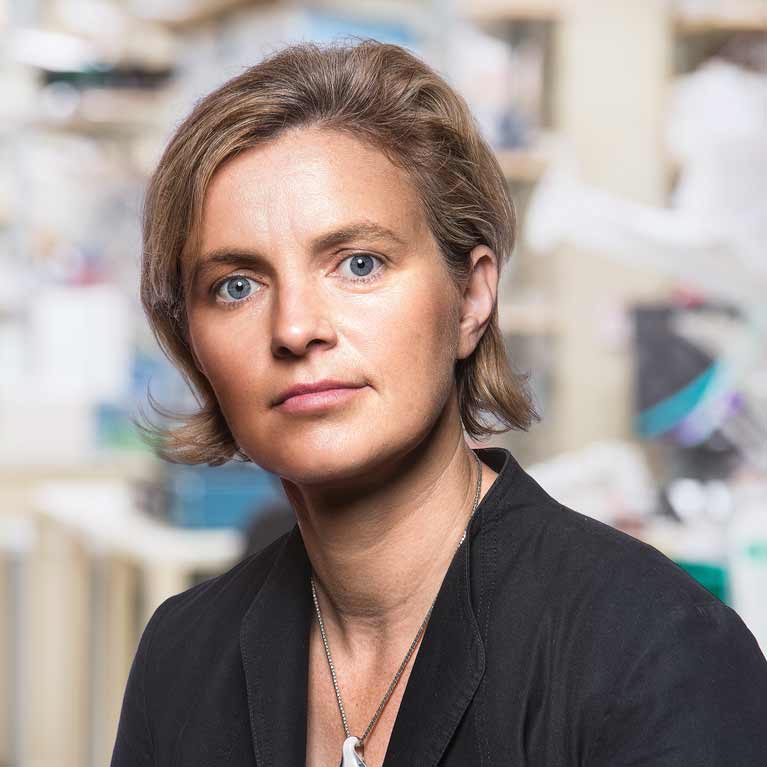
Clodagh O’Shea, PhD

Profesor

Laboratorio de Biología Molecular y Celular

Investigador Titular del Instituto Médico Howard Hughes

Silla Wicklow

Instituto Salk de Estudios Biológicos - Vídeos

Videos


Científicos de Salk resuelven un antiguo misterio biológico sobre la organización del ADN

LA JOLLA—Stretched out, the DNA from all the cells in our body would reach Pluto. So how does each tiny cell pack a two-meter length of DNA into its nucleus, which is just one-thousandth of a millimeter across?

The answer to this daunting biological riddle is central to understanding how the three-dimensional organization of DNA in the nucleus influences our biology, from how our genome orchestrates our cellular activity to how genes are passed from parents to children. Leer más »


La respuesta al daño del ADN se vuelve viral: una vía hacia nuevos tratamientos contra el cáncer

Every organism–from a seedling to a president–must protect its DNA at all costs, but precisely how a cell distinguishes between damage to its own DNA and the foreign DNA of an invading virus has remained a mystery.

Now, scientists at the Salk Institute have discovered critical details of how a cell’s response system tells the difference between these two perpetual threats. The discovery could help in the development of new cancer-selective viral therapies and may help explain why aging and certain diseases seem to open the door to viral infections. Leer más »


TWiV 291: Ft. Collins abuzz with virologists

33rd annual meeting of the American Society for Virology at Colorado State
University in Ft. Collins, Colorado
Featuring Clodagh O’Shea
Hosted by Vincent Racaniello


Los virus del resfriado señalan el camino hacia nuevas terapias contra el cáncer

Cold viruses generally get a bad rap—which they’ve certainly earned—but new findings by a team of scientists at the Salk Institute for Biological Studies suggest that these viruses might also be a valuable ally in the fight against cancer.

Adenovirus, a type of cold virus, has developed molecular tools—proteins—that allow it to hijack a cell’s molecular machinery, including large cellular machines involved in growth, replication and cancer suppression. The Salk scientists identified the construction of these molecular weapons and found that they bind together into long chains (polymers) to form a three-dimensional web inside cells that traps and overpowers cellular sentries involved in growth and cancer suppression. The findings, published October 11 in Cell, suggest a new avenue for developing cancer therapies by mimicking the strategies employed by the viruses. Leer más »


¿Usar el virus del resfriado común para atacar y desestabilizar las células cancerosas?

A novel mechanism used by adenovirus to sidestep the cell’s suicide program, could go a long way to explain how tumor suppressor genes are silenced in tumor cells and pave the way for a new type of targeted cancer therapy, report researchers at the Salk Institute for Biological Studies in the Aug. 26, 2010 issue of Naturaleza.

When a cell is under stress, the tumor suppressor p53 springs into action activating an army of foot soldiers that initiate a built-in “auto-destruct” mechanism that eliminates virus-infected or otherwise abnormal cells from the body. Just like tumor cells, adenoviruses, which cause upper-respiratory infections, need to get p53 out of the way to multiply successfully. Leer más »


Educación

BS, Bioquímica y Microbiología, University College Cork, Irlanda
Doctorado, Imperial College London/Imperial Cancer Research Fund, Reino Unido.
Investigador posdoctoral, Centro Integral de Cáncer de la UCSF, San Francisco, EE. UU.


Premios y distinciones

  • Premio Allen Distinguished Investigator 2018
  • Investigador del Howard Hughes Medical Institute de 2016
  • Premio del Programa de Investigación Médica W. M. Keck 2014
  • Beca Rose Hills 2014
  • 2011Science/NSF International Science & Visualization Challenge, Voto del Público
  • Premio Anna Fuller de Investigación del Cáncer 2011
  • 2010, 2011, 2012 Becario Kavli Frontiers, Academia Nacional de Ciencias
  • Premio Sontag 2009 al Científico Distinguido
  • Premio de Investigación de la Sociedad Americana del Cáncer 2009
  • Premio Joven Investigador ACGT 2008 en Terapia Génica contra el Cáncer
  • Premio Arnold and Mabel Beckman Young Investigator 2008
  • 2008 William Scandling Profesor Asistente, Presidente de Desarrollo
  • Académico de la Emerald Foundation 2007