
April 25, 2013
Salk findings suggest vitamin D therapy could be a powerful weapon in the fight against liver fibrosis
Salk findings suggest vitamin D therapy could be a powerful weapon in the fight against liver fibrosis
LA JOLLA, CA—Liver fibrosis results from an excessive accumulation of tough, fibrous scar tissue and occurs in most types of chronic liver diseases. In industrialized countries, the main causes of liver injury leading to fibrosis include chronic hepatitis virus infection, excess alcohol consumption and, increasingly, nonalcoholic steatohepatitis (NASH).
Now, in a new study published in the journal Célula, scientists at the Salk Institute for Biological Studies have discovered that a synthetic form of vitamin D, calcipotriol (a drug already approved by the FDA for the treatment of psoriasis), deactivates the switch governing the fibrotic response in mouse liver cells, suggesting a potential new therapy for fibrotic diseases in humans.
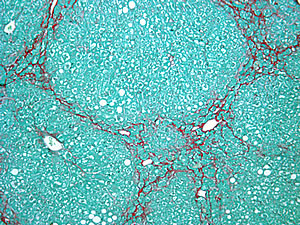
This image shows mouse liver tissue with fibrosis (red), a type of scarring caused by chronic liver diseases and injuries. Salk researchers found that a drug already approved by the FDA for the treatment of psoriasis deactivates the switch governing the fibrotic response in mouse liver cells, suggesting a potential new therapy for fibrotic diseases in humans.
Images: Courtesy of the Salk Institute for Biological Studies
“Because there are currently no effective drugs for liver fibrosis, we believe our findings would open a new door for treatment,” says senior author Ronald M. Evans, profesor del Instituto Salk Laboratorio de Expresión Génica and lead researcher in the Institute’s new Helmsley Center for Genomic Medicine.
The Salk study focused on a star-shaped “stellate” cell in the liver that serves as a beacon for damage. When called into action, stellate cells produce fibrotic proteins in an attempt to heal an injury. Under chronic stress, however, localized fibrosis expands, eventually leading to cirrhosis, increased risk of liver cancer, and the need for a liver transplant in advanced cases.
The Evans lab discovered a genetic switch through which vitamin D-related ligands such as calcitriol, a hormonally active form of the vitamin, can put the brakes on fibrosis. “Preclinical results suggest the ‘vitamin D brake’ is highly efficacious and led us to believe that the time is right to consider a trial in the context of chronic liver disease,” says Evans, a Howard Hughes Medical Institute Investigator and holder of the March of Dimes Chair in Molecular and Developmental Biology.
Previous studies have shown a physiologic role for vitamin D in liver function, but “it was our discovery of high levels of vitamin D receptor (VDR) in the stellate cell that led us to consider it as a possible off switch for liver fibrosis,” says lead author Ning Ding, a research associate in the Gene Expression Laboratory.
“Current therapeutic approaches, which treat the symptoms of liver disease, don’t stop liver fibrosis from progressing,” says Michael Downes, a senior staff scientist in the Gene Expression Laboratory and co-corresponding author on the paper. “In liver diseases where the underlying cause cannot be cured, progression to cirrhosis is currently inevitable in some people. What we have discovered is that by acting on the genome, VDR can simultaneously defend against multiple fibrotic activators. This is important because many different pro-fibrotic signaling pathways converge on the genome to affect their fibrotic response.”
The Salk discovery that calcipotriol counters the fibrotic response in stellate cells illuminates a potentially safer, more effective strategy capable of neutralizing multiple convergent fibrotic triggers.
The Salk scientists say that clinical trials of the vitamin D analog for the treatment of liver fibrosis are being planned. The synthetic vitamin D analog is better than natural vitamin D, they say, for a couple of reasons. First, natural vitamin D, which is found in small amounts in a few foods and produced in the body by exposure to sunlight, degrades quickly, while synthetic versions of vitamin D are less susceptible to breakdown. Second, too much natural vitamin D can cause hypercalcemia, or elevated calcium in the blood, which can lead to nausea and vomiting, frequent urination, muscle weakness and joint aches and pain. The synthetic vitamin D analog, on the other hand, produces a strong response without adding calcium to the blood.
In addition, the researchers say this new model for treating liver fibrosis may also be helpful in treating other diseases with a fibrotic component, including those of the lung, kidney and pancreas.
Other researchers on the study were Ruth T. Yu, Mara H. Sherman, Mathias Leblanc, Mingxiao He, Annette R. Atkins and Grant D. Barish, from the Salk Institute; Nanthakumar Subramaniam, Caroline Wilson, Renuka Rao, Sally Coulter and Christopher Liddle, of the University of Sydney (Australia); and Sue L. Lau , Christopher Scott and Jenny E. Gunton, of the Garvan Insitute for Medical Research (Australia).
The work was supported by grants from the Institutos Nacionales de Salud, la Howard Hughes Medical Institute, la National Health and Medical Research Council of Australia, la Genentech Foundation, la Fundación Benéfica Leona M. y Harry B. Helmsley, la Samuel Waxman Cancer Research Foundation, Stand Up to Cancer y Ipsen/Biomeasure.
For information on the commercialization of this technology, please contact Michelle Booden at 858-453-4100 x1612 or mbooden@salk.edu in the Salk Office of Technology Development.
Acerca del Instituto Salk de Estudios Biológicos:
El Instituto Salk de Estudios Biológicos es una de las instituciones de investigación básica más destacadas del mundo, donde un cuerpo docente de prestigio internacional investiga cuestiones fundamentales de las ciencias de la vida en un entorno único, colaborativo y creativo. Centrados tanto en el descubrimiento como en la formación de las futuras generaciones de investigadores, los científicos del Salk realizan contribuciones revolucionarias a nuestra comprensión del cáncer, el envejecimiento, el Alzheimer, la diabetes y las enfermedades infecciosas mediante el estudio de la neurociencia, la genética, la biología celular y vegetal, y otras disciplinas relacionadas.
Los logros del cuerpo docente han sido reconocidos con numerosos galardones, entre los que se incluyen premios Nobel y la pertenencia a la Academia Nacional de Ciencias. Fundado en 1960 por el Dr. Jonas Salk, pionero en la vacuna contra la poliomielitis, el Instituto es una organización independiente sin fines de lucro y un hito arquitectónico.
DIARIO
Célula
AUTORES
Ning Ding, Ruth T. Yu, Nanthakumar Subramaniam, Mara H. Sherman, Caroline Wilson, Renuka Rao, Mathias Leblanc, Sally Coulter, Mingxiao He, Christopher Scott, Sue L. Lau, Annette R. Atkins, Grant D. Barish, Jenny E. Gunton, Christopher Liddle, Michael Downes, Ronald M. Evans
Oficina de Comunicaciones
Tel.: (858) 453-4100
press@salk.edu




