April 29, 2013
Salk researchers solve an ecological mystery of how smoke and ash from forest fires
Salk researchers solve an ecological mystery of how smoke and ash from forest fires
LA JOLLA, CA—In the spring following a forest fire, trees that survived the blaze explode in new growth and plants sprout in abundance from the scorched earth. For centuries, it was a mystery how seeds, some long dormant in the soil, knew to push through the ashes to regenerate the burned forest.
In the April 23, 2013 early online edition of the Actas de la Academia Nacional de Ciencias (PNAS), scientists at the Salk Institute and the University of California, San Diego, report the results of a study that answers this fundamental “circle of life” question in plant ecology. In addition to explaining how fires lead to regeneration of forests and grasslands, their findings may aid in the development of plant varieties that help maintain and restore ecosystems that support all human societies.
“This is a very important and fundamental process of ecosystem renewal around the planet that we really didn’t understand,” says co-senior investigator Joseph P. Noel, professor and director of Salk’s Centro Jack H. Skirball de Biología Química y Proteómica. “Now we know the molecular triggers for how it occurs.”
Noel’s co-senior investigator on the project, Joanne Chory, professor and director of Salk’s Laboratorio de Biología Molecular y Celular Vegetal, says the team found the molecular “wake-up call” for burned forests. “What we discovered,” she says, “is how a dying plant generates a chemical message for the next generation, telling dormant seeds it’s time to sprout.”
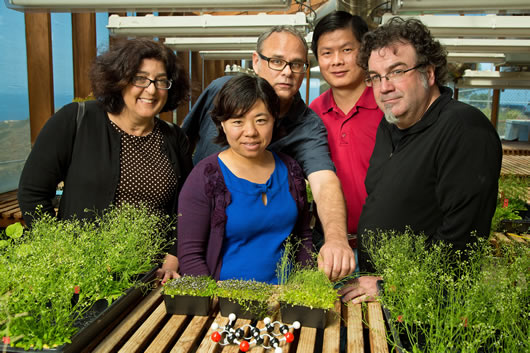
From left: Joanne Chory, Yongxia Guo, Joseph Noel, Zuyu Zheng and James J. La Clair
Imagen: Cortesía del Instituto Salk de Estudios Biológicos
While controlled burns are common today, they weren’t 50 years ago. The U.S. park service actively suppressed forest fires until they realized that the practice left the soil of mature forests lacking important minerals and chemicals. This created an intensely competitive environment that was ultimately detrimental to the entire forest ecosystem.
“When Yellowstone National Park was allowed to burn in 1988, many people felt that it would never be restored to its former beauty,” says James J. La Clair, a researcher from the Department of Chemistry and Biochemistry at the University of California who worked on the project. “But by the following spring, when the rains arrived, there was a burst of flowering plants amid the nutrient-rich ash and charred ground.”
In previous studies, scientists had discovered that special chemicals known as karrikins are created as trees and shrubs burn during a forest fire and remain in the soil after the fire, ensuring the forest will regenerate.
The Salk scientists’ new study sought to uncover exactly how karrikins stimulate new plant growth. First, the researchers determined the structure of a plant protein know as KAI2, which binds to karrikin in dormant seeds. Then, comparing the karrikin-bound KAI2 protein to the structure of an unbound KAI2 protein allowed the researchers to speculate how KAI2 allows a seed to perceive karrikin in its environment.
The chemical structures the team solved revealed all the molecular contacts between karrikin and KAI2, according to Salk research associate Yongxia Guo, a structural enzymologist and one of the study’s lead investigators. “But, more than that,” Gou says, “we also now know that when karrikin binds to the KAI2 protein it causes a change in its shape.”
The studies’ other lead investigator, Salk research associate and plant geneticist Zuyu Zheng, says this karrikin-induced shape change may send a new signal to other proteins in the seeds. “These other protein players,” he says, “together with karrikin and KAI2, generate the signal causing seed germination at the right place and time after a wildfire.”
Guo and Zheng, a married couple working as postdoctoral researchers in the Noel and Chory labs, respectively, came up with the idea for the study while talking over dinner. La Clair then joined the study, contributing his chemistry expertise.
While the new findings were made in Arabidopsis, a model organism that many plant researchers study, the scientists say the same karrikin-KAI2 regeneration strategy is undoubtedly found in many plant species.
“In plants, one member of this family of enzymes has been recruited somehow through natural selection to bind to this molecule in smoke and ash and generate this signal,” says Noel, holder of Salk’s Arthur and Julie Woodrow Chair and a Howard Hughes Medical Institute investigator. “KAI2 likely evolved when plant ecosystems started to flourish on the terrestrial earth and fire became a very important part of ecosystems to free up nutrients locked up in dying and dead plants.”
More research is needed to understand exactly how the change in shape of the KAI2 protein activates a genetic pathway that regulates germination, says Chory, the Howard H. and Maryam R. Newman Chair in Plant Biology and a Howard Hughes Medical Institute investigator. “But this finding is an absolutely critical step in understanding this genetic program and how plant ecosystems, forests and grasslands renew themselves.”
El trabajo contó con el apoyo de la Institutos Nacionales de Salud grants 5R01GM52413 and GM094428, Fundación Nacional de Ciencias awards EEC-0813570 and MCB-0645794 and the Howard Hughes Medical Institute.
Acerca del Instituto Salk de Estudios Biológicos:
El Instituto Salk de Estudios Biológicos es una de las instituciones de investigación básica más destacadas del mundo, donde un cuerpo docente de prestigio internacional investiga cuestiones fundamentales de las ciencias de la vida en un entorno único, colaborativo y creativo. Centrados tanto en el descubrimiento como en la formación de las futuras generaciones de investigadores, los científicos del Salk realizan contribuciones revolucionarias a nuestra comprensión del cáncer, el envejecimiento, el Alzheimer, la diabetes y las enfermedades infecciosas mediante el estudio de la neurociencia, la genética, la biología celular y vegetal, y otras disciplinas relacionadas.
Los logros del cuerpo docente han sido reconocidos con numerosos galardones, entre los que se incluyen premios Nobel y la pertenencia a la Academia Nacional de Ciencias. Fundado en 1960 por el Dr. Jonas Salk, pionero en la vacuna contra la poliomielitis, el Instituto es una organización independiente sin fines de lucro y un hito arquitectónico.
DIARIO
Actas de la Academia Nacional de Ciencias
AUTORES
Yongxia Guo, Zuyu Zheng, James J. La Clair, Joanne Chory and Joseph P. Noel
Oficina de Comunicaciones
Tel.: (858) 453-4100
press@salk.edu