August 8, 2017
LA JOLLA—As part of the National Science Foundation’s funding for new multidisciplinary approaches to neuroscience, Salk Professor Terrence Sejnowski together with the California Institute of Technology will receive over $1 million over 3 years to pursue advanced modeling of the brain.
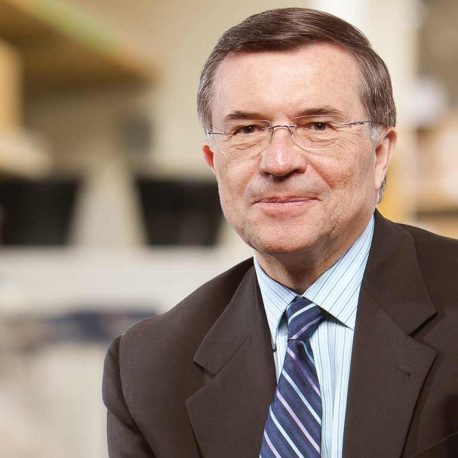
Haga clic aquí para obtener una imagen en alta resolución.
Crédito: Instituto Salk
The NSF awarded a total of $16 million in 19 awards to cross-disciplinary teams from across the United States to conduct innovative research focused on neural and cognitive systems. The awards will contribute to NSF’s investments in support of Understanding the Brain and the BRAIN Initiative, a coordinated research effort that seeks to accelerate the development of new neurotechnologies.
“This generous NSF award will advance the cutting-edge computational neuroscience research the Sejnowski lab is carrying out,” says Salk President Elizabeth Blackburn. “Awards such as these help foster collaborations that will continue to reveal the intricacies of the brain and lead us closer to treatments for devastating brain diseases.”
Sejnowski’s lab uses computer modeling and other techniques to test hypotheses on how brain cells process, sort and store information. By creating and refining computational models on how the brain stores information for different activities, Sejnowski gets a better understanding of what information different cell types encode, what molecules are needed and how signals move throughout the brain. At the same time, his lab learns how diseases such as schizophrenia or Parkinson’s might alter these patterns.
“Our new NSF award will enable us, together with Caltech collaborators, to model the brain as a layered control system operating on a wide range of time scales,” says Sejnowski, who is a Howard Hughes Medical Institute investigator and holder of the Francis Crick chair. “We will test our models on humans with tasks that require fast reflexes and long-range planning, such as riding a mountain bike down a bumpy, twisting trail.”
El new NSF projects leverage advanced research to investigate how neural and cognitive systems interact with education, engineering and computer science, thanks to the support of the NSF Integrative Strategies for Understanding Neural and Cognitive Systems (NCS) program. The NCS program supports innovative, boundary-crossing efforts to push the frontiers of brain science.
“It takes insight and courage to tackle these problems,” said Ken Whang, NSF program director in the Computer and Information Science and Engineering Directorate (CISE). “These teams are combining their expertise to try to forge new paths forward on some of the most complex and important challenges of understanding the brain. They are posing problems in new ways, taking intellectual and technical risks that have huge potential payoff.”
Oficina de Comunicaciones
Tel.: (858) 453-4100
press@salk.edu
El Instituto Salk es un centro de investigación independiente y sin fines de lucro fundado en 1960 por Jonas Salk, creador de la primera vacuna segura y eficaz contra la poliomielitis. La misión del Instituto es impulsar una investigación fundamental, colaborativa y audaz que aborde los retos más acuciantes de la sociedad, entre ellos el cáncer, la enfermedad de Alzheimer y la vulnerabilidad agrícola. Esta ciencia fundamental sustenta todos los esfuerzos traslacionales, generando conocimientos que permiten el desarrollo de nuevos medicamentos e innovaciones en todo el mundo.