April 12, 2023
Salk scientists find mitochondria at dysfunctional synapses fail to meet energetic demand, supplying either too much or too little power and potentially causing age-related cognitive impairment
Salk scientists find mitochondria at dysfunctional synapses fail to meet energetic demand, supplying either too much or too little power and potentially causing age-related cognitive impairment
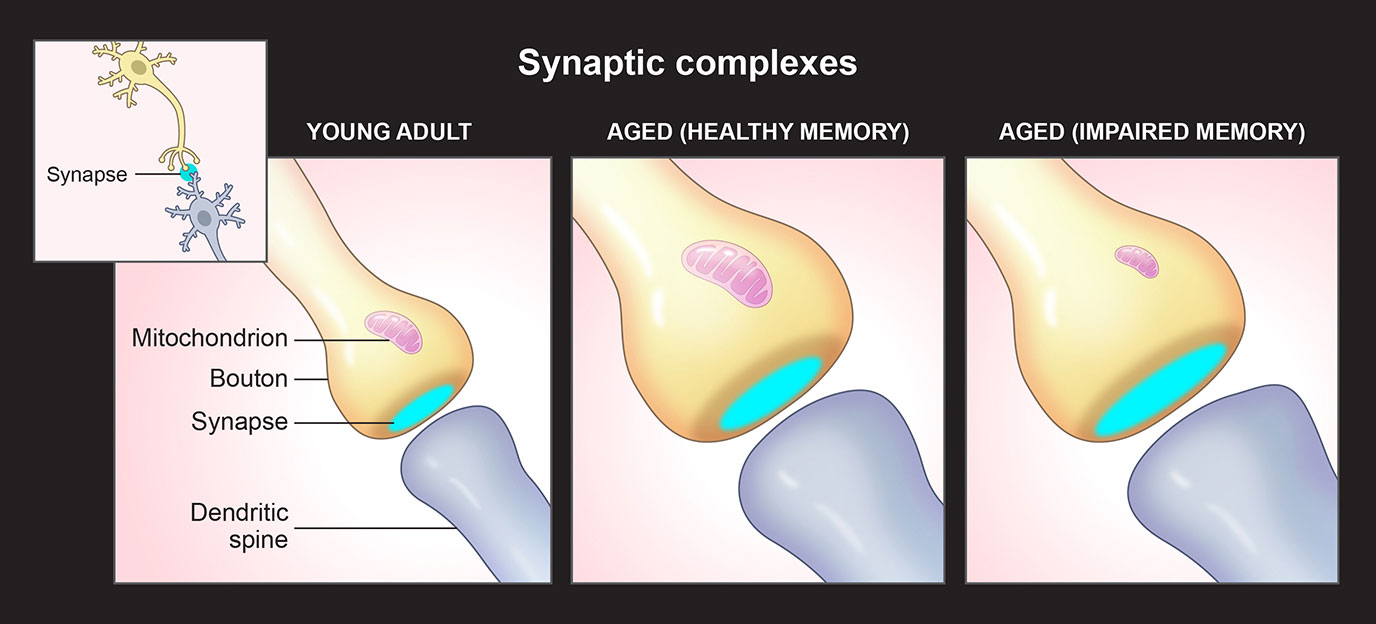
LA JOLLA—Brains are like puzzles, requiring many nested and codependent pieces to function well. The brain is divided into areas, each containing many millions of neurons connected across thousands of synapses. These synapses, which enable communication between neurons, depend on even smaller structures: message-sending boutons (swollen bulbs at the branch-like tips of neurons), message-receiving dendrites (complementary branch-like structures for receiving bouton messages), and power-generating mitochondria. To create a cohesive brain, all these pieces must be accounted for.
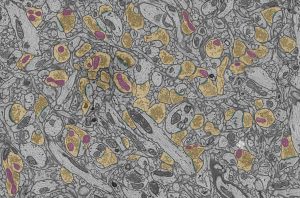
However, in the aging brain, these pieces can get lost or altered and no longer fit in the greater brain puzzle.
“Fifty percent of people experience loss of working memory with old age, meaning their ability to hold and manipulate information in the short-term decreases,” says co-first author Courtney Glavis-Bloom, a senior staff scientist in Salk Institute Professor John Reynolds’ lab. “We set out to understand why some individuals maintain healthy working memory as they age, while others do not. In the process, we discovered a novel mechanism for the synaptic basis of cognitive impairment.”
Prior studies had found that brains lose synapses as they age, and the researchers saw this pattern in their animal model, too. But when they looked at the synapses that remained, they found evidence of a breakdown in coordination between the size of boutons and the mitochondria they contained. A fundamental neuroscientific principle, the ultrastructural size principle, explains that whenever one part of the synaptic complex changes in size, so too must all the other parts. The synapse, the mitochondria, the boutons—all these parts must scale in accordance with one another. Before the Salk team’s study, published in Frontiers in Aging Neuroscience on April 12, 2023, nobody had asked whether this principle could be violated with age or disease.
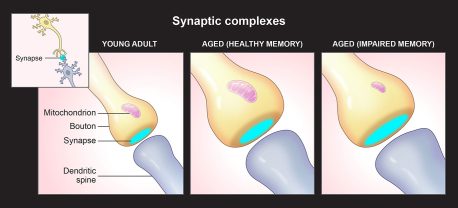
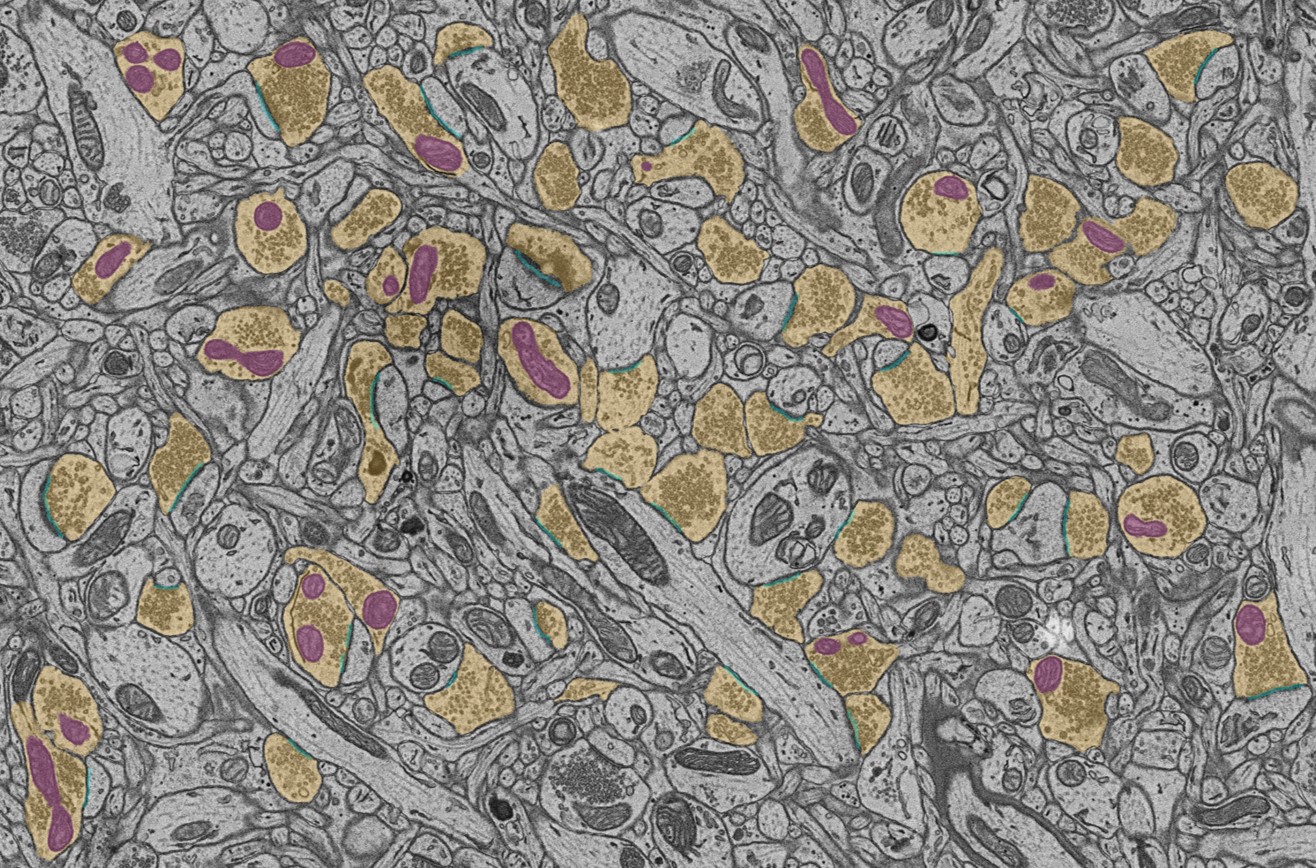
“To examine this, we turned to electron microscopy,” says co-first author Casey Vanderlip, a former research assistant in Reynolds’ lab. “This enabled us to visualize these components across many synapses. We found that synaptic loss occurred with healthy and impaired aging, but what differed was the breakdown in the correlation between the sizes of boutons and their mitochondria.”
“It is a ripple effect, with unfathomably small synaptic structures altering networks of neurons, brain function, and behavior,” says Glavis-Bloom. “Investigating these microscopic dysfunctions is uncharted territory that could revolutionize our understanding of aging and its impact on cognition.”
The team found that adherence to the ultrastructural size principle was essential for avoiding working memory impairment with age. By viewing violation of the ultrastructural size principle and mitochondria-related failures as the key to age-related cognitive impairment, the study ushers in a new era for aging research.
“The images we have captured of synapses are snapshots of a dynamic process,” says Reynolds, holder of the Fiona and Sanjay Jha Chair in Neuroscience. “With these snapshots in hand, we can begin to think first about the mechanisms that coordinate the expansion and contraction of the various parts of the synaptic complex, then ask how disruption of these mechanisms can explain age-related cognitive decline. This opens an entirely new way of thinking about cognitive decline that could lead to new targets for future therapeutics.”
Other authors include Sammy Weiser Novak and Uri Manor of the Salk Institute; and Masaaki Kuwajima, Lyndsey Kirk, and Kristen M. Harris of the University of Texas at Austin.
The work was supported by an Allen Initiative in Brain Health and Cognitive Impairment award made jointly through the American Heart Association and the Paul G. Allen Frontiers Group (19PABH134610000AHA), the National Institutes of Health (1R21AG068967-01, P30014195), the National Science Foundation (2014862), the Kavli Institute for Brain and Mind at UC San Diego (Innovative Research Grant 2021), the Waitt Foundation, the Larry L. Hillblom Foundation, the Don and Lorraine Freeberg Foundation, and the Conrad Prebys Foundation.
DOI: 10.3389/fnagi.2023.1146245
DIARIO
Frontiers in Aging Neuroscience
AUTORES
Courtney Glavis-Bloom, Casey R. Vanderlip, Sammy Weiser Novak, Masaaki Kuwajima, Lyndsey Kirk, Kristen M. Harris, Uri Manor, John H. Reynolds
Oficina de Comunicaciones
Tel.: (858) 453-4100
press@salk.edu
El Instituto Salk es un centro de investigación independiente y sin fines de lucro fundado en 1960 por Jonas Salk, creador de la primera vacuna segura y eficaz contra la poliomielitis. La misión del Instituto es impulsar una investigación fundamental, colaborativa y audaz que aborde los retos más acuciantes de la sociedad, entre ellos el cáncer, la enfermedad de Alzheimer y la vulnerabilidad agrícola. Esta ciencia fundamental sustenta todos los esfuerzos traslacionales, generando conocimientos que permiten el desarrollo de nuevos medicamentos e innovaciones en todo el mundo.