November 8, 2018
Salk scientists find how the enzyme AMPK, largely thought to suppress cancer, actually helps some tumors survive
Salk scientists find how the enzyme AMPK, largely thought to suppress cancer, actually helps some tumors survive
LA JOLLA—Long thought to suppress cancer by slowing cellular metabolism, the protein complex AMPK also seemed to help some tumors grow, confounding researchers. Now, Salk Institute researchers have solved the long-standing mystery around why AMPK can both hinder and help cancer.
The lab of Salk Professor Reuben Shaw showed that late-stage cancers can trigger AMPK’s cellular recycling signal to cannibalize pieces of the cell, supplying large lung tumors with the nutrients they need to grow. The work, which appeared in Metabolismo celular on November 8, 2018, suggests that blocking AMPK in some conditions could stop the growth of advanced tumors in the most common type of lung cancer.
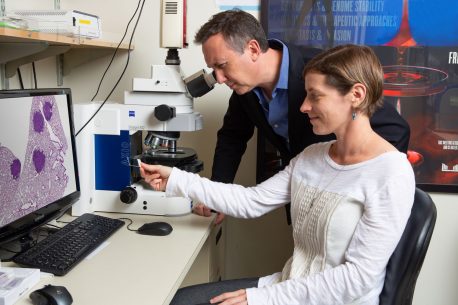
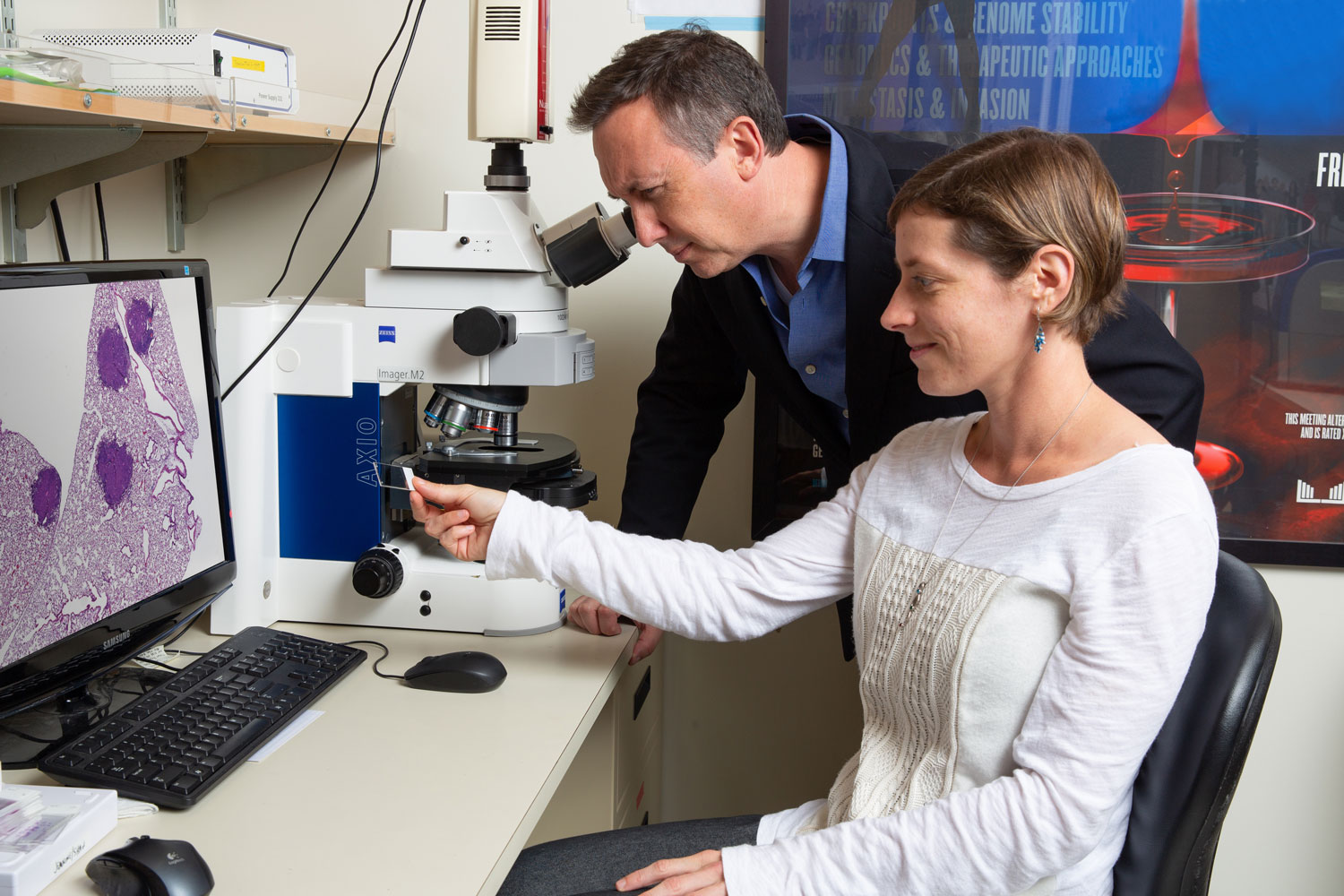
Haga clic aquí para obtener una imagen en alta resolución.
Crédito: Instituto Salk
“Our study shows that the same dysfunction in a genetic circuit that causes non-small-cell lung cancer to begin with is necessary for more mature tumor cells to survive when they don’t have enough nutrients,” says Shaw, director of the Salk Cancer Center and the paper’s co-senior author. “It’s exciting because not only does it solve a genetic ‘whodunnit,’ but it also points to a potential new therapeutic target for a cancer that is often diagnosed very late.”
AMPK acts as a fuel gauge for the cell, overseeing energy input and output to keep the cell running smoothly. Similar to a car sensor flashing a low-gas signal or turning off a vehicle’s AC to save energy, AMPK slows down cell growth and changes the cell’s metabolism if the cell’s fuel (nutrients) is low. Previously, Shaw discovered that AMPK could halt tumors’ revved-up metabolism, as well as restore normal function to the liver and other tissues in diabetics.
But the Shaw lab’s new work suggests that AMPK actually helps large tumors grow. In the current study, the team observed groups of mice with and without the AMPK fuel gauge to see how tumors developed.
“We found that tumors grew much more slowly when AMPK was not present,” says Research Associate Lillian Eichner, the paper’s co-first author. “That means that AMPK is not always functioning as a tumor suppressor, as we originally thought.”
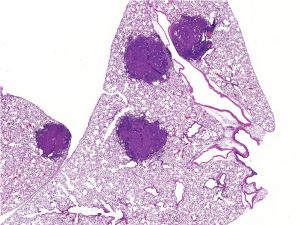
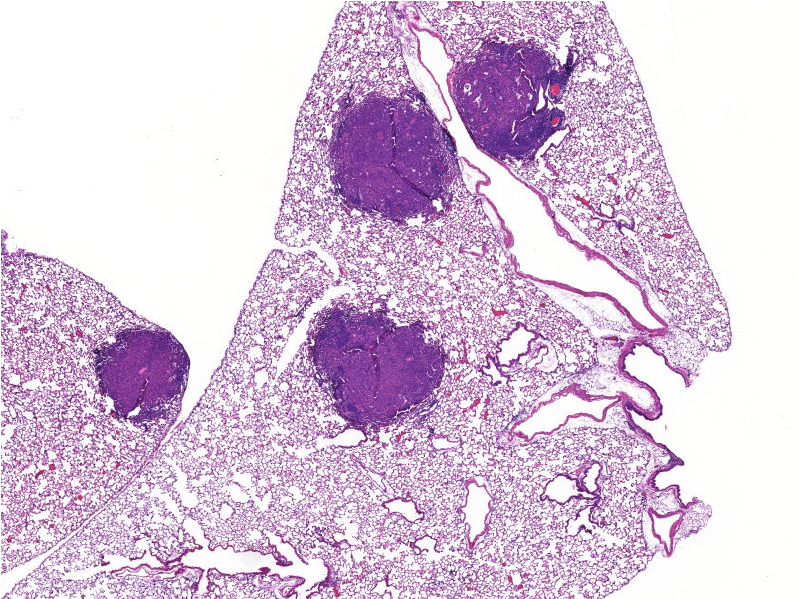
Haga clic aquí para obtener una imagen en alta resolución.
Crédito: Instituto Salk
The team analyzed which genes in tumor cells from the same mouse models were being activated under various conditions. One gene that was particularly active was Tfe3, which is known to activate cellular recycling. It turned out that when tumors became large enough that cells in the middle were too far from easy access to nutrients, AMPK signaled Tfe3 to initiate recycling of cellular materials as nutrients—effectively cannibalizing pieces of the cell—for the tumor to use.
“Previously we were focused on how we could activate AMPK,” says Eichner. “Now that we’ve identified this mechanism, we can shift to how to inhibit it in certain cancers.”
Shaw, who holds the William R. Brody Chair, adds, “We’re excited because more advanced tumors seem to rely on AMPK to survive, and understanding this mechanism means we may be able to treat them.”
Other authors included Sonja N. Brun, Sébastien Herzig, Nathan P. Young, Stephanie D. Curtis, David B. Shackelford, Maxim N. Shokhirev, Mathias Leblanc, Liliana I. Vera, Amanda Hutchins, Debbie S. Ross and Robert U. Svensson, who was the paper’s co-first and co-senior author.
The work was funded by the National Institutes of Health (R35CA220538, P01CA120964), the Samuel Waxman Cancer Research Foundation, The Leona M. and Harry B. Helmsley Charitable Trust (grant #2012-PG- MED002) and the American Cancer Society (ACS#124183-PF-13-023-01-CSM)(PF-15-037-01-DMC).
DIARIO
Metabolismo celular
AUTORES
Lillian J. Eichner, Sonja N. Brun, Sébastien Herzig, Nathan P. Young, Stephanie D. Curtis, David B. Shackelford, Maxim N. Shokhirev, Mathias Leblanc, Liliana I. Vera, Amanda Hutchins, Debbie S. Ross, Reuben J. Shaw and Robert U. Svensson
Oficina de Comunicaciones
Tel.: (858) 453-4100
press@salk.edu
El Instituto Salk es un centro de investigación independiente y sin fines de lucro fundado en 1960 por Jonas Salk, creador de la primera vacuna segura y eficaz contra la poliomielitis. La misión del Instituto es impulsar una investigación fundamental, colaborativa y audaz que aborde los retos más acuciantes de la sociedad, entre ellos el cáncer, la enfermedad de Alzheimer y la vulnerabilidad agrícola. Esta ciencia fundamental sustenta todos los esfuerzos traslacionales, generando conocimientos que permiten el desarrollo de nuevos medicamentos e innovaciones en todo el mundo.