20 de septiembre de 2018
Salk Institute researchers uncover molecular details of a new
genetic engineering tool
Salk Institute researchers uncover molecular details of a new genetic engineering tool
LA JOLLA—En los últimos años, CRISPR-Cas9 ha trascendido el laboratorio y ha llegado a la conciencia pública. Esta herramienta de edición genética promete corregir defectos dentro de células individuales y potencialmente curar o prevenir muchas dolencias humanas. Sin embargo, el sistema Cas9 modifica el ADN, no el ARN, y algunos expertos creen que poder modificar el ARN podría resultar igual de útil.
Now scientists from the Salk Institute are reporting for the first time the detailed molecular structure of CRISPR-Cas13d, a promising enzyme for emerging RNA-editing technology. They were able to visualize the enzyme thanks to cryo-electron microscopy (cryo-EM), a cutting-edge technology that enables researchers to capture the structure of complex molecules in unprecedented detail. The findings were reported September 20, 2018, in the journal Célula.
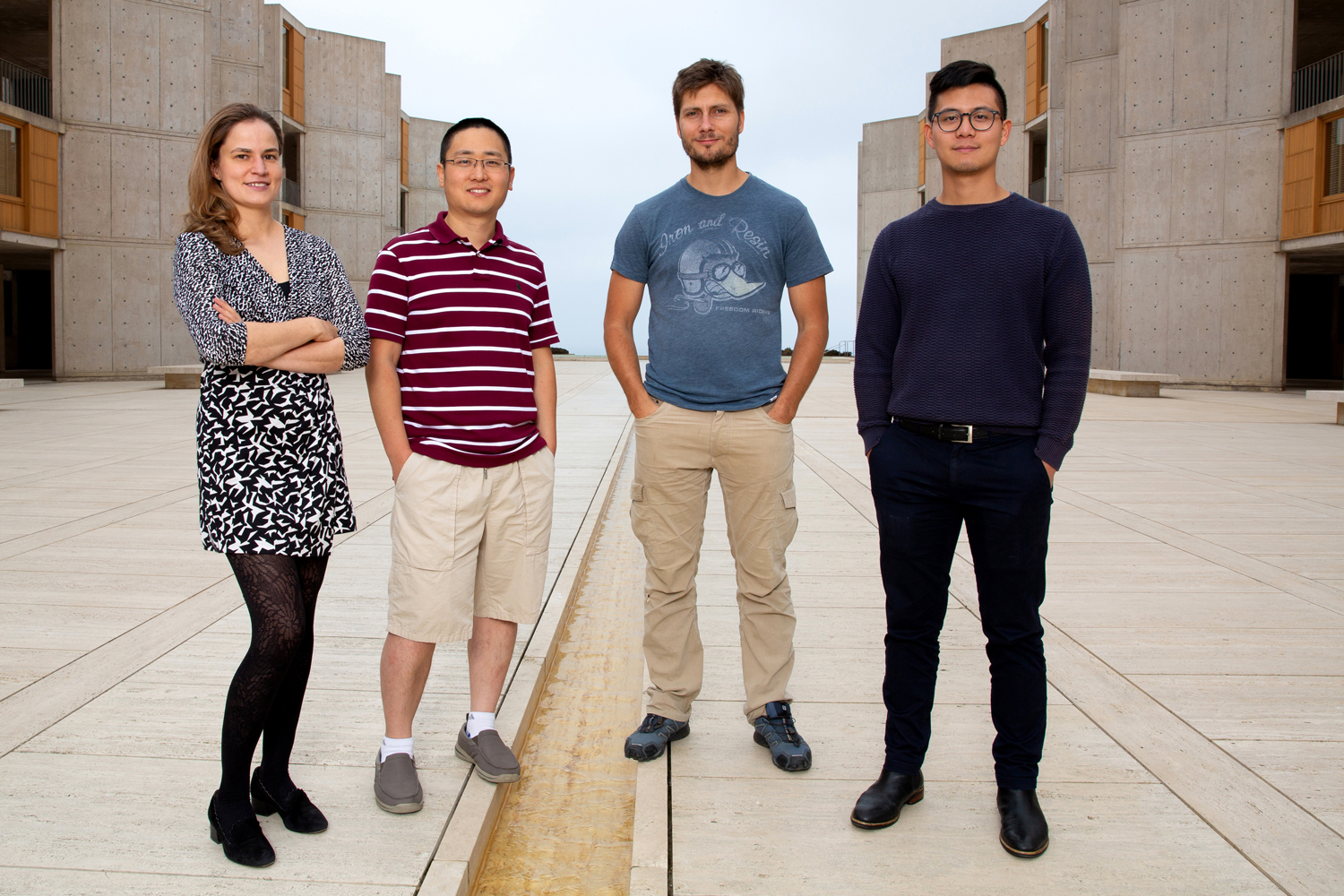
Haga clic aquí para una imagen de alta resolución
Crédito: Instituto Salk
“This paper provides a molecular blueprint for RNA-targeted genetic engineering,” says Salk Assistant Professor Dmitry Lyumkis, a structural biologist and one of the corresponding authors of the study. “It adds to the breadth of tools that are needed for conducting this kind of crucial biomedical research.”
Derived from genes originally found in bacteria, CRISPR has been described as “molecular scissors” or a “word processing program for living cells.” It swaps out one segment of genetic code with another. In the CRISPR-Cas9 system, Cas9 is the enzyme that cuts DNA. Having editing tools for RNA, however, would allow scientists to modify a gene’s activity without making a permanent—and potentially dangerous—change to the gene itself.
“DNA is constant, but what’s always changing are the RNA messages that are copied from the DNA,” says Salk Research Associate Silvana Konermann, a Howard Hughes Medical Institute Hanna Gray Fellow and one of the study’s first authors. “Being able to modulate those messages by directly controlling the RNA has important implications for influencing a cell’s fate.”
Earlier this year, Konermann and Helmsley-Salk Fellow Patrick Hsu published another paper in Célula discovering the family of enzymes called CRISPR-Cas13d and reporting that this alternate CRISPR system was effective in recognizing and cutting RNA. The team also showed this tool could be used to correct a disease-causing protein imbalance in cells from a person with dementia.
The new study, a collaboration between the Lyumkis and Hsu labs, built on the discovery of the Cas13d family and provides the molecular details that explain how it works.
“In our previous paper, we discovered a new CRISPR family that can be used to engineer RNA directly inside of human cells,” says Hsu, who is the other corresponding author of the new work. “Now that we’ve been able to visualize the structure of Cas13d, we can see in more detail how the enzyme is guided to the RNA and how it is able to cut the RNA. These insights are allowing us to improve the system and make the process more effective, paving the way for new strategies to treat RNA-based diseases.”
The team used cryo-EM to reveal new details into Cas13d by freezing the enzyme in different, dynamic states, allowing researchers to decode a range of activities instead of just seeing one activity at a single point in time.
“This enabled us to see how Cas13d guides, binds and targets the RNA,” says Cheng Zhang, a research associate in the Lyumkis lab and the paper’s other first author. “We hope this new knowledge will help expand on the power of gene-editing tools.”
The paper’s other authors were Nicholas J. Brideau and Peter Lotfy of Salk; Xuebing Wu of the Whitehead Institute for Biomedical Research; and Scott J. Novick, Timothy Strutzenberg and Patrick R. Griffin of The Scripps Research Institute.
This work was supported by a Howard Hughes Medical Institute Hannah H. Gray Fellowship; a Helen Hay Whitney Foundation Fellowship; National Institutes of Health grants NIH-NCI CCSG P30 014195, DP5 OD021369, DP5 OD021396 and U54GM103368; and the Helmsley Charitable Trust.
DIARIO
Célula
AUTORES
Cheng Zhang, Silvana Konermann, Nicholas J. Brideau, Peter Lotfy, Xuebing Wu, Scott J. Novick, Timothy Strutzenberg, Patrick R. Griffin, Patrick D. Hsu, Dmitry Lyumkis
Oficina de Comunicaciones
Tel.: (858) 453-4100
press@salk.edu
El Instituto Salk es un centro de investigación independiente y sin fines de lucro fundado en 1960 por Jonas Salk, creador de la primera vacuna segura y eficaz contra la poliomielitis. La misión del Instituto es impulsar una investigación fundamental, colaborativa y audaz que aborde los retos más acuciantes de la sociedad, entre ellos el cáncer, la enfermedad de Alzheimer y la vulnerabilidad agrícola. Esta ciencia fundamental sustenta todos los esfuerzos traslacionales, generando conocimientos que permiten el desarrollo de nuevos medicamentos e innovaciones en todo el mundo.