June 10, 2022
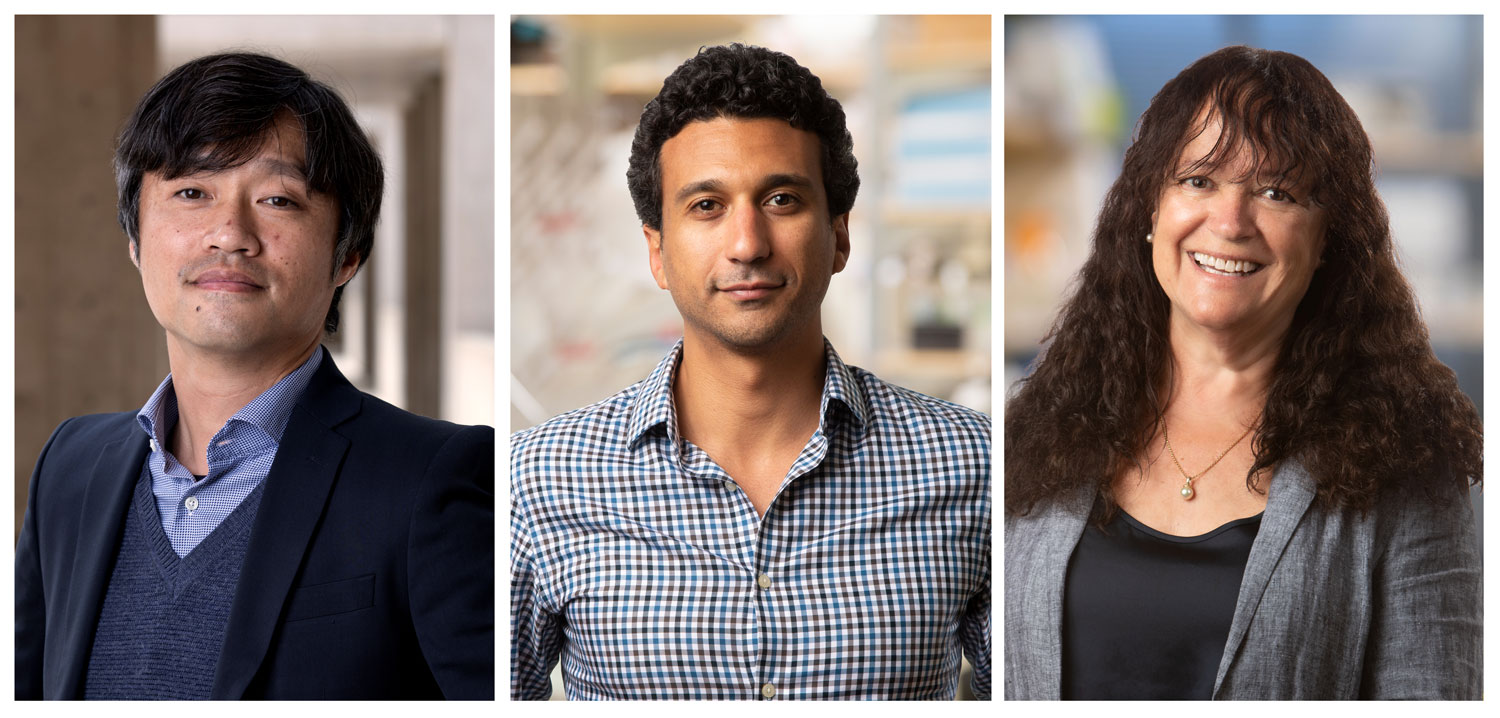
LA JOLLA—Three Salk Institute faculty members have been promoted based on their outstanding scientific contributions. They are leaders who have made original, innovative and notable contributions to neuroscience. Assistant Professors Kenta Asahina und Eiman Azim were promoted to associate professor, and Associate Research Professor Margarita Behrens was promoted to research professor.
“These are well-deserved promotions for an extremely talented group of scientists,” says Salk President Rusty Gage. “Kenta, Eiman and Marga are all innovative leaders in the field of neuroscience and bring a high level of passion and insight to the Salk community. We are elated to support their continued work at Salk.”

Kredit: Salk Institut
Kenta Asahina, holder of the Helen McLoraine Developmental Chair in Neurobiology, conducts research on the genetic and neural basis of social interactions as part of the Molecular Neurobiology Laboratory. To study the basis of animal social behavior, Asahina uses the common fruit fly Drosophila melanogaster as a model organism for understanding the genes and brain cells that cause behavioral responses, such as aggression, escape and courtship. His discoveries include a molecule released from brain cells associated with aggressive behavior in Drosophila. This same molecule was linked to aspects of aggressive behavior in mammalian models, which suggests it may serve as a therapeutic target for alleviating some behavioral symptoms associated with mental and psychiatric disorders.
Eiman Azim, who holds the William Scandling Development Chair, conducts research in the Molecular Neurobiology Laboratory, where he studies how the nervous system guides movement. Understanding how movements are learned, planned, executed and corrected can teach us more about the ways our brains coordinate complex motions such as reaching, grasping and object manipulation. By dissecting the movement pathways one element at a time, Azim aims to pinpoint neural circuits and piece together the underpinnings of skilled motions. Dexterous movements of the arms and hands are critical functions often affected by neurodegenerative disease and injury, and Azim’s work seeks to lay the groundwork for better treatments and recovery of function.
Margarita Behrens is a member of the Computational Neurobiology Laboratory, where she studies brain development and disruption. From birth to adulthood our brains activate or inhibit cells in response to our environments. However, this context-dependent regulatory mechanism may go awry in some individuals as they develop. Behrens focuses on the interplay between our environments and cellular processes to determine why some people develop brain disorders while others do not. She also investigates brain circuit formation and disruption within the regions responsible for planning, reasoning and decision-making. By charting how cells control gene activity and changes that occur during cell maturation, Behrens’ work could lead to a better understanding of neuropsychiatric and neurodevelopmental disorders, such as depression, bipolar disorder, schizophrenia and autism.
Büro für Kommunikation
Telefon: (858) 453-4100
press@salk.edu
Das Salk Institute ist ein unabhängiges, gemeinnütziges Forschungsinstitut, das 1960 von Jonas Salk, dem Entwickler des ersten sicheren und wirksamen Polio-Impfstoffs, gegründet wurde. Die Aufgabe des Instituts besteht darin, grundlegende, kooperative und risikofreudige Forschung voranzutreiben, die sich mit den dringendsten Herausforderungen der Gesellschaft befasst, darunter Krebs, Alzheimer und die Gefährdung der Landwirtschaft. Diese Grundlagenforschung bildet die Basis für alle translationalen Bemühungen und führt zu Erkenntnissen, die neue Medikamente und Innovationen weltweit ermöglichen.