November 18, 2015
Renowned molecular biologist and scientific leader to join Salk
Renowned molecular biologist and scientific leader to join Salk
LA JOLLA—Nobel Prize-winning scientist Elizabeth Blackburn, a pioneering molecular biologist and highly respected leader in the scientific community, has been named president of the Salk Institute for Biological Studies.
Blackburn will join the Salk Institute from the University of California, San Francisco (UCSF), where she is a professor in the Department of Biochemistry and Biophysics. She will assume her new role effective January 1, 2016.
As Salk’s president, Blackburn will take the helm of the Institute’s world-renowned scientific enterprise, leading a cadre of scientists as they push the frontiers of discovery in fields such as cancer, neuroscience, aging and plant biology.
“Few scientists garner the kind of admiration and respect that Dr. Blackburn receives from her peers for her scientific accomplishments and her leadership, service and integrity,” says Irwin M. Jacobs, chairman of Salk’s Board of Trustees. “Her deep insight as a scientist, her vision as a leader, and her warm personality will prove invaluable as she guides the Salk Institute on its continuing journey of discovery.”
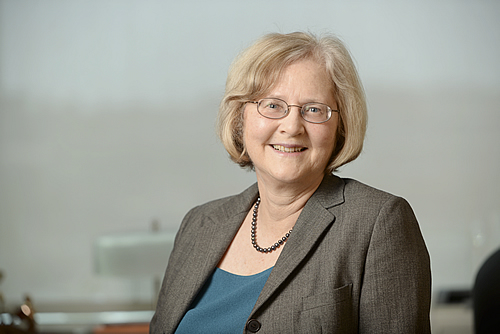
Image credit: Rob Searcey
Blackburn won the Nobel Prize in Physiology or Medicine in 2009 for discovering the molecular nature of telomeres, the ends of chromosomes that serve as protective caps essential for preserving genetic information, and for co-discovering telomerase, an enzyme that maintains telomere ends. Both telomeres and telomerase are thought to play central roles in aging and diseases such as cancer, and her work helped launch entire new fields of research in these areas.
Neben dem Nobelpreis hat Blackburn fast jeden wichtigen Wissenschaftspreis erhalten, darunter die Lasker-, Gruber- und Gairdner-Preise. Sie wurde 2007 in die TIME 100 aufgenommen, die jährliche Liste des Magazins der einflussreichsten Persönlichkeiten der Welt. Sie ist Mitglied zahlreicher renommierter wissenschaftlicher Gesellschaften, darunter die National Academy of Sciences, die National Academy of Medicine und die Royal Society of London.
Blackburn has shown an abiding commitment to public service in the scientific, academic and public policy arenas. She has served as president of both the American Association of Cancer Research and the American Society for Cell Biology, and has served on the editorial boards of several scientific journals, including the influential journals Cell and Science.
Zur Steuerung der öffentlichen Wissenschaftspolitik war sie Mitglied des Stem Cell Research Advisory Panel für die Legislative des Staates Kalifornien und Mitglied des President’s Council of Bioethics, eines beratenden Ausschusses für den Präsidenten der Vereinigten Staaten.
Blackburn’s tenure as Salk’s president will begin on January 1, 2016. However, she is no stranger to the Institute. Since 2001, she has served as a Salk nonresident fellow, one of a group of leading scientists that advise the Institute’s leadership and play key decision-making roles in the appointment and promotion of Salk professors.
“I am truly honored to be asked to be the next president of the Salk Institute. The Salk is full of absolutely terrific people and brimming with great science. Building on its distinguished history and current success, I am delighted to be playing a role in continuing and growing its major contributions to science and health research,” says Blackburn.
Blackburn wurde in der kleinen Stadt Hobart in Tasmanien, Australien, in eine Familie von Ärzten und Wissenschaftlern geboren. Ihre Eltern waren beide Hausärzte und ihr Großvater und Urgroßvater waren Geologen. Inspiriert von ihrer Faszination für Tiere und einer Biografie der ikonischen französischen Wissenschaftlerin Marie Curie, entschied sich Blackburn, ebenfalls eine wissenschaftliche Karriere einzuschlagen.
Sie erwarb ihren Bachelor- und Masterabschluss in Biochemie an der Universität Melbourne und promovierte 1975 in Molekularbiologie an der University of Cambridge in England. Von 1975 bis 1977 absolvierte sie ein Postdoc-Studium an der Yale University.
Blackburn trat 1978 in die Fakultät der University of California, Berkeley ein. 1990 wechselte sie an die University of California, San Francisco und leitete von 1993 bis 1999 die Abteilung für Mikrobiologie und Immunologie.
Büro für Kommunikation
Telefon: (858) 453-4100
press@salk.edu
Das Salk Institute ist ein unabhängiges, gemeinnütziges Forschungsinstitut, das 1960 von Jonas Salk, dem Entwickler des ersten sicheren und wirksamen Polio-Impfstoffs, gegründet wurde. Die Aufgabe des Instituts besteht darin, grundlegende, kooperative und risikofreudige Forschung voranzutreiben, die sich mit den dringendsten Herausforderungen der Gesellschaft befasst, darunter Krebs, Alzheimer und die Gefährdung der Landwirtschaft. Diese Grundlagenforschung bildet die Basis für alle translationalen Bemühungen und führt zu Erkenntnissen, die neue Medikamente und Innovationen weltweit ermöglichen.