July 16, 2012
Protocol may open new avenues for cell-replacement therapies for neurological conditions
Protocol may open new avenues for cell-replacement therapies for neurological conditions
LA JOLLA, CA—For more than 20 years, doctors have been using cells from blood that remains in the placenta and umbilical cord after childbirth to treat a variety of illnesses, from cancer and immune disorders to blood and metabolic diseases.
Now, scientists at the Salk Institute for Biological Studies have found a new way-using a single protein, known as a transcription factor-to convert cord blood (CB) cells into neuron-like cells that may prove valuable for the treatment of a wide range of neurological conditions, including stroke, traumatic brain injury and spinal cord injury.
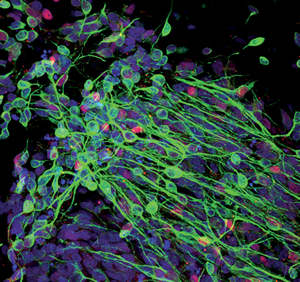
This microscope image shows a colony of neurons derived from cord-blood cells using stem cell reprogramming technology. The green and red glow indicates that the cells are producing protein makers found in neurons, evidence that the cord-blood cells did in fact morph into neurons. The blue glow marks the nuclei of the neurons.
Image: Courtesy of Alessandra Giorgetti
The researchers demonstrated that these CB cells, which come from the mesoderm, the middle layer of embryonic germ cells, can be switched to ectodermal cells, outer layer cells from which brain, spinal and nerve cells arise. “This study shows for the first time the direct conversion of a pure population of human cord blood cells into cells of neuronal lineage by the forced expression of a single transcription factor,” says Juan Carlos Izpisua Belmonte, a professor in Salk’s Genexpressionslabor, who led the research team. The study, a collaboration with Fred H. Gage, a professor in Salk’s Laboratorium für Genetik, and his team, was published on July 16 in the Verhandlungen der Nationalen Akademie der Wissenschaften.
“Unlike previous studies, where multiple transcription factors were necessary to convert skin cells into neurons, our method requires only one transcription factor to convert CB cells into functional neurons,” says Gage.
The Salk researchers used a retrovirus to introduce Sox2, a transcription factor that acts as a switch in neuronal development, into CB cells. After culturing them in the laboratory, they discovered colonies of cells expressing neuronal markers. Using a variety of tests, they determined that the new cells, called induced neuronal-like cells (iNC), could transmit electrical impulses, signaling that the cells were mature and functional neurons. Additionally, they transferred the Sox2-infused CB cells to a mouse brain and found that they integrated into the existing mouse neuronal network and were capable of transmitting electrical signals like mature functional neurons.
“We also show that the CB-derived neuronal cells can be expanded under certain conditions and still retain the ability to differentiate into more mature neurons both in the lab and in a mouse brain,” says Mo Li, a scientist in Belmonte’s lab and a co-first author on the paper with Alessandra Giorgetti, of the Center for Regenerative Medicine, in Barcelona, and Carol Marchetto of Gage’s lab. “Although the cells we developed were not for a specific lineage-for example, motor neurons or mid-brain neurons-we hope to generate clinically relevant neuronal subtypes in the future.”
Importantly, says Marchetto, “We could use these cells in the future for modeling neurological diseases such as autism, schizophrenia, Parkinson’s or Alzheimer’s disease.”
Cord blood cells, says Giorgetti, offer a number of advantages over other types of stem cells. First, they are not embryonic stem cells and thus they are not controversial. They are more plastic, or flexible, than adult stem cells from sources like bone marrow, which may make them easier to convert into specific cell lineages. The collection of CB cells is safe and painless and poses no risk to the donor, and they can be stored in blood banks for later use.
“If our protocol is developed into a clinical application, it could aid in future cell-replacement therapies,” says Li. “You could search all the cord blood banks in the country to look for a suitable match.”
Other researchers on the study were Diana Yu, Yangling Mu, Cedric Bardy and Guang-Hui Liu, from the Salk Institute; and Rafaella Fazzina, Antonio Adamo, Ida Paramonov, Julio Castaño Cardoso, Montserrat Barragan Monasterio and Riccardo Cassiani-Ingoni of the Center for Regenerative Medicine in Barcelona.
The work was supported by the California Institute for Regenerative Medicine, The Lookout Foundation, the G. Harold and Leila Y. Mathers Charitable Foundation, der Die gemeinnützige Stiftung von Leona M. und Harry B. Helmsley, the JPB Medical Foundation, MINECO, Fundacion Cellex and Sanofi.
Über das Salk Institute for Biological Studies:
Das Salk Institute for Biological Studies ist eine der weltweit führenden Institutionen für Grundlagenforschung, an der international renommierte Fakultätsmitglieder grundlegende Fragen der Biowissenschaften in einem einzigartigen, kollaborativen und kreativen Umfeld untersuchen. Mit dem Fokus auf Entdeckungen und die Ausbildung zukünftiger Forschergenerationen leisten Salk-Wissenschaftler bahnbrechende Beiträge zu unserem Verständnis von Krebs, Alterung, Alzheimer, Diabetes und Infektionskrankheiten durch die Untersuchung von Neurowissenschaften, Genetik, Zell- und Pflanzenbiologie sowie verwandten Disziplinen.
Die Leistungen der Fakultät wurden mit zahlreichen Auszeichnungen gewürdigt, darunter Nobelpreise und Mitgliedschaften in der National Academy of Sciences. Das 1960 vom Polio-Impfstoff-Pionier Dr. Jonas Salk gegründete Institut ist eine unabhängige gemeinnützige Organisation und ein architektonisches Wahrzeichen.
JOURNAL
Verhandlungen der Nationalen Akademie der Wissenschaften
AUTOREN
Alessandra Giorgetti, Maria Carolina Marchetto, Mo Li, Diana Yu, Raffaella Fazzina, Yangling Mu, Antonio Adamo, Ida Paramonov, Julio Castaño Cardoso, Montserrat Barragan Monasterio, Cedric Bardy, Riccardo Cassiani-Ingoni, Guang-Hui Liu, Fred H. Gage and Juan Carlos Izpisua Belmonte
Büro für Kommunikation
Telefon: (858) 453-4100
press@salk.edu