August 25, 2021
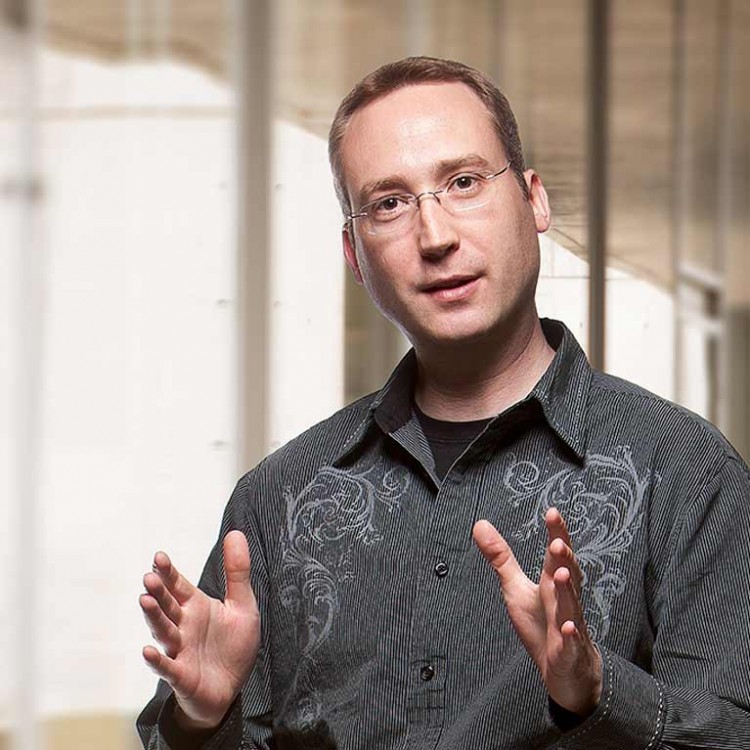
LA JOLLA—Salk Associate Professor Axel Nimmerjahn is leading a research team that has been awarded $11.2 million by The Brain Research through Advancing Innovative Neurotechnologies (BRAIN) Initiative, an effort that aims to investigate overarching principles of brain circuit function, including sensation, perception, decision-making and motor control. Nimmerjahn will lead an interdisciplinary five-year project investigating how astrocytes, star-shaped cells in the brain, process and modulate signals from neurons to better understand overall brain function.
“In the brain, about half of the cells are not neurons. Non-neural cells traditionally have not been thought to play an important role in information processing, but this notion is starting to crumble.” says Nimmerjahn, director of Salk’s Biophotonics Center. “Think of the brain as a symphony. While some players (neurons) may stand out because of their unique abilities (fast electrical signals), it takes the entire orchestra to play the composition. If one player is out of tune, the entire orchestra may sound off. Non-neural cells don’t just support neurons. They enable or enhance their abilities. When non-neural cells malfunction, brain operation and behavior may be impaired, as is the case in neurodegenerative and infectious diseases.”
The project will focus on astrocytes, one of the most abundant non-neuronal cell types in the brain. Over the past two decades, studies have indicated that astrocytes play crucial roles in nervous system development and disease. However, how these cells interact with neurons in the healthy adult brain is much less understood.
At Salk, Nimmerjahn has developed new microscopy techniques to visualize the structural and functional dynamics of neural and non-neural cells, cell-type-specific staining and large-scale data analysis tools. Using these technologies, he and his collaborators address long-standing questions regarding the role of non-neural cells in the healthy or diseased human central nervous system to protect or restore its function. Nimmerjahn will employ his and other cutting-edge techniques to study neuron-astrocyte communication in this interdisciplinary project.
“Axel’s research in understanding the role of non-neural cells has continually provided an informative lens on the way we understand brain function,” says Salk President and Professor Rusty Gage. “We’re excited to see his collaborations beyond Salk, and very pleased that the BRAIN Circuit program will be funding this important work.”
Other researchers on the team include Associate Professor Lin Tian from UC Davis, Associate Professor Cagla Eroglu from Duke University, and Associate Professor Guoqian Yu from Virginia Tech.
Büro für Kommunikation
Telefon: (858) 453-4100
press@salk.edu
Das Salk Institute ist ein unabhängiges, gemeinnütziges Forschungsinstitut, das 1960 von Jonas Salk, dem Entwickler des ersten sicheren und wirksamen Polio-Impfstoffs, gegründet wurde. Die Aufgabe des Instituts besteht darin, grundlegende, kooperative und risikofreudige Forschung voranzutreiben, die sich mit den dringendsten Herausforderungen der Gesellschaft befasst, darunter Krebs, Alzheimer und die Gefährdung der Landwirtschaft. Diese Grundlagenforschung bildet die Basis für alle translationalen Bemühungen und führt zu Erkenntnissen, die neue Medikamente und Innovationen weltweit ermöglichen.