
February 3, 2011
Stem cell based treatment to focus on Parkinson's disease
Stem cell based treatment to focus on Parkinson's disease
LA JOLLA, CA—The Salk Institute has been awarded a $2.3 million grant by the California Institute for Regenerative Medicine (CIRM) for translational research focusing on developing a novel stem cell based therapy for Parkinson’s disease.
The research will concentrate on studying human induced pluripotent stem (iPS) cells derived from patients suffering from Parkinson’s disease to replicate the disorder in the lab and investigate the role of inflammation in the cause and progression of the neurodegeneration typical of the disease.
Led by Fred H. Gage, Ph.D., a professor in the Salk’s Laboratory of Genetics and holder of the Vi and John Adler Chair for Research on Age-Related Neurodegenerative Diseases, the grant will fund a joint effort between Salk researchers, the team of Christopher Glass, Ph.D., a professor of Medicine and Cellular and Molecular Medicine at the University of California, San Diego, and international collaborators in Germany.
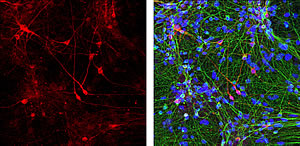
These images show dopaminergic neurons, the cell type implicated in Parkinson’s Disease, differentiated from human pluripotent stem cells.
Image: Courtesy of Leah Boyer, Salk Institute for Biological Studies
Parkinson’s disease is a chronic, progressive neurological disease that usually occurs later in life and is linked to decreased dopamine production, the chemical messenger involved in communication between the brain and the muscles. The most common neurodegenerative movement disorder, Parkinson’s disease is characterized by motor impairment such as slowness of movements, shaking and gait disturbances.
“Given that age is the most consistent risk factor for Parkinson’s, and we have an aging population, it is of utmost importance that we unravel the cellular, molecular, and genetic causes of the highly specific cell death characteristic of the disease and find new therapies to limit the social, economic and emotional impact,” said Gage.
Most studies to find better drugs to treat Parkinson’s disease were done with mice and often failed when tested in patients. In the past, scientists had been limited to study the brains of people with Parkinson’s disease via imaging technologies or postmortem brain tissues. Now, the ability to obtain iPS cells from patients’ skin cells, which can be reprogrammed into neurons provides researchers with a model to study the pathological development of Parkinson’s in a human system.
The main goal of the collaborative effort is to identify key molecular events involved in the early stages of the disease, which can be exploited as potential points of therapeutic intervention.
“This is an extremely exciting development – the ability to create stem cells from skin cells taken from patients with Parkinson’s disease, then use those stem cells to create networks of neurons which can then be studied to give clues about the abnormal function of nerve cells in this debilitating disease – that would never have been conceived, let alone come to fruition, without the significant investment in regenerative medicine by CIRM,” said Salk president William R. Brody, M.D., Ph.D.
Acerca del Instituto Salk de Estudios Biológicos:
El Instituto Salk de Estudios Biológicos es una de las instituciones de investigación básica más destacadas del mundo, donde un cuerpo docente de prestigio internacional investiga cuestiones fundamentales de las ciencias de la vida en un entorno único, colaborativo y creativo. Centrados tanto en el descubrimiento como en la formación de las futuras generaciones de investigadores, los científicos del Salk realizan contribuciones revolucionarias a nuestra comprensión del cáncer, el envejecimiento, el Alzheimer, la diabetes y las enfermedades infecciosas mediante el estudio de la neurociencia, la genética, la biología celular y vegetal, y otras disciplinas relacionadas.
Los logros del cuerpo docente han sido reconocidos con numerosos galardones, entre los que se incluyen premios Nobel y la pertenencia a la Academia Nacional de Ciencias. Fundado en 1960 por el Dr. Jonas Salk, pionero en la vacuna contra la poliomielitis, el Instituto es una organización independiente sin fines de lucro y un hito arquitectónico.
Oficina de Comunicaciones
Tel.: (858) 453-4100
press@salk.edu




