November 19, 2015
The ability to turn human skin cells into neurons that produce serotonin will be a boon for researchers
The ability to turn human skin cells into neurons that produce serotonin will be a boon for researchers
LA JOLLA—Scientists at the Salk Institute have taken human skin cells and turned them into neurons that signal to one another using serotonin, a brain chemical that is crucial to our mental well-being.
Although serotonin neurons comprise only a small fraction of the brain’s cells, these neurons are tied to debilitating disorders such as major depression, schizophrenia and autism. Depression is commonly treated using selective serotonin reuptake inhibitors, which heighten serotonin signaling in the small gaps between neighboring neurons.
Described October 27, 2015 in Molecular Psychiatry, the method gives researchers a new lens with which to study serotonin’s mechanisms and how they may go awry in mental illness.
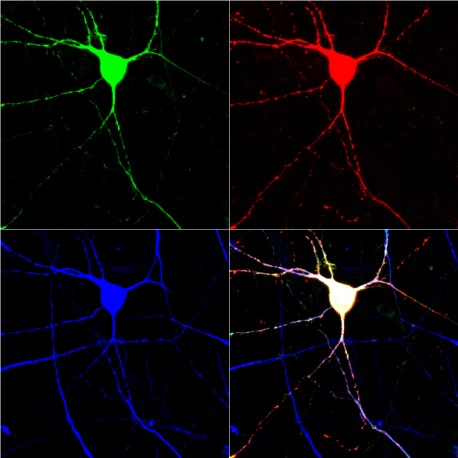
Haga clic aquí para obtener una imagen en alta resolución.
Image: Krishna Vadodaria/Salk Institute
“We can finally start asking questions about cells from people affected by depression and other disorders,” says Salk Professor Rusty Gage, the study’s senior investigator.
Scientists have long been producing specialized types of human cells for study in culture dishes. For nearly a decade, for example, it has been possible to transform the cells of specific tissues, converting them into pluripotent stem cells (iPS) and, in turn, prompting them to develop into other types of cells, including neurons. Although more recent methods have turned skin cells directly into neurons, those neurons use a different brain chemical, glutamate.
In the new study, the Salk team isolated the minority population of serotonin neurons that were differentiated from stem cells and asked what unique genes were activated in these cells. The researchers then found a cocktail of six gene-activating proteins that worked to direct differentiation to serotonergic neurons directly from human fibroblasts.
“When I looked into the microscope and saw serotonin positive neurons, it was really exciting and the moment when I said, ‘Wow, we’ve got serotonergic neurons!’” says the study’s lead author Krishna Vadodaria, a research associate in the Gage laboratory. “While these neurons may not be identical to the brain’s serotonergic neurons, the iSNs have functional properties of neurons, produce serotonin and respond to antidepressants in the dish, which will help us more accurately study serotonergic neurotransmission in neuropsychiatric disorders.”
Other authors on the study include Jerome Mertens, Apua Paquola, Cedric Bardy, Xinyi Li, Roberto Jappelli, Lianna Fung, Carol Marchetto, Michael Hamm and Mark Gorris, all of the Salk Institute; and Philipp Koch of the University of Bonn in Germany.
This study was supported by the Swiss National Science Foundation (SNSF), the
Glenn Center for Aging Research, the FP7 Marie Curie, Lynn and Edward Streim, the Robert and Mary Jane Engman Foundation, the JPB Foundation, y el Fundación Benéfica Leona M. y Harry B. Helmsley.
DIARIO
Molecular Psychiatry
AUTORES
KC Vadodaria, J Mertens, A Paquola, C Bardy, X Li, R Jappelli, L Fung1, MC Marchetto, M Hamm, M Gorris, P Koch and FH Gage
Oficina de Comunicaciones
Tel.: (858) 453-4100
press@salk.edu
El Instituto Salk es un centro de investigación independiente y sin fines de lucro fundado en 1960 por Jonas Salk, creador de la primera vacuna segura y eficaz contra la poliomielitis. La misión del Instituto es impulsar una investigación fundamental, colaborativa y audaz que aborde los retos más acuciantes de la sociedad, entre ellos el cáncer, la enfermedad de Alzheimer y la vulnerabilidad agrícola. Esta ciencia fundamental sustenta todos los esfuerzos traslacionales, generando conocimientos que permiten el desarrollo de nuevos medicamentos e innovaciones en todo el mundo.