11 de julio de 2023
Salk scientists discover dopamine regulates worm egg-laying and food-seeking behaviors in response to predation
Salk scientists discover dopamine regulates worm egg-laying and food-seeking behaviors in response to predation
LA JOLLA—La vida del pequeño gusano llamado Caenorhabditis elegans consiste principalmente en buscar comida, comer comida y poner huevos. Por lo tanto, cuando cualquiera de estos comportamientos se interrumpe, hay motivos de preocupación. En un nuevo estudio, científicos del Instituto Salk descubrieron que el químico cerebral de “bienestar” dopamina regula el comportamiento ansioso de los gusanos en presencia de depredadores que mordisquean.
Los hallazgos, publicados en eLife on July 11, 2023, illuminate how this dopamine-regulated brain pathway may be related to anxiety and could provide insight into human conditions, such as post-traumatic stress disorder (PTSD).
“Worms are a wonderful model for studying anxiety because the cause of their anxiety is typically known, like predation,” says Professor Sreekanth Chalasani, senior author of the new work. “Thus, we can use worms to better understand fundamental neural pathways related to anxiety and stress responses that could be conserved across species.”
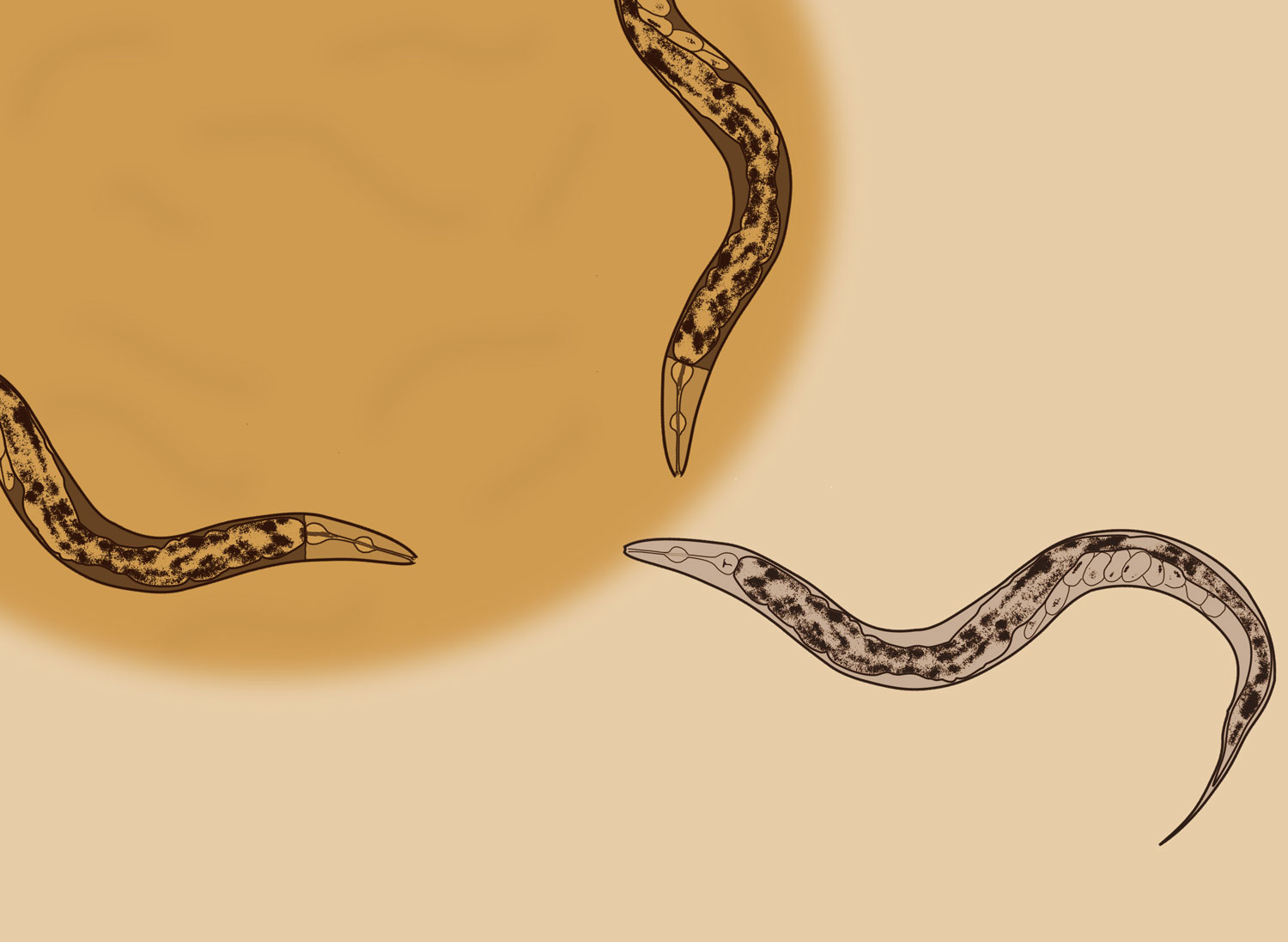
In this study, the researchers observed what happened when a predator worm species (Pristionchus pacificus) nipped at the worms, discouraging the worms from eating the food source. In response, the worms moved away from the food source, and the predators were able to eat more. Additionally, the worms also laid their eggs away from the old food source and the threat of predation.
The researchers noticed that the worms would stay away even after the predators had left—indicating the worms were learning that it was safer to stay away. Furthermore, the behavior of laying the eggs far away from predators was regulated by dopamine. But when the researchers blocked dopamine pathways in the worms, they did not avoid predators as frequently to lay their eggs.
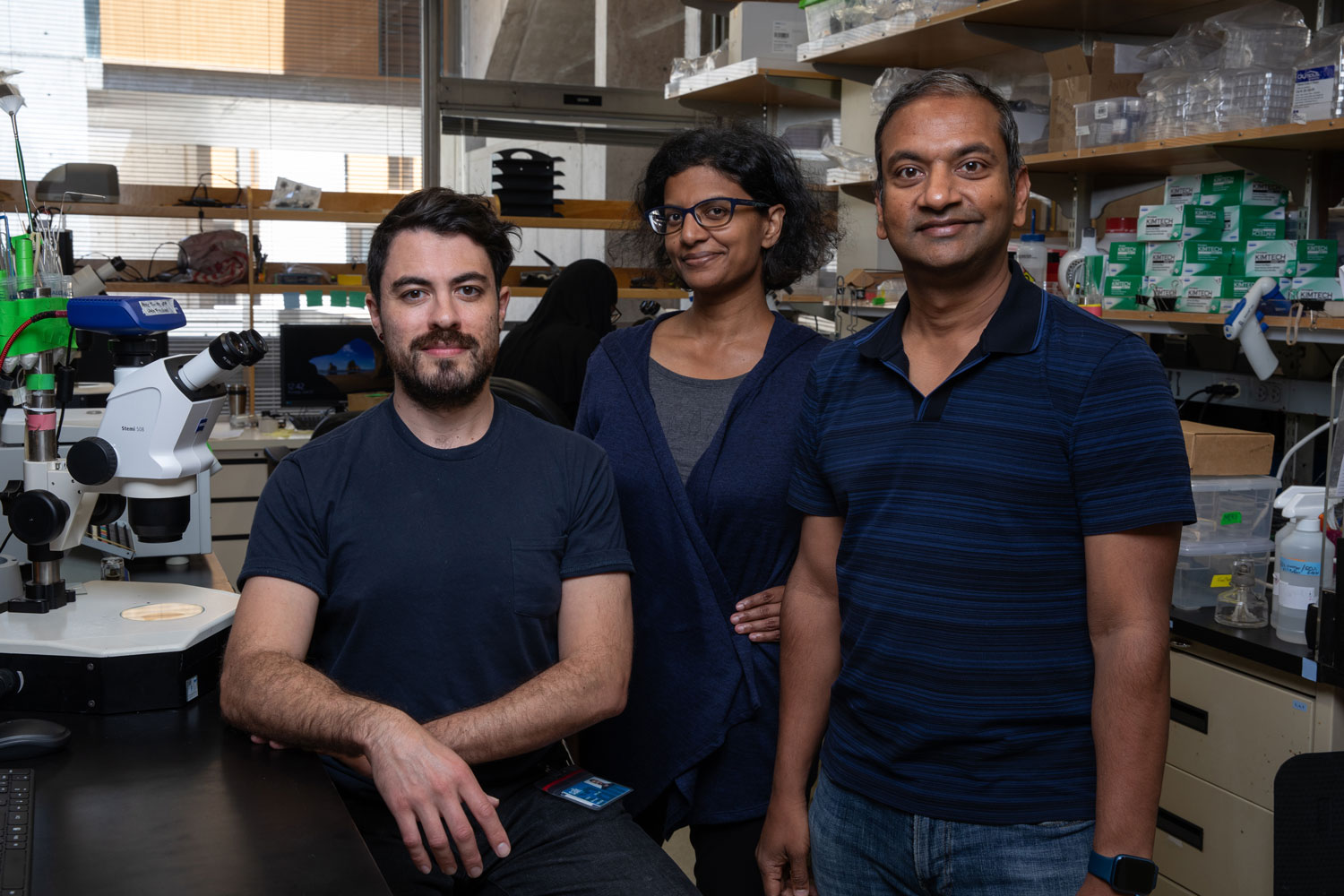
“To understand how the brain works, it is important to study it in its natural context,” says co-first author Amy Pribadi, a former graduate student researcher in Chalasani’s lab. “To do that, we can use a simple worm with an easily constructed natural environment, then look at how that worm’s brain networks and molecules modulate behavior in that ‘natural’ environment.”
Additionally, the researchers explored how the presence of smaller patches of food away from the main food source impacted worm-predator interactions. While predators were busy monopolizing a main food source, the presence of alternate (albeit smaller) food sources elsewhere made the worms more likely to avoid predators.

“Worms make decisions based on environmental changes similar to more complex animals and humans,” says co-first author Michael Rieger, a postdoctoral researcher in Chalasani’s lab. “Difficulty adapting to change—especially due to threat or stress—is common in humans, especially those with neurological disorders. Our research in this simple organism reveals new avenues for exploring the neuroscience of decision-making, which we hope can generalize all the way up the food chain to humans.”
In the future, the team will examine the role of another brain chemical called serotonin in this evasive behavior, since serotonin is known to regulate other dopamine-dependent behaviors, like searching for food. They also hope their study serves as a springboard for future inquiry into the impact of other brain signaling pathways that influence feeding, reproduction, and other behaviors.
“By looking at worms, you capture so much intricate biology in an animal that has evolved over billions of years,” says Chalasani. “Any insight—even in worms—into the mechanisms of predator-prey behaviors enriches our understanding of so many other phenomena that exhibit this biological push-pull relationship, like the co-evolution of animals and their environment or the delicate balance of chemical conversations between cells.”
Other authors include Kaila Rosales and Kirthi C. Reddy of Salk.
The work was supported by a National Science Foundation Graduate Research Fellowship, an Innovation Grant from Kavli Institute of Brain and Mind, and the National Institutes of Health (R01 MH113905).
DOI: https://doi.org/10.7554/eLife.83957
DIARIO
eLife
TÍTULO
Dopamine signaling regulates predator-driven changes in Caenorhabditis elegans’ egg laying behavior
AUTORES
Amy Pribadi, Michael A. Rieger, Kaila Rosales, Kirthi C. Reddy, and Sreekanth H. Chalasani
Oficina de Comunicaciones
Tel.: (858) 453-4100
press@salk.edu
El Instituto Salk es un centro de investigación independiente y sin fines de lucro fundado en 1960 por Jonas Salk, creador de la primera vacuna segura y eficaz contra la poliomielitis. La misión del Instituto es impulsar una investigación fundamental, colaborativa y audaz que aborde los retos más acuciantes de la sociedad, entre ellos el cáncer, la enfermedad de Alzheimer y la vulnerabilidad agrícola. Esta ciencia fundamental sustenta todos los esfuerzos traslacionales, generando conocimientos que permiten el desarrollo de nuevos medicamentos e innovaciones en todo el mundo.