November 2, 2016
Salk scientists identify the cell nucleus as a driver of gene expression and, sometimes, disease
Salk scientists identify the cell nucleus as a driver of gene expression and, sometimes, disease
LA JOLLA—We put things into a container to keep them organized and safe. In cells, the nucleus has a similar role: keeping DNA protected and intact within an enveloping membrane. But a new study by Salk Institute scientists, detailed in the November 2 issue of Genes & Development, reveals that this cellular container acts on its contents to influence gene expression.
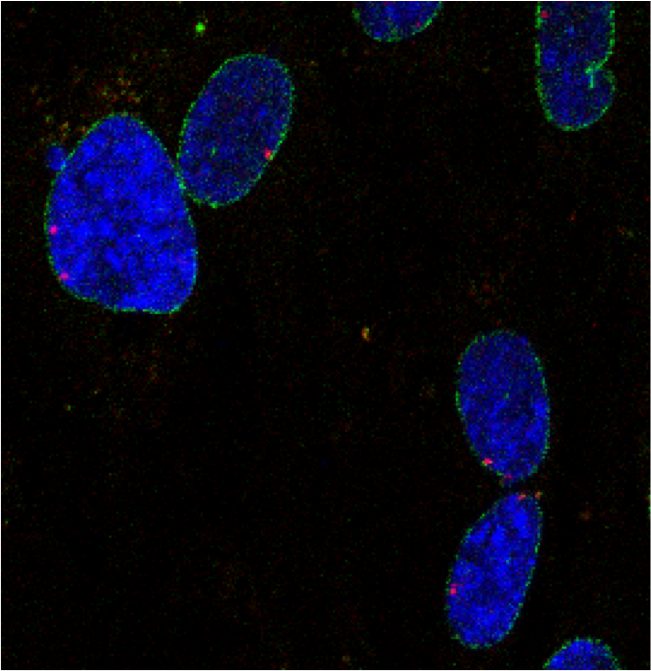
Haga clic aquí for a high-resolution image
Crédito: Instituto Salk
“Our research shows that, far from being a passive enclosure as many biologists have thought, the nuclear membrane is an active regulatory structure,” says Salk Professor Martín Hetzer, who is also holder of the Jesse and Caryl Philips Foundation chair. “Not only does it interact with portions of the genome to drive gene expression, but it can also contribute to disease processes when components are faulty.”
Using a suite of molecular biology technologies, the Salk team discovered that two proteins, which sit in the nuclear envelope, together with the membrane-spanning complexes they form, actively associate with stretches of DNA to trigger expression of key genes. Better understanding these higher-level functions could provide insight into diseases that appear to be related to dysfunctional nuclear membrane components, such as leukemia, heart disease and aging disorders.
Historically, the nuclear membrane’s main purpose was thought to be keeping the contents of the nucleus physically separated from the rest of the cell. Complexes of at least thirty different proteins, called nucleoporins, form gateways (pores) in the membrane, controlling what goes in or out. But as the Hetzer lab’s work on nucleoporins shows, these nuclear pore complexes (NPCs), beyond being mere gateways into the nucleus, have surprising regulatory effects on the DNA inside.
“Discovering that key regulatory regions of the genome are actually positioned at nuclear pores was very unexpected,” says Arkaitz Ibarra, a Salk staff scientist and first author of the paper. “And even more importantly, nuclear pore proteins are critical for the function of those genomic sites.”
Curious about all the regions of DNA with which nucleoporins potentially interact, the team turned to a human bone cancer cell line. The scientists used a molecular biology technique called DamID to pinpoint where two nucleoporins, Nup153 and Nup93, came into contact with the genome. Then they used several other sequencing techniques to understand which genes were being affected in those regions, and how.
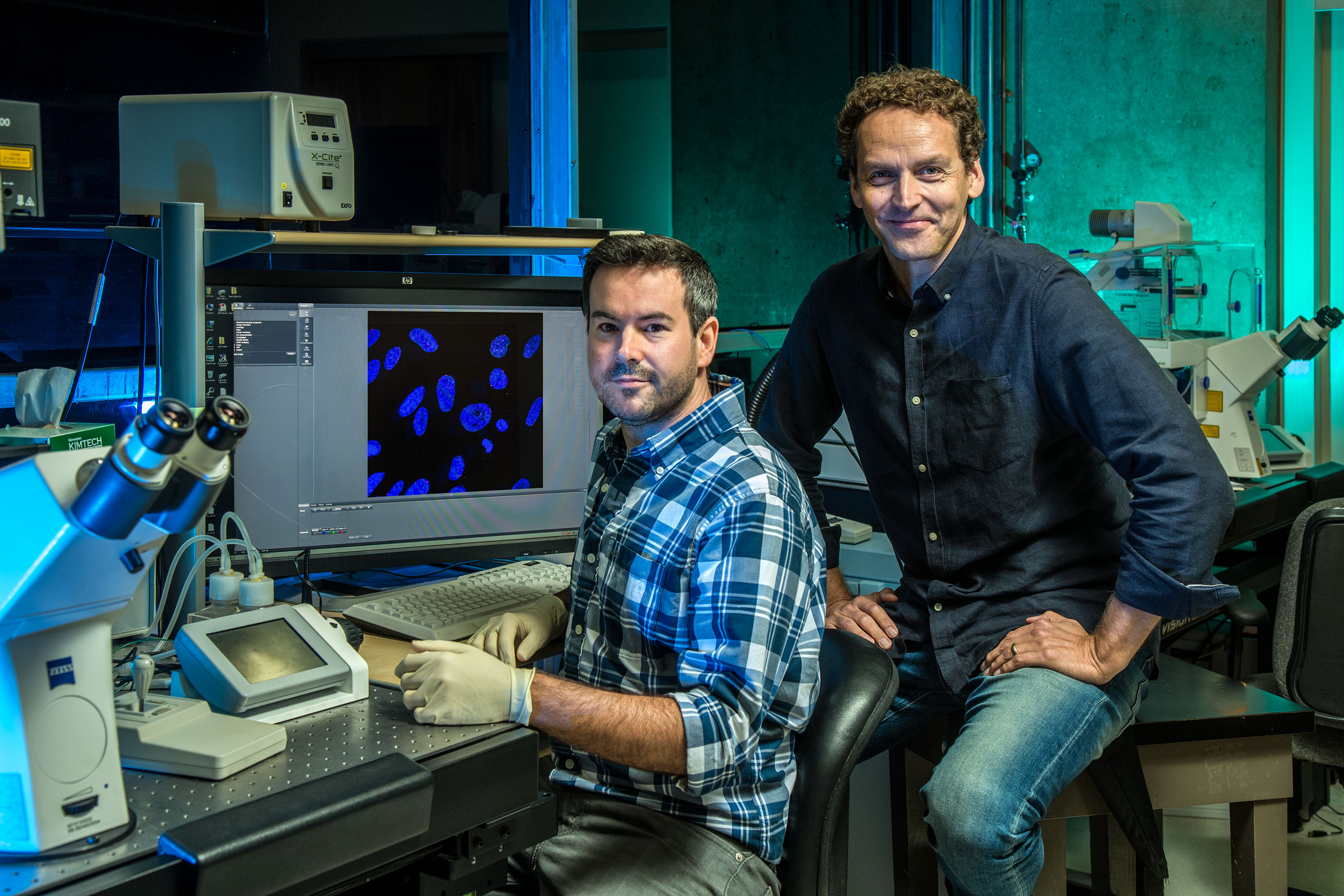
Haga clic aquí for a high-resolution image
Crédito: Instituto Salk
The Salk team discovered that Nup153 and Nup93 interacted with stretches of the genome called super-enhancers, which are known to help determine cell identity. Since every cell in our body has the same DNA, what makes a muscle cell different from a liver cell or a nerve cell is which particular genes are turned on, or expressed, within that cell. In the Salk study, the presence of Nup153 and Nup93 was found to regulate expression of super-enhancer driven genes and experiments that silenced either protein resulted in abnormal gene expression from these regions. Further experiments in a lung cancer cell line validated the bone cancer line results: Nucleoporins in the NPC were found to interact with multiple super-enhancer regions to drive gene expression, while experiments that altered the NPC proteins made related gene expression faulty, even though the proteins still performed their primary role as gatekeepers in the cell membrane.
“It was incredible to find that we could perturb the proteins without affecting their gateway role, but still have nearby gene expression go awry,” says Ibarra.
The results bolster other work indicating that problems with the nuclear membrane play a role in heart disease, leukemia and progeria, a rare premature aging syndrome.
“People have thought the nuclear membrane is just a protective barrier, which is maybe the reason why it evolved in the first place. But there are many more regulatory levels that we don’t understand. And it’s such an important area because so far, every membrane protein that has been studied and found to be mutated or mis-localized, seems to cause a human disease,” says Hetzer.
Other authors on the paper were Swati Tyagi of the Salk Institute, Chris Benner of the University of California, San Diego, and Jonah Cool of Organovo Holdings, Inc.
The work was funded by the Human Frontier Science Program, Institutos Nacionales de Salud grant R01GM098749, NIH Transformative Research Award R01NS096786, the Glenn Foundation For Medical Research, la Fundación NOMIS, la Keck Foundation y American Cancer Society Award number P30CA014195.
DIARIO
Genes & Development
AUTORES
Arkaitz Ibarra, Chris Benner, Swati Tyagi, Jonah Cool and Martin W. Hetzer
Oficina de Comunicaciones
Tel.: (858) 453-4100
press@salk.edu
El Instituto Salk es un centro de investigación independiente y sin fines de lucro fundado en 1960 por Jonas Salk, creador de la primera vacuna segura y eficaz contra la poliomielitis. La misión del Instituto es impulsar una investigación fundamental, colaborativa y audaz que aborde los retos más acuciantes de la sociedad, entre ellos el cáncer, la enfermedad de Alzheimer y la vulnerabilidad agrícola. Esta ciencia fundamental sustenta todos los esfuerzos traslacionales, generando conocimientos que permiten el desarrollo de nuevos medicamentos e innovaciones en todo el mundo.