
January 14, 2011
LA JOLLA, CA—Salk researcher Edward M. Callaway, a professor in the Systems Neurobiology Laboratories has been awarded the distinction of AAAS Fellow for his “distinguished research on the organization and function of neocortical circuits.”
Election as a Fellow of the American Association for the Advancement of Science is an honor bestowed upon members by their peers for their scientifically or socially distinguished efforts to advance science. The tradition of AAAS Fellows began in 1874. The new fellows will be honored during the 2011 AAAS annual meeting in Washington D.C. on Feb. 19.
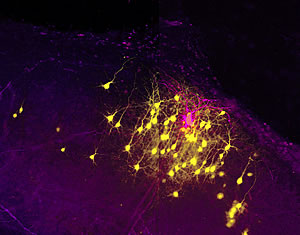
Ed Callaway pioneered a method that allows him to trace a single neuron’s connections to its neighbors.
Image: Courtesy of David Lyon, Salk Institute for Biological Studies
Callaway’s research is aimed at understanding how neural circuits give rise to perception and behavior and focuses primarily on the organization and function of neural circuits in the visual cortex. Relating neural circuits to function in the visual system, where correlations between neural activity and perception can be directly tested, provides fundamental insight into the basic mechanisms by which cortical circuits mediate perception.
A native of Southern California, Callaway received his bachelor’s degree from Stanford University and his doctorate from the California Institute of Technology. After traveling east to conduct postdoctoral studies at Rockefeller University and Duke University, Callaway returned to California to join the Salk Institute where he has been a faculty member since 1995.
This year’s election of Dr. Callaway brings the total number of Salk Institute faculty currently designated as AAAS fellows to 13.
Acerca del Instituto Salk de Estudios Biológicos:
El Instituto Salk de Estudios Biológicos es una de las instituciones de investigación básica más destacadas del mundo, donde un cuerpo docente de prestigio internacional investiga cuestiones fundamentales de las ciencias de la vida en un entorno único, colaborativo y creativo. Centrados tanto en el descubrimiento como en la formación de las futuras generaciones de investigadores, los científicos del Salk realizan contribuciones revolucionarias a nuestra comprensión del cáncer, el envejecimiento, el Alzheimer, la diabetes y las enfermedades infecciosas mediante el estudio de la neurociencia, la genética, la biología celular y vegetal, y otras disciplinas relacionadas.
Los logros del cuerpo docente han sido reconocidos con numerosos galardones, entre los que se incluyen premios Nobel y la pertenencia a la Academia Nacional de Ciencias. Fundado en 1960 por el Dr. Jonas Salk, pionero en la vacuna contra la poliomielitis, el Instituto es una organización independiente sin fines de lucro y un hito arquitectónico.
About AAAS:
The American Association for the Advancement of Science (AAAS) is the world’s largest general scientific society, and publisher of the journal, Science (www.sciencemag.org). AAAS was founded in 1848, and includes some 262 affiliated societies and academies of science, serving 10 million individuals. Science has the largest paid circulation of any peer-reviewed general science journal in the world, with an estimated total readership of 1 million. The non-profit AAAS (www.aaas.org) is open to all and fulfills its mission to “advance science and serve society” through initiatives in science policy; international programs; science education; and more. For the latest research news, log onto EurekAlert!, www.eurekalert.org, the premier science-news Web site, a service of AAAS.
Oficina de Comunicaciones
Tel.: (858) 453-4100
press@salk.edu




