17. Dezember 2021
LA JOLLA—Professor Ronald Evans and Assistant Professor Dannielle Engle have been granted a 2021 ASPIRE (Accelerating Scientific Platforms and Innovative Research) award to study the cellular and molecular drivers of pancreatic cancer, one of the deadliest cancers with few effective treatment options. The $250,000 award, supported by the Mark Foundation for Cancer Research, enables innovative approaches to solving impactful problems in cancer research. The 23 scientists chosen to lead 2021 ASPIRE projects represent disciplines across the spectrum of cancer research at top academic institutions worldwide.
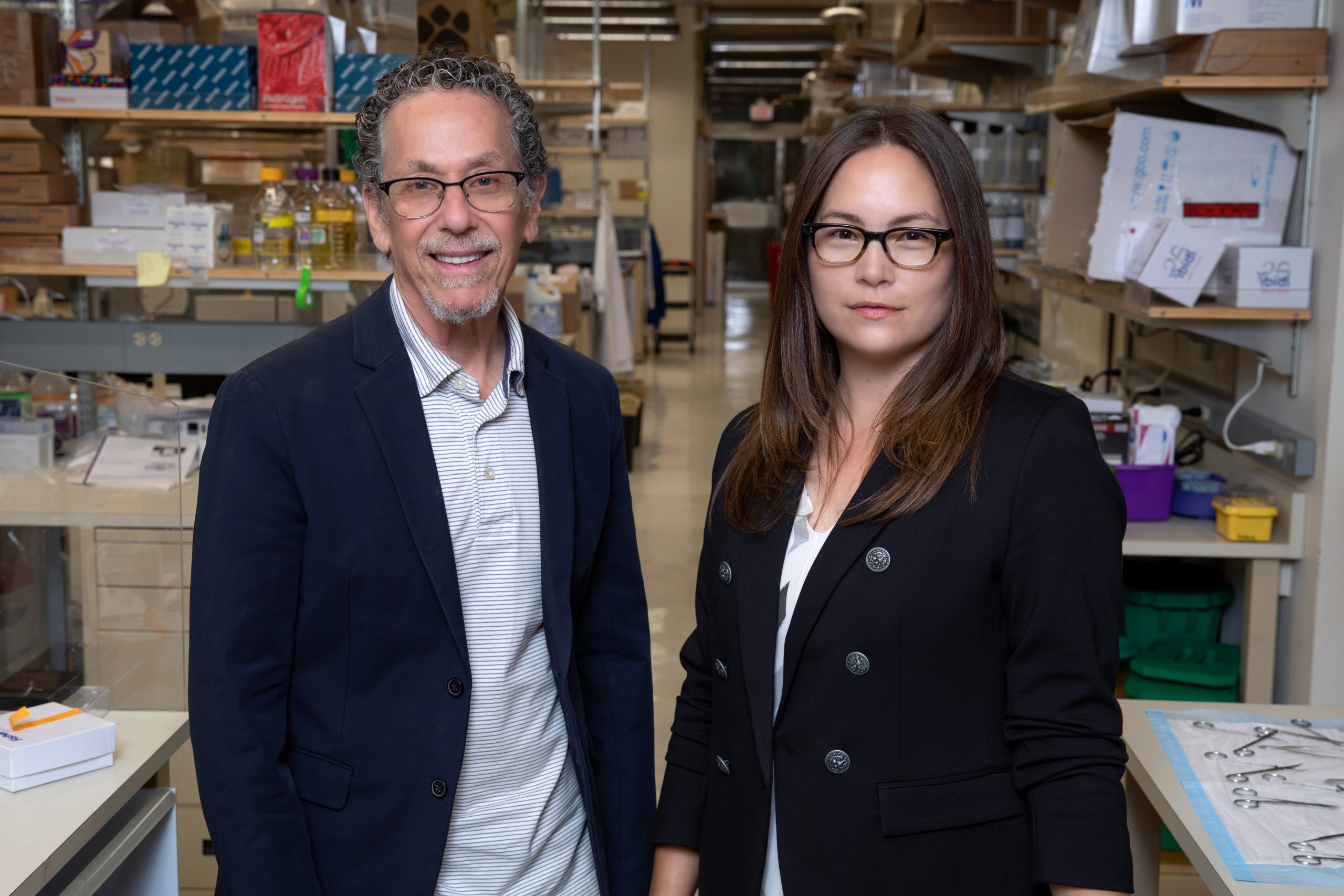
Klicken Sie hier für ein hochauflösendes Bild.
Kredit: Salk Institut
“With the support of the ASPIRE award, Ron and Dannie will take a novel approach to uncover what is driving pancreatic cancer,” says Salk President Rusty Gage. “Their work will hopefully fuel new avenues of pancreatic cancer research and lead to new, more-effective treatment options for those experiencing the disease.”
Pancreatic cancer, specifically pancreatic ductal adenocarcinoma, is the third-leading cause of cancer-related deaths in the United States. Abnormal levels of bile acids, which help digest fats, are commonly observed in pancreatic cancer, but scientists are unsure of the significance. Evans and Engle previously found that the sugar CA19-9 causes pancreatitis, the precursor to pancreatic cancer. CA19-9 also plays a role in bile acid signaling, and the scientists believe this mechanism could be driving the progression of pancreatitis to pancreatic cancer. For this project, the team will use liver and pancreatic organoids, three-dimensional clusters of cells in a dish that mimic the tissues from which they were derived, to better understand the cellular and molecular basis of how CA19-9 and bile acids may interact to promote tumor growth. Evans and Engle think this work could lead to the development of new therapies for pancreatic cancer and other gastrointestinal cancers.
Büro für Kommunikation
Telefon: (858) 453-4100
press@salk.edu
Das Salk Institute ist ein unabhängiges, gemeinnütziges Forschungsinstitut, das 1960 von Jonas Salk, dem Entwickler des ersten sicheren und wirksamen Polio-Impfstoffs, gegründet wurde. Die Aufgabe des Instituts besteht darin, grundlegende, kooperative und risikofreudige Forschung voranzutreiben, die sich mit den dringendsten Herausforderungen der Gesellschaft befasst, darunter Krebs, Alzheimer und die Gefährdung der Landwirtschaft. Diese Grundlagenforschung bildet die Basis für alle translationalen Bemühungen und führt zu Erkenntnissen, die neue Medikamente und Innovationen weltweit ermöglichen.