October 13, 2015
LA JOLLA–Salk Institute scientist Janelle Ayres has received an award of $500,000 over two years from the Defense Advanced Research Projects Agency (DARPA) to further her research on bolstering a person’s microbiome to help their body overcome an infection. The award comes with the possibility of an additional $500,000 for a third year.
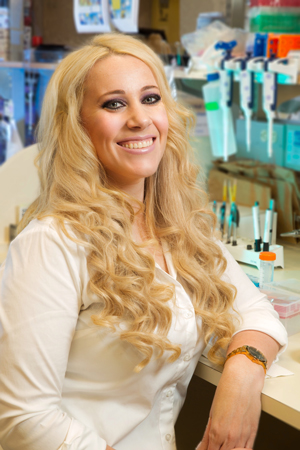
Janelle Ayres, Salk Assistant Professor of Immunobiology and Microbial Pathogenesis
Bild: Mit freundlicher Genehmigung des Salk Institute for Biological Studies
Ayres, assistant professor in Salk’s Nomis Foundation Laboratory for Immunobiology and Microbial Pathogenesis, is one of 24 to receive DARPA’s Young Faculty Award (YFA). “There is a disconnect between our methods for treating infectious disease and our understanding of the mechanisms that keep us healthy during infection,” says Ayres. “With DARPA’s support, I hope to develop a better understanding of how the body’s microbiome helps defend it against infections and how these mechanisms might be enhanced to improve disease tolerance.”
Ayres’ award comes as DARPA is proposing a new approach for medical countermeasure against biological threats with a shift away from eradicating pathogens and instead finding therapies for disease tolerance. The agency is part of the U.S. Department of Defense and responsible for the development of emerging technologies for use by the military for national security.
“Support for basic biomedical research that is aimed at identifying new ways to combat infectious diseases rather than the traditional anti-microbial based strategies is important and timely,” Ayres says. “Especially given the rate at which infectious diseases are evolving resistance to our anti-microbial strategies.”
In pivotal studies, Ayres was one of the first to demonstrate that animals encode disease tolerance defense strategies and that these defense mechanisms are crucial for survival of lethal infections. A main goal of Ayres’ research program is to elucidate disease tolerance mechanisms by studying how the body controls and repairs the collateral damage generated during interactions with harmful microbes. She is taking an innovative approach grounded in mathematical and evolutionary predictions that uses the beneficial microbes that inhabit our digestive system for damage-control therapeutics.
Ayres’ revelation of an entirely new set of defense mechanisms will likely lead to novel therapies that bacteria won’t be able to evolve resistance to. And because pathologies that arise during infection are similar to those created by non-infectious diseases, therapies that manipulate damage-control mechanisms could also have broader applications than antibiotics.
Ultimately, by leveraging those damage-control mechanisms, Ayres aims to develop treatments for infectious and non-infectious diseases (such as pathologies associated with cancer and aging) without the need for antibiotics.
Büro für Kommunikation
Telefon: (858) 453-4100
press@salk.edu
Das Salk Institute ist ein unabhängiges, gemeinnütziges Forschungsinstitut, das 1960 von Jonas Salk, dem Entwickler des ersten sicheren und wirksamen Polio-Impfstoffs, gegründet wurde. Die Aufgabe des Instituts besteht darin, grundlegende, kooperative und risikofreudige Forschung voranzutreiben, die sich mit den dringendsten Herausforderungen der Gesellschaft befasst, darunter Krebs, Alzheimer und die Gefährdung der Landwirtschaft. Diese Grundlagenforschung bildet die Basis für alle translationalen Bemühungen und führt zu Erkenntnissen, die neue Medikamente und Innovationen weltweit ermöglichen.