April 9, 2026
Salk Institute scientists uncover an internal “thermostat” that lets plants sense temperature and adapt growth, opening potential new paths to more resilient crops
Salk Institute scientists uncover an internal “thermostat” that lets plants sense temperature and adapt growth, opening potential new paths to more resilient crops
LA JOLLA—Plants can’t move to escape the heat like humans can—they are forced to adapt. As temperatures fluctuate, one key survival strategy is the ability of roots to keep growing, allowing plants to access water and nutrients further away in the soil. But how do plants sense temperature and translate it into growth?

Salk Institute scientists have uncovered a new answer in a familiar plant hormone: auxin. Auxin is at the center of plant growth, governing everything from cell elongation to root and stem development. But it’s not the center of this story—instead, the latest research found auxin’s partner proteins serve as internal plant “thermostats.” These partner proteins directly sense temperature, then change genetic programs to direct root growth accordingly.
The findings, published in Nature Communications on March 27, 2026, could be used in future efforts to engineer plants that withstand more extreme temperatures.
“It’s been known for a long time that plants grow at different rates at different temperatures,” says Lucia Strader, PhD, senior author of the study and a professor and holder of the Howard H. and Maryam R. Newman Chair in Plant Biology at Salk. “Now we have discovered this protein that can directly sense temperature and consequently adjust root growth, which is a huge step toward understanding how plants integrate environmental cues into life.”
Auxin is a master regulator of plant growth—and it’s also a bit like Goldilocks. Strader explains that “it has to be just right, because too little or too much can inhibit growth.”
For decades, scientists thought that temperature influenced plant growth mainly by altering hormone levels, such as auxin. Scientists have long known that warm temperatures increase both auxin levels and root growth—but that creates a paradox, since high auxin typically slows root cell elongation.
So, what else could be controlling root growth in response to temperature?
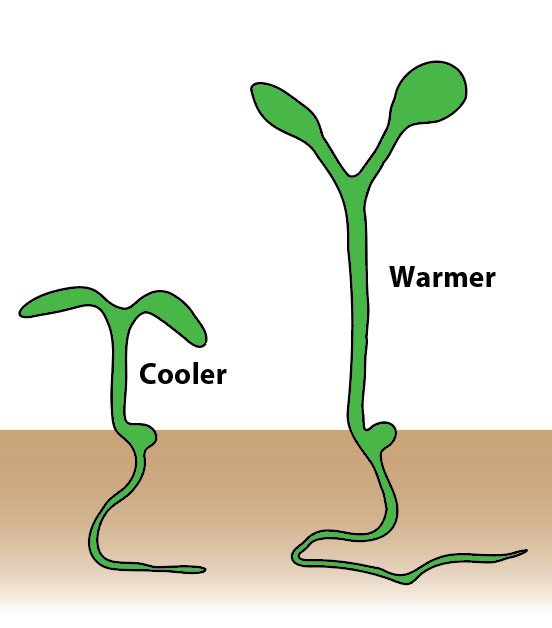
Auxin acts through Auxin Response Factor transcription factors (ARFs), proteins that regulate the expression of growth genes. The team discovered that these ARFs directly sense temperature. At cooler temperatures, ARFs are stored in inactive clusters inside the cell, like a reserve. As temperatures rise, the proteins become more soluble, dissociate from these clusters, and move into the nucleus, where they activate growth-related genes.
“You have this reservoir of protein that can be activated depending on the environment, and temperature allows the cell to shift more of that protein into an active form,” says first author Edward Wilkinson, PhD, a former graduate student researcher in Strader’s lab at Duke University. “We think this is something to do with the properties of the protein itself—at higher temperatures, it is more stable and more soluble, so it can readily accumulate and drive temperature responses.”
This system allows plants to respond quickly to environmental changes by redistributing existing proteins rather than making new ones. “You can think of it as a built-in thermostat within the cell—a very clever way to regulate growth,” adds co-first author Katelyn Sageman-Furnas, PhD, a postdoctoral researcher in Strader’s lab at Duke University.
This dynamic system gives plants a powerful advantage. Instead of making new proteins from scratch, they can rapidly adjust growth by redistributing proteins they already have.
Understanding how plants sense and respond to environmental stressors is increasingly important for agriculture.
Scientists’ newfound ability to identify molecular components that act as temperature sensors and protein activators opens the possibility of designing crops that continue to grow at higher temperatures.
Because root growth is essential for accessing water and nutrients, this kind of resilience could help protect crop productivity under challenging conditions.
The Salk study was published in tandem with a complementary study from the lab of Jorge Casal, PhD, at the Institute for Agricultural Plant Physiology and Ecology (IFEVA) at the University of Buenos Aires and the Instituto Leloir. After meeting at a conference, Strader and Casal decided to create distinct research plans with one shared goal: to uncover how plants turn environmental signals into growth.
“This kind of discovery really represents Salk’s collaborative spirit, and how our culture encourages relationships within and beyond our campus,” says Strader. “Our cooperation helped optimize resources, getting us closer to understanding plant signaling without competing or wasting time or money.”
Both papers were published on the same day, and Strader and Casal are credited as co-authors on each other’s publications. You can read Casal’s lab’s Nature Communications paper here.
Other authors include Matías Ezequiel Pereyra and María Belén Borniego of the University of Buenos Aires.
This work was supported by the National Science Foundation, National Institutes of Health, and Duke University
DOI: 10.1038/s41467-026-71012-y
JOURNAL
Nature Communications
AUTOREN
Edward G. Wilkinson, Katelyn Sageman-Furnas, Matías Ezequiel Pereyra, María Belén Borniego, Jorge J. Casal, Lucia C. Strader
Büro für Kommunikation
Telefon: (858) 453-4100
press@salk.edu
Das Salk Institute ist ein unabhängiges, gemeinnütziges Forschungsinstitut, das 1960 von Jonas Salk, dem Entwickler des ersten sicheren und wirksamen Polio-Impfstoffs, gegründet wurde. Die Aufgabe des Instituts besteht darin, grundlegende, kooperative und risikofreudige Forschung voranzutreiben, die sich mit den dringendsten Herausforderungen der Gesellschaft befasst, darunter Krebs, Alzheimer und die Gefährdung der Landwirtschaft. Diese Grundlagenforschung bildet die Basis für alle translationalen Bemühungen und führt zu Erkenntnissen, die neue Medikamente und Innovationen weltweit ermöglichen.