March 7, 2022
Salk scientists surprised to discover flexible decision-making capabilities in a worm with just 302 neurons
Salk scientists surprised to discover flexible decision-making capabilities in a worm with just 302 neurons
LA JOLLA—How does an animal make decisions? Scientists have spent decades trying to answer this question by focusing on the cells and connections of the brain that might be involved. Salk scientists are taking a different approach—analyzing behavior, not neurons. They were surprised to find that worms can take multiple factors into account and choose between two different actions, despite having only 302 neurons compared to approximately 86 billion in humans.
Los hallazgos, publicados en Current Biology on March 7, 2022, have important implications for the way researchers assess motivation and cognitive abilities in animals. What’s more, the study demonstrates that complex decision-making capabilities could be encoded in small biological and artificial networks.
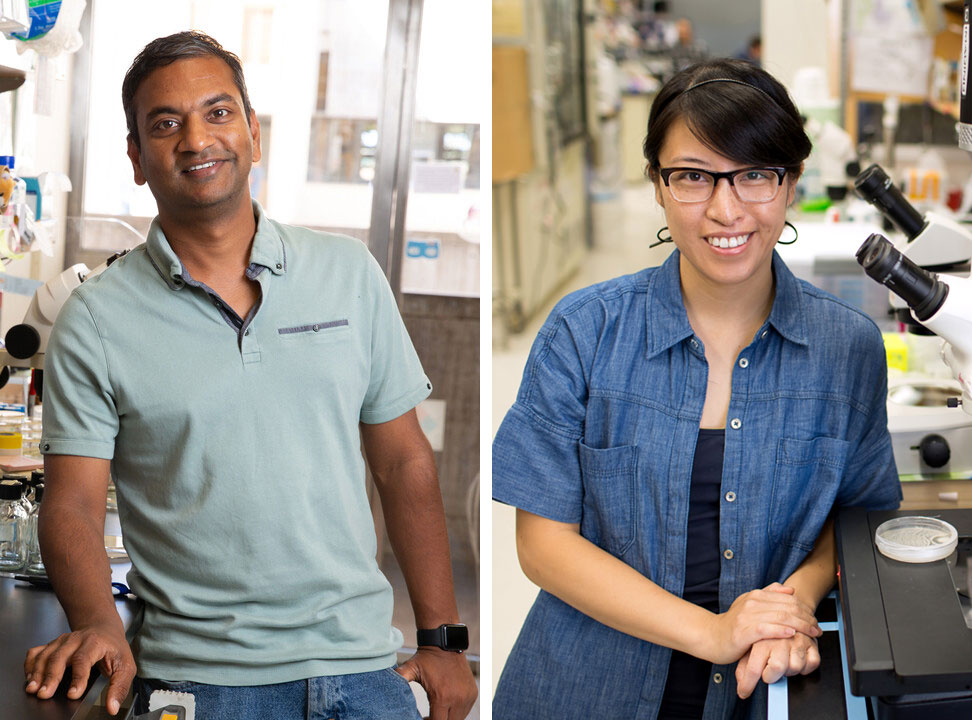
“Our study shows you can use a simple system such as the worm to study something complex, like goal-directed decision-making. We also demonstrated that behavior can tell us a lot about how the brain works,” says senior author Sreekanth Chalasani, associate professor in Salk’s Molecular Neurobiology Laboratory. “Even simple systems like worms have different strategies, and they can choose between those strategies, deciding which one works well for them in a given situation. That provides a framework for understanding how these decisions are made in more complex systems, such as humans.”
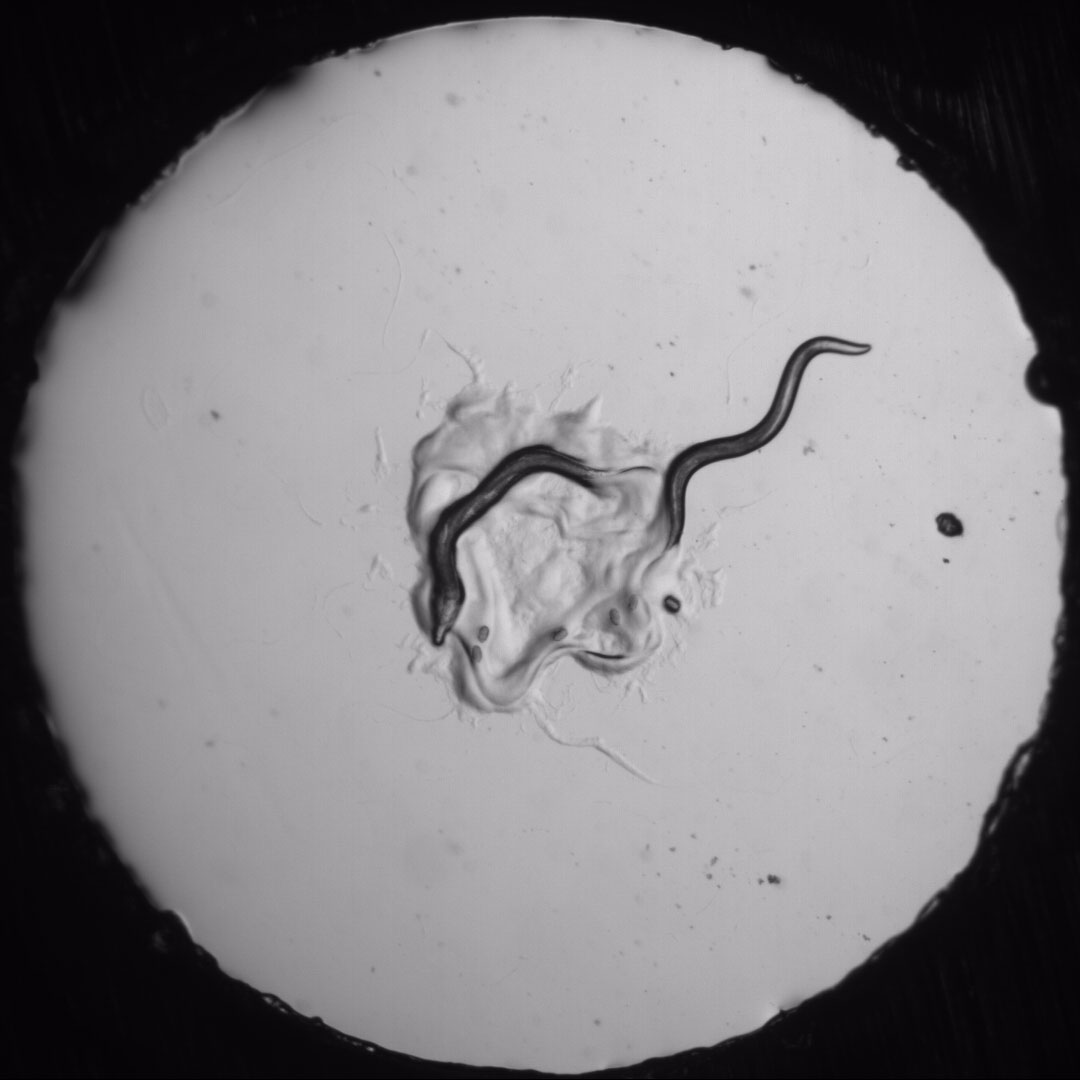
Whether eating prey or defending its food source, the predatory worm Pristionchus pacificus relies on biting. The team’s challenge was to determine the worm’s intentions when it bites.
The researchers found that P. pacificus chooses between two foraging strategies for biting its prey and competitor, another worm called Caenorhabditis elegans: 1) predatory strategy, in which its goal for biting is to kill prey, or 2) territorial strategy, in which biting is instead used to force C. elegans away from a food source. P. pacificus chooses the predatory strategy against larval C. elegans, which is easy to kill. In contrast, P. pacificus selects the territorial strategy against adult C. elegans, which is difficult to kill and outcompetes P. pacificus for food.
To the team, it appeared that P. pacificus weighed the costs and benefits of multiple potential outcomes of an action—behavior that’s familiar in vertebrates but unexpected in a worm.
“Scientists have always assumed that worms were simple—when P. pacificus bites we thought that was always for a singular predatory purpose,” says first author Kathleen Quach, a postdoctoral fellow in Chalasani’s lab. “Actually, P. pacificus is versatile and can use the same action, biting C. elegans, to achieve different long-term goals. I was surprised to find that P. pacificus could leverage what seemed like failed predation into successful and goal-directed territoriality.”
In the future, the scientists would like to determine which of P. pacificus’ cost-benefit calculations are hard-wired or flexible. They hope more research like this will help further uncover the molecular underpinnings of decision-making.
The research was supported by the National Institutes of Health (5R01MH113905), the W.M. Keck Foundation, the National Science Foundation, Salk Women & Science and a Paul F. Glenn Foundation Postdoctoral Fellowship.
DOI: 10.1016/j.cub.2022.02.033
DIARIO
Current Biology
AUTORES
Kathleen T. Quach & Sreekanth H. Chalasani
Oficina de Comunicaciones
Tel.: (858) 453-4100
press@salk.edu
El Instituto Salk es un centro de investigación independiente y sin fines de lucro fundado en 1960 por Jonas Salk, creador de la primera vacuna segura y eficaz contra la poliomielitis. La misión del Instituto es impulsar una investigación fundamental, colaborativa y audaz que aborde los retos más acuciantes de la sociedad, entre ellos el cáncer, la enfermedad de Alzheimer y la vulnerabilidad agrícola. Esta ciencia fundamental sustenta todos los esfuerzos traslacionales, generando conocimientos que permiten el desarrollo de nuevos medicamentos e innovaciones en todo el mundo.