
May 20, 2025
LA JOLLA—Salk Professor Terrence Sejnowski, head of the Computational Neurobiology Laboratory and holder of the Francis Crick Chair, has been elected to the Royal Society and the American Philosophical Society. These prestigious elections recognize his outstanding leadership and extraordinary achievement in computational neuroscience.
Sejnowski is one of the newest Foreign Members of the Royal Society, an independent scientific academy in the United Kingdom dedicated to promoting excellence in science for the benefit of humanity. Founded in 1660, the Royal Society is the world’s oldest scientific academy in continuous existence.
Founded in 1743 by Benjamin Franklin, the American Philosophical Society is the oldest learned society in the United States. The society aims to gather creative thinkers in the sciences and beyond to promote the free exchange of ideas and critical thought for the public’s best interest.
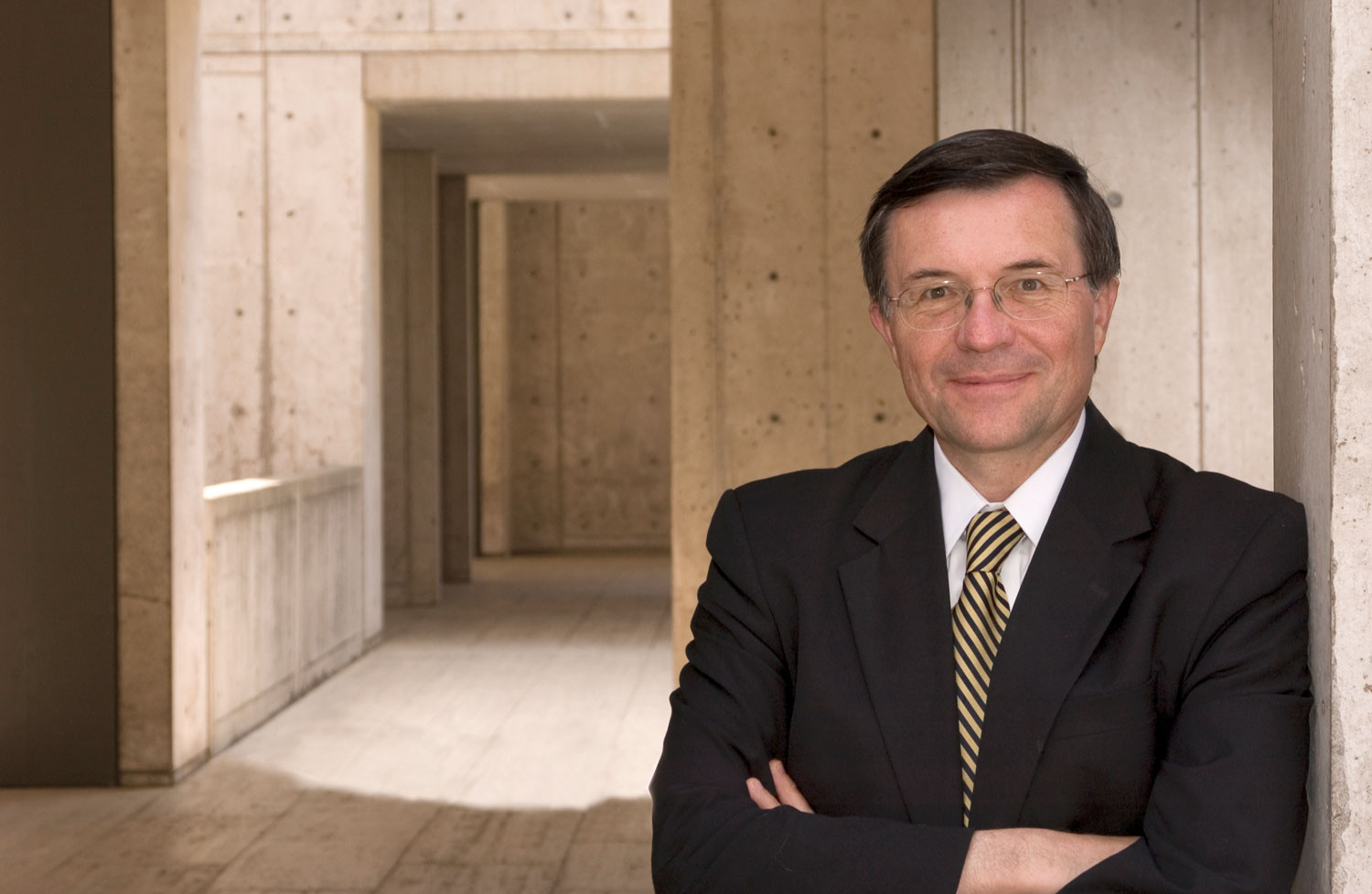
Sejnowski joins the ranks of several other past and present Salk faculty members who have received both honors, including Francis Crick, Renato Dulbecco, Sydney Brenner, Tony Hunter, and Joanne Chory.
“These are two of the most prestigious recognitions a scientist can receive, and Terry is truly deserving of both honors,” says Salk President Gerald Joyce. “His pioneering work in the fields of computational and theoretical neuroscience has long been recognized throughout the scientific community. It is impossible to imagine modern brain science without Terry’s many contributions, and we are proud to have him as a long-standing member of our faculty.”
Throughout his career, Sejnowski has played a fundamental role in developing the fields of neuroeconomics, neuroanatomy, neurophysiology, psychology, and artificial intelligence. Among his greatest accomplishments is his invention of the Boltzmann machine in 1985, alongside computer scientist and colleague Geoffrey Hinton. The Boltzmann machine is the first algorithm to solve the problem of learning in multilayered neural networks and persists today as the most biologically plausible algorithm for artificial neural networks.
After the Boltzmann machine came NETtalk, Sejnowski’s computer program capable of learning how to turn written text into speech in a method similar to the human brain. NETtalk was an enormous milestone in engineering and raised fundamental questions for the fields of philosophy, linguistics, and cognitive science.
Sejnowski has also contributed to advances in human brain imaging and our understanding of the neural basis of behavior. His laboratory developed independent component analysis (ICA), an algorithm for blind source separation that has many applications in signal processing and is universally used for analyzing brain imaging in electroencephalography (EEG) and functional magnetic resonance imaging (fMRI).
Sejnowski has received numerous honors for his work, including the 2024 Brain Prize, ARCS Foundation of San Diego 2024 Scientist of the Year, 2022 Gruber Prize in Neuroscience, Institute of Electrical and Electronics Engineers Frank Rosenblatt Award, Neural Network Pioneer Award, Hebb Prize, and Wright Prize. He is a member of the US National Academy of Sciences, National Academy of Medicine, National Academy of Engineering, and National Academy of Inventors.
Oficina de Comunicaciones
Tel.: (858) 453-4100
press@salk.edu
El Instituto Salk es un centro de investigación independiente y sin fines de lucro fundado en 1960 por Jonas Salk, creador de la primera vacuna segura y eficaz contra la poliomielitis. La misión del Instituto es impulsar una investigación fundamental, colaborativa y audaz que aborde los retos más acuciantes de la sociedad, entre ellos el cáncer, la enfermedad de Alzheimer y la vulnerabilidad agrícola. Esta ciencia fundamental sustenta todos los esfuerzos traslacionales, generando conocimientos que permiten el desarrollo de nuevos medicamentos e innovaciones en todo el mundo.




