June 25, 2018
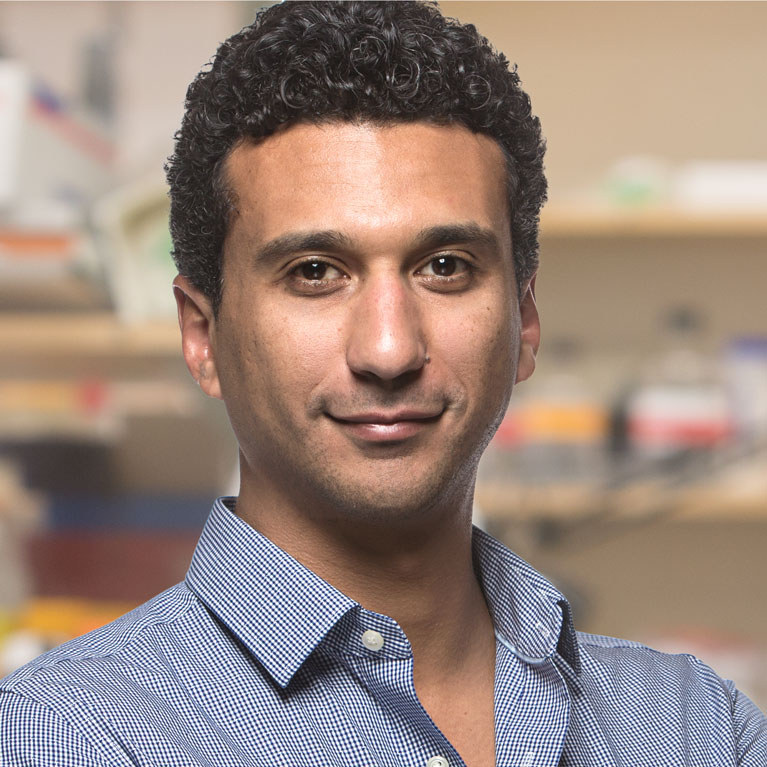
LA JOLLA—Eiman Azim, an assistant professor in Salk’s Molecular Neurobiology Laboratory, has received a McKnight Scholar Award from the McKnight Foundation. The award, which totals $225,000 over three years, encourages neuroscientists at early stages of their careers to focus on disorders of learning and memory. Each year it is awarded to no more than six neuroscientists.

Haga clic aquí para obtener una imagen en alta resolución.
Crédito: Instituto Salk
“Eiman’s multidisciplinary approach to understanding how the nervous system controls movement is garnering increasing interest,” says Salk President Rusty Gage. “We are extremely gratified that the McKnight Foundation sees the tremendous potential of his work to inform clinical applications for restoring function in motor circuits affected by injury or disease.”
Azim, who in 2017 was named a Searle Scholar, a Pew Scholar and a Kathryn W. Davis Aging Brain Scholar, explores how neural circuits solve the many challenges of dexterous motor control, such as holding a cup of coffee or catching a ball. His laboratory takes advantage of genetic and viral tools, anatomical analysis, electrophysiological recording, imaging and detailed motor behavioral tests to piece together the underpinnings of skilled limb movements like reaching and grasping. This type of knowledge could clarify how injury or disease disrupts the normal execution of movement and pave the way for improved diagnosis and treatment of motor circuits damaged by injury or disease.
The McKnight Scholars Award is funded by the Endowment Fund for Neuroscience, an independent charitable organization established by the McKnight Foundation that works to bring science closer to the day when diseases of the brain and behavior can be accurately diagnosed, prevented, and treated.
Oficina de Comunicaciones
Tel.: (858) 453-4100
press@salk.edu
El Instituto Salk es un centro de investigación independiente y sin fines de lucro fundado en 1960 por Jonas Salk, creador de la primera vacuna segura y eficaz contra la poliomielitis. La misión del Instituto es impulsar una investigación fundamental, colaborativa y audaz que aborde los retos más acuciantes de la sociedad, entre ellos el cáncer, la enfermedad de Alzheimer y la vulnerabilidad agrícola. Esta ciencia fundamental sustenta todos los esfuerzos traslacionales, generando conocimientos que permiten el desarrollo de nuevos medicamentos e innovaciones en todo el mundo.