
August 15, 2011
LA JOLLA, CA—Thomson Reuters Essential Science Indicators has seeded the Salk Institute as the number one research organization for plant biology in the world.
Led by plant biologists, Joanne Chory, Ph.D., Joe Ecker, Ph.D., Jeff Long, Ph.D. and Joe Noel, Ph.D., the program was recognized for the number of highly cited papers with the most impact, from 2000-2010. Thomson Reuters analyzed 36 institutions from around the world with the greatest number of highly cited papers (top 1% of all papers in the field of plant sciences and mycology). Although Salk’s plant biology laboratory only produced 53 highly cited papers, the impact of each individual paper from the Salk was far greater than most of the other institutions – an average of 162 citations per highly cited paper. Click here to view the Plant Biology Rankings.
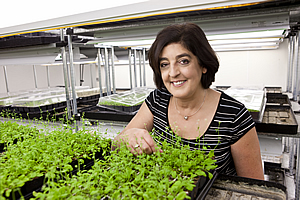
Joanne Chory, Professor and Director,
Laboratorio de Biología Molecular y Celular Vegetal
Imagen: Cortesía del Instituto Salk de Estudios Biológicos
The report included plant biology programs from the U.S., Japan, France, Germany, Netherlands, United Kingdom, Australia, China, Spain and Sweden.
“It is a remarkable achievement for our plant biology program, considering we have reached this level with just a handful of faculty over the years,” said Joanne Chory, Ph.D., professor and director of plant molecular and cellular biology laboratory, Salk Institute. “Plants are the foundation for all human life on earth, providing food, fiber, medications, building materials, and the oxygen we breathe. Moreover, we have to better understand how plants grow, if we are going to feed 9 billion people, provide alternatives to fossil fuel, and understand the impact human activity is having on our environment.”
“The Salk Institute has a dream team of plant biologists,” said William R. Brody, president, Salk Institute. “Understanding how plants grow, develop, how their genome works, and how they respond to normal and abnormal environmental conditions is important ultimately to help improve crop yields, with obvious impact on the economy, health and well being.”
Salk’s plant biology program is best known for mapping the interface between genetic, metabolic and environmental factors that dictate traits such as biomass, sustainability, yield, and flowering time. These experiments have informed not only plant biologists and breeders, but plant genomic studies have also set the stage for how to analyze genomic data that will decipher stem cell biology and the plasticity of the brain.
Founded more than 28 years ago, the Salk’s plant biology program is home to groundbreaking research that profoundly impacts many areas of science, including: agriculture, stem cell research, tumor biology and drug development.
Acerca del Instituto Salk de Estudios Biológicos:
El Instituto Salk de Estudios Biológicos es una de las instituciones de investigación básica más destacadas del mundo, donde un cuerpo docente de prestigio internacional investiga cuestiones fundamentales de las ciencias de la vida en un entorno único, colaborativo y creativo. Centrados tanto en el descubrimiento como en la formación de las futuras generaciones de investigadores, los científicos del Salk realizan contribuciones revolucionarias a nuestra comprensión del cáncer, el envejecimiento, el Alzheimer, la diabetes y las enfermedades infecciosas mediante el estudio de la neurociencia, la genética, la biología celular y vegetal, y otras disciplinas relacionadas.
Los logros del cuerpo docente han sido reconocidos con numerosos galardones, entre los que se incluyen premios Nobel y la pertenencia a la Academia Nacional de Ciencias. Fundado en 1960 por el Dr. Jonas Salk, pionero en la vacuna contra la poliomielitis, el Instituto es una organización independiente sin fines de lucro y un hito arquitectónico.
Oficina de Comunicaciones
Tel.: (858) 453-4100
press@salk.edu




