October 14, 2021
The latest research has implications for understanding sensory disorders and building better prosthetics and robots that can fine-tune their movements based on what they touch.
The latest research has implications for understanding sensory disorders and building better prosthetics and robots that can fine-tune their movements based on what they touch.
LA JOLLA—As you read this article, touch receptors in your skin are sensing your environment. Your clothes and jewelry, the chair you’re sitting on, the computer keyboard or mobile device you’re using, even your fingers as they brush one another unintentionally—each touch activates collections of nerve cells. But, unless a stimulus is particularly unexpected or required to help you orient your own movements, your brain ignores many of these inputs.
Now, Salk researchers have discovered how neurons in a small area of the mammalian brain help filter distracting or disruptive signals—specifically from the hands—to coordinate dexterous movements. Their results, published in the journal Ciencia on October 14, 2021, may hold lessons in how the brain filters other sensory information as well.
“These findings have implications not only for gaining a better understanding of how our nervous system interacts with the world, but also for teaching us how to build better prosthetics and robots, and how to more effectively repair neural circuitry after disease or injury,” says Eiman Azim, assistant professor in Salk’s Molecular Neurobiology Laboratory and the William Scandling Developmental Chair.
Scientists have long known that input from the hands is needed to coordinate dexterous movements, from throwing a ball to playing a musical instrument. In one classic experiment, volunteers with anesthetized, numb fingertips found it extremely difficult to pick up and light a match.
“There’s a common misconception that the brain sends a signal and you just perform the resulting movement,” says Azim. “But in reality, the brain is constantly incorporating feedback information about the state of your limbs and fingers and adjusting its output in response.”
If the brain responded to every signal from the body, it would quickly become overwhelmed—as happens with some sensory processing disorders. Azim and his colleagues wanted to identify exactly how a healthy brain manages to pick and choose which tactile signals to take into account to coordinate dexterous movements like manipulating objects.
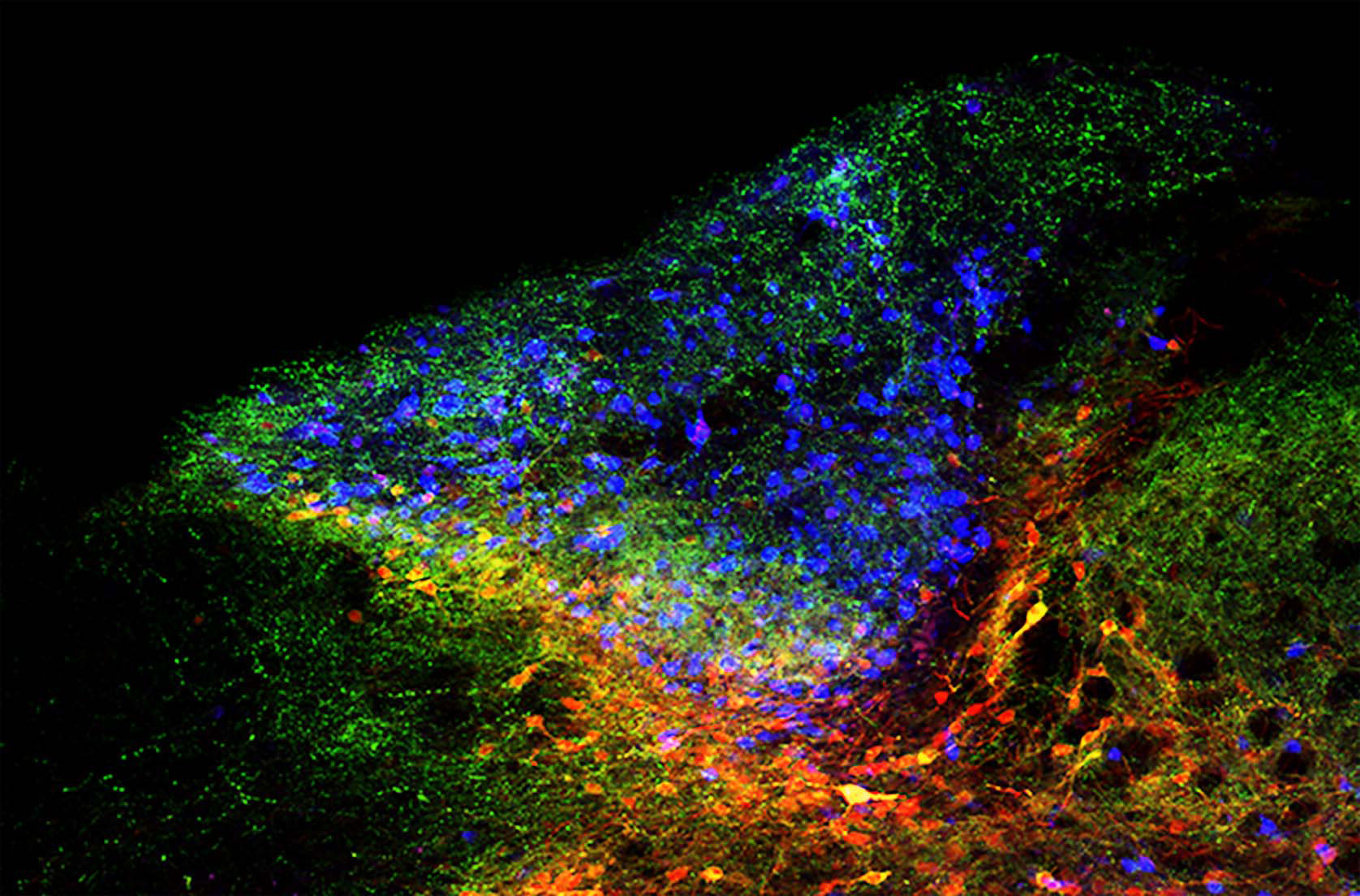
They used a combination of tools in mice to study cells within a small area in the brainstem called the cuneate nucleus, which is the first area signals from the hand enter the brain. While it was known that sensory information passes through the cuneate nucleus, the team discovered that a set of neurons in this region actually controls how much information from the hands eventually passes on to other parts of the brain. By manipulating those circuits to allow more or less tactile feedback through, Azim’s team could influence how mice perform dexterous tasks—such as pulling a rope or learning to distinguish textures—to earn rewards.

“The cuneate nucleus is often referred to as a relay station, as if information was just passing through it,” says Staff Researcher James Conner, first author of the new paper. “But it turns out that sensory information is actually being modulated in this structure.”
Conner and Azim went on to show how different parts of the cortex in mice—the region responsible for more complex, adaptive behavior—can in turn control the neurons of the cuneate to dictate how strongly they’re filtering sensory information from the hands.
Today, despite decades of work, most prosthetics and robots struggle to be nimble-fingered and carry out small, precise hand movements. Azim and Conner say their work could help inform the design of better processes to integrate sensory information from artificial fingers into these kinds of systems to improve their dexterity. It also could have implications for understanding sensory processing disorders or troubleshooting what goes wrong in the brain when the flow of sensory information is thrown out of balance.
“Sensory systems have evolved to have very high sensitivity in order to maximize protective responses to external threats. But our own actions can activate these sensory systems, thereby generating feedback signals that can be disruptive to our intended actions,” says Conner.
“We’re constantly bombarded with information from the world, and the brain needs ways to decide what comes through and what doesn’t,” says Azim. “It’s not just tactile feedback, but visual and olfactory and auditory, temperature and pain—the lessons we’re learning about this circuitry likely apply in general ways to how the brain modulates these types of feedback as well.”
Other authors included Andrew Bohannon, Masakazu Igarashi, James Taniguchi and Nicholas Baltar of Salk.
DOI: 10.1126/science.abh1123
DIARIO
Ciencia
AUTORES
James M. Conner, Andrew Bohannon, Masakazu Igarashi, James Taniguchi, Nicholas Baltar and Eiman Azim
Oficina de Comunicaciones
Tel.: (858) 453-4100
press@salk.edu
El Instituto Salk es un centro de investigación independiente y sin fines de lucro fundado en 1960 por Jonas Salk, creador de la primera vacuna segura y eficaz contra la poliomielitis. La misión del Instituto es impulsar una investigación fundamental, colaborativa y audaz que aborde los retos más acuciantes de la sociedad, entre ellos el cáncer, la enfermedad de Alzheimer y la vulnerabilidad agrícola. Esta ciencia fundamental sustenta todos los esfuerzos traslacionales, generando conocimientos que permiten el desarrollo de nuevos medicamentos e innovaciones en todo el mundo.