
August 15, 2011
LA JOLLA, CA—Thomson Reuters Essential Science Indicators has seeded the Salk Institute as the number one research organization for plant biology in the world.
Led by plant biologists, Joanne Chory, Ph.D., Joe Ecker, Ph.D., Jeff Long, Ph.D. and Joe Noel, Ph.D., the program was recognized for the number of highly cited papers with the most impact, from 2000-2010. Thomson Reuters analyzed 36 institutions from around the world with the greatest number of highly cited papers (top 1% of all papers in the field of plant sciences and mycology). Although Salk’s plant biology laboratory only produced 53 highly cited papers, the impact of each individual paper from the Salk was far greater than most of the other institutions – an average of 162 citations per highly cited paper. Click here to view the Plant Biology Rankings.
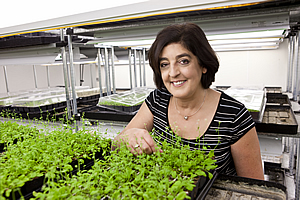
Joanne Chory, Professor and Director,
Labor für molekulare und zelluläre Pflanzenbiologie
Bild: Mit freundlicher Genehmigung des Salk Institute for Biological Studies
The report included plant biology programs from the U.S., Japan, France, Germany, Netherlands, United Kingdom, Australia, China, Spain and Sweden.
“It is a remarkable achievement for our plant biology program, considering we have reached this level with just a handful of faculty over the years,” said Joanne Chory, Ph.D., professor and director of plant molecular and cellular biology laboratory, Salk Institute. “Plants are the foundation for all human life on earth, providing food, fiber, medications, building materials, and the oxygen we breathe. Moreover, we have to better understand how plants grow, if we are going to feed 9 billion people, provide alternatives to fossil fuel, and understand the impact human activity is having on our environment.”
“The Salk Institute has a dream team of plant biologists,” said William R. Brody, president, Salk Institute. “Understanding how plants grow, develop, how their genome works, and how they respond to normal and abnormal environmental conditions is important ultimately to help improve crop yields, with obvious impact on the economy, health and well being.”
Salk’s plant biology program is best known for mapping the interface between genetic, metabolic and environmental factors that dictate traits such as biomass, sustainability, yield, and flowering time. These experiments have informed not only plant biologists and breeders, but plant genomic studies have also set the stage for how to analyze genomic data that will decipher stem cell biology and the plasticity of the brain.
Founded more than 28 years ago, the Salk’s plant biology program is home to groundbreaking research that profoundly impacts many areas of science, including: agriculture, stem cell research, tumor biology and drug development.
Über das Salk Institute for Biological Studies:
Das Salk Institute for Biological Studies ist eine der weltweit führenden Institutionen für Grundlagenforschung, an der international renommierte Fakultätsmitglieder grundlegende Fragen der Biowissenschaften in einem einzigartigen, kollaborativen und kreativen Umfeld untersuchen. Mit dem Fokus auf Entdeckungen und die Ausbildung zukünftiger Forschergenerationen leisten Salk-Wissenschaftler bahnbrechende Beiträge zu unserem Verständnis von Krebs, Alterung, Alzheimer, Diabetes und Infektionskrankheiten durch die Untersuchung von Neurowissenschaften, Genetik, Zell- und Pflanzenbiologie sowie verwandten Disziplinen.
Die Leistungen der Fakultät wurden mit zahlreichen Auszeichnungen gewürdigt, darunter Nobelpreise und Mitgliedschaften in der National Academy of Sciences. Das 1960 vom Polio-Impfstoff-Pionier Dr. Jonas Salk gegründete Institut ist eine unabhängige gemeinnützige Organisation und ein architektonisches Wahrzeichen.
Büro für Kommunikation
Telefon: (858) 453-4100
press@salk.edu




