March 10, 2015
Salk scientists re-engineered the bacterial defense system CRISPR to recognize HIV inside human cells and destroy the virus, offering a potential new therapy
Salk scientists re-engineered the bacterial defense system CRISPR to recognize HIV inside human cells and destroy the virus, offering a potential new therapy
LA JOLLA–Imagine a single drug that could prevent human immunodeficiency virus (HIV) infection, treat patients who have already contracted HIV, and even remove all the dormant copies of the virus from those with the more advanced disease. It sounds like science fiction, but Salk scientists have gotten one step closer to creating such a drug by customizing a powerful defense system used by many bacteria and training this scissor-like machinery to recognize the HIV virus.
“Evolution has led to some of the most astonishing mechanisms for protecting organisms against their natural pathogens,” says Juan Carlos Izpisua Belmonte, a professor of Salk’s Genexpressionslabor and senior author of the new work, published March 10, 2015 in Nature Communications. “Understanding the immune responses by which bacteria protect themselves against viral infections has allowed us to engineer novel platforms for the targeting of devastating viruses, such as HIV, in human patients.”
When a copy of the HIV virus sneaks into a human cell, it can cause havoc. It co-opts the cell’s own molecular machinery to made copies of the virus’s genetic material and then buries these copies in the cell’s own genes. From there, the host’s cell becomes an HIV factory, making new copies of the virus to spread throughout the body. Existing HIV drugs target individual steps of this lifecycle; some stop the virus from integrating into cells’ DNA, for instance, while others try to stop the affected cells from producing more virus.
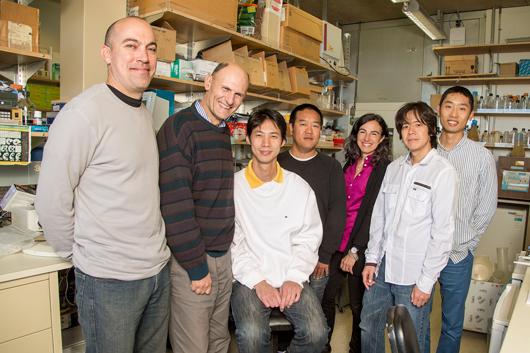
From left: John Martlett, Juan Carlos Izpisua Belmonte, Hsin-Kai Liao, Yuta Takahashi, Concepcion Rodriguez Esteban, Tomoaki Hishida and Mo Li
Klicken Sie hier für ein hochauflösendes Bild.
Bild: Mit freundlicher Genehmigung des Salk Institute for Biological Studies
The problem with these drugs, explains Hsin-Kai (Ken) Liao, a research associate in the Izpisua Belmonte lab and first author of the new paper, is that they don’t actually remove the copies of the virus that are hidden within cells’ DNA. These copies can remain dormant for years and then activate again.
“Patients normally need to take drugs every day or every week for their whole lives, because of the HIV that can be latent,” says Liao. “This costs money, time and effort.”
To combat this problem, Liao and Izpisua Belmonte turned to a molecular defense system called CRISPR that bacteria use to cut up foreign DNA at specified spots. Since its recent discovery, scientists have started using CRISPR to edit genes. But Liao and Izpisua Belmonte were also intrigued by its defensive ability and wondered if CRISPR could be programmed to slice and destroy viruses inside human cells.
CRISPR uses bits of genetic material called guide RNAs to dictate its cuts, so the scientists developed guide RNAs that bound to unique spots on the HIV virus. They added CRISPR, the guide RNAs and other molecules needed for the system to work to immune cells that had been infected with HIV, and found that CRISPR successfully cut the right spots in HIV’s genes, inactivating the virus. This resulted in the virus being completely removed from up to 72 percent of cells. Not only did CRISPR chop up loose copies of the virus as they initially infected the cell, but it also cut up HIV that was hidden and dormant within the cells’ DNA.
While other research groups have taken similar approaches in targeting CRISPR to HIV, the new Salk study showed that the method is effective against active, full-length HIV rather than a shortened, inactive version of the virus. The Salk team also illustrated in a more complete way how CRISPR targets HIV in living human cells, verifying that it works both before and after the virus is embedded in the genome.
“CRISPR can actually excise the virus out of the human genome,” Liao says.
Next, Liao and his colleagues tried adding the CRISPR system to human cells before they becoming infected with HIV. Having the system in place, they showed, prevented an infection–CRISPR chopped up any copies of the virus before they could start replicating.
“The main advantage of this technology is not only that viral DNA integrated into the human genome can be eliminated but perhaps, most importantly, the prophylactic application,” says Izpisua Belmonte. “By eliminating the virus at the early steps of its life cycle, we can altogether prevent the infection of human cells in an analogous manner to how conventional vaccines work.”
Still, more research is needed to determine how the technology could be used in human patients and whether HIV will quickly evolve to escape CRISPR. With that in mind, the team is studying the effectiveness of adding more guiding RNAs to the CRISPR mix so that the defense simultaneously recognizes more areas of the virus. “The HIV virus can mutate very quickly,” says Liao. “If we target multiple regions at the same time, we reduce the chance that the virus can develop resistance.”
Other authors of the paper were Ying Gu, Arturo Diaz, John Marlett, Yuta Takahashi, Mo Li, Keiichiro Suzuki, Tomoaki Hishida, Chan-Jung Chang, Concepcion Rodriguez Esteban, and John Young of the Salk Institute; and Ruo Xu of Iowa State University.
The work was supported by Die Leona M. und Harry B. Helmsley Charitable Trust und die G. Harold and Leila Y. Mathers Charitable Foundation.
Über das Salk Institute for Biological Studies:
Das Salk Institute for Biological Studies ist eine der weltweit führenden Institutionen für Grundlagenforschung, wo international anerkannte Fakultätsmitglieder in einem einzigartigen, kooperativen und kreativen Umfeld grundlegende Fragen der Lebenswissenschaften erforschen. Mit Fokus auf sowohl Entdeckungen als auch die Ausbildung zukünftiger Forschergenerationen leisten Salk-Wissenschaftler bahnbrechende Beiträge zu unserem Verständnis von Krebs, Altern, Alzheimer, Diabetes und Infektionskrankheiten durch die Erforschung von Neurowissenschaften, Genetik, Zell- und Pflanzenbiologie sowie verwandten Disziplinen.
Die Leistungen der Fakultät wurden mit zahlreichen Auszeichnungen gewürdigt, darunter Nobelpreise und Mitgliedschaften in der National Academy of Sciences. Das 1960 vom Polio-Impfstoff-Pionier Dr. Jonas Salk gegründete Institut ist eine unabhängige gemeinnützige Organisation und ein architektonisches Wahrzeichen.
JOURNAL
Nature Communications
TITEL
Use of the CRISPR/Cas9 system as an intracellular defense against HIV-1 infection in human cells
AUTOREN
Hsin-Kai Liao, Ying Gu, Arturo Diaz, John Marlett, Yuta Takahashi, Mo Li, Keiichiro Suzuki, Tomoaki Hishida, Chan-Jung Chang, Concepcion Rodriguez Esteban, John Young, and Juan Carlos Izpisua Belmonte of the Salk Institute; and Ruo Xu of Iowa State University
Büro für Kommunikation
Telefon: (858) 453-4100
press@salk.edu